
Laughter really is the best medicine. When stress piles up so much that even the easy stuff feels impossible, everything gets harder. Your mind races, you can't focus, emotions are all over the place, and it just feels like too much to handle. In those moments, we desperately look for some kind of escape-anything to lighten the load.
Believe it or not, one of the quickest ways to feel better is also the simplest: just laughing.
Sometimes Laughter Is the Best Medicine
It sounds like a cliché until you actually feel it for yourself. You can't stay completely stuck in panic, anger, or frustration if you're really laughing at the same time. Even just a quick, honest laugh cuts through the intensity your brain's been dragging around.

Yeah, people have said "laughter is the best medicine" forever, but it turns out modern psychology and neuroscience back that up. Of course, laughter doesn't magically erase your problems. The bills are still there. Tough situations don't just disappear. Your anxiety doesn't vanish overnight. But a genuine joke or funny moment gives your mind a break from all that emotional heaviness. For a little while, your nervous system relaxes, and you get to step out of stress and survival mode. That shift actually matters more than most folks realize.
Personally, I have always found it difficult to stay upset while genuinely laughing. Even during stressful periods, humor somehow creates a small mental reset that makes situations feel more manageable afterward. Problems may still exist, but they often stop feeling quite as emotionally overwhelming for a while.
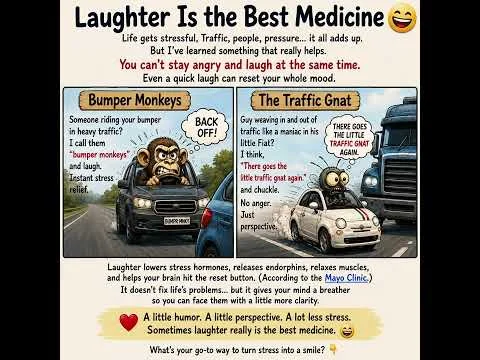
For example, when I notice people being inconsiderate in heavy traffic, following way too close behind for no reason, I just make up a ridiculous name like "bumper monkey" and laugh out loud. This visual itself prevents me from becoming angry at all.
Or there was another time, I remember a guy weaving aggressively through traffic in a tiny Fiat and nearly getting clipped by a truck. I laughed and thought, "there goes the little freeway gnat again."
It's all in good humor. No real exchange of insults, just a mental construct (the buffer) that helps change my perspective.
What Happens During Emotional Overload?
Most people eventually reach a point where the brain simply feels overloaded. Too much stress, uncertainty, emotional pressure, bad news, responsibility, or exhaustion starts piling up at once.
This can happen because of:
- Burnout from work or school
- Financial stress
- Relationship problems
- Health worries
- Major life changes
- Chronic anxiety
- Lack of quality sleep
- Constant information overload
When stress keeps building without relief, the body often remains trapped in a prolonged stress response. Sleep becomes harder, patience gets shorter, concentration weakens, and even small problems start feeling disproportionately heavy.
This is usually the point where people begin desperately needing some form of emotional release.
Why Laughter Helps the Brain and Nervous System
A genuine laugh changes the body's stress response almost immediately.
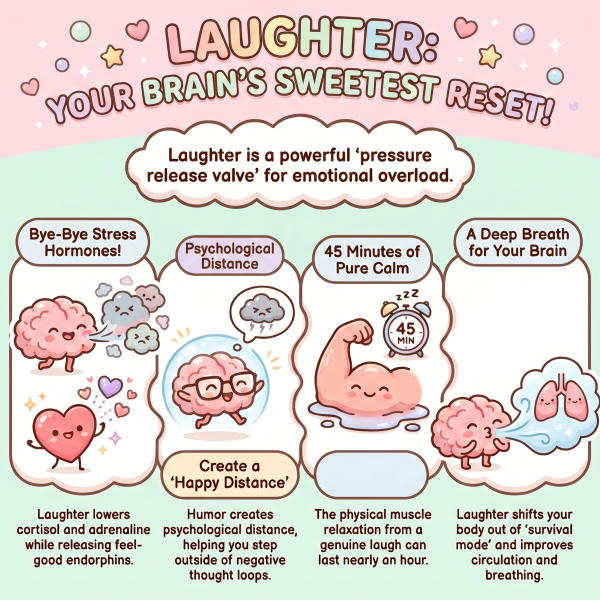
Research from organizations including the Mayo Clinic suggests that laughter may help lower stress hormones such as cortisol and adrenaline while stimulating endorphin release and improving mood temporarily.
When people laugh:
- Breathing becomes deeper
- Muscles loosen
- Physical tension decreases
- Circulation improves
- Mental focus temporarily shifts away from stress
Even if the relief only lasts briefly, the nervous system finally gets a moment where it is not completely locked onto pressure and emotional tension. Some studies have even suggested that muscle relaxation after genuine laughter may continue for up to 45 minutes afterward.
Most people have experienced this naturally without thinking much about it. Sometimes during a terrible week, one funny conversation, joke, memory, or video suddenly cuts through all the mental tension for a few moments. The problems are still there afterward, but they no longer feel quite as emotionally crushing as they did before.
Laughter's temporary reset can make a surprising difference (it's like a heartfelt deep breath for your brain).
Humor Creates Psychological Distance
Stress pulls your mind into the same negative thoughts, circling again and again. Fear keeps echoing. Anxiety just gets louder. Problems start to feel bigger and heavier than they really are.
But laughter breaks up that pattern.
Humor gives you a little space from whatever's weighing on you. It gives your brain a short break from all that raw emotion. Even that small pause makes it easier to see things clearly, calm down, and start thinking straight again.
We Rarely Know What Others Are Carrying
Humor also helps create space for compassion.
Years back, I had this guy tailgating me and laying on his horn while we were both inching down some gravel road. I was taking it slow because, honestly, I didn't want my car pelted with rock chips, but he clearly saw me as the problem.
Frustrated and baffled, I finally pulled over. We both got out, and right away, it hit us-we actually worked at the same place.
He apologized straight off. Turns out he was racing home because his daughter was having seizures. The stress had just boiled over and he admitted he wasn't handling it well.
Just like that, my whole perspective changed.
What felt like aggression wasn't really about me at all-it was fear, exhaustion, and the weight of everything he had going on. And he had no clue I was just protecting my car on the only back road we both had.
That moment stuck with me.
A lot of the time, people aren't out to be rude or thoughtless. They've just got their own pain or stress or fear riding in the backseat, and nobody else can see it.
These days, I try to reach for humor when I'm stressed; it keeps me from snapping. But I also remember to look for the story underneath people's behavior, because there usually is one.
Honestly, laughter works like a pressure valve for the nervous system-it's not magic, but it sure helps.
Why Humor Often Appears During Difficult Situations
One interesting thing about human behavior is that humor tends to appear most often during stressful experiences.
People joke in hospitals, emergency rooms, military environments, funerals, high pressure workplaces, and family crises. From the outside this can sometimes seem strange or inappropriate, but psychologically it makes sense.
The mind naturally searches for ways to reduce emotional intensity when stress becomes overwhelming.
Laughing during hard times is not always denial or avoidance. In many cases, it is emotional regulation.
Even Dark Humor Can Serve a Purpose
Dark humor especially tends to appear during periods of fear, uncertainty, grief, or emotional exhaustion.
Not everyone enjoys it, and it can absolutely go too far, but psychologically it often serves a purpose. Humor allows people to mentally approach painful realities without feeling completely consumed by them.
Many first responders, healthcare workers, military personnel, and people under chronic stress use dark humor this way. It creates emotional distance from situations that might otherwise become mentally overwhelming.
That does not necessarily make someone insensitive. Often it means the opposite. The person is trying to cope with emotional intensity the best way they know how.
The Nervous System Was Not Built for Constant Pressure
Modern life keeps many people mentally overstimulated almost nonstop.
Phones, work demands, financial pressure, social media, endless notifications, and constant news cycles keep the brain in a near continuous state of alertness.
The human nervous system was never designed for endless pressure without recovery.
This is one reason small moments of humor can feel surprisingly powerful. Laughter briefly interrupts the stress cycle and gives the brain a chance to loosen its grip.
After laughing, people often think more clearly, react less emotionally, and feel slightly more capable of handling whatever was stressing them beforehand.
There Are Physical Benefits Too
Humor affects more than mood alone.
Research has shown that laughter may help:
- Reduce stress hormone levels
- Ease physical tension
- Improve mood temporarily
- Stimulate circulation
- Increase pain tolerance briefly
- Promote relaxation afterward
Even the physical act of laughing changes breathing patterns and muscle tension throughout the body.
Psychologists have long recognized humor as a healthy coping mechanism during periods of stress and emotional overload.
This is partly why people often describe laughing as physically relieving after long periods of emotional tension.
Laughter Is Not a Replacement for Real Help
Of course, humor is not a cure for serious mental health struggles, trauma, burnout, or major life problems.
People still need rest, support, healthy relationships, emotional processing, and sometimes professional help. Laughing at problems does not automatically solve them.
But emotional relief still has value.
Sometimes the brain simply needs a temporary break from carrying the full emotional weight of everything all at once. Humor can provide that breathing room.
Healthy Ways to Bring More Humor Into Stressful Periods
When life starts feeling mentally heavy, intentionally creating space for humor can genuinely help.
- Watching comedy or stand up
- Talking with funny friends
- Sharing old memories
- Spending time around people who lighten the mood
- Allowing yourself to laugh without guilt
- Finding humor in small everyday frustrations
Sometimes even a few minutes of laughter can interrupt a negative mental spiral long enough for the mind to reset.
Key Takeaways About Why Laughter Helps During Stress
- Laughter can temporarily interrupt stress spirals and emotional overload
- Humor may help lower stress hormones and reduce physical tension
- Laughing creates psychological distance from overwhelming situations
- Even dark humor can function as a coping mechanism during hardship
- The nervous system needs periods of relief and recovery
- Humor does not replace therapy or real support, but it can help people emotionally reset
Final Thoughts
Often, indeed laughter is the best medicine, and is the only real way to get through a tough situation.
Not because it magically removes suffering, but because it briefly loosens the grip stress and emotional overload place on the mind and body.
Humor creates a moment where the brain is no longer fully consumed by pressure. That small interruption can restore perspective, reduce emotional intensity, and help people feel more grounded again.
Sometimes even a brief moment of relief is just enough to help someone keep moving forward.