
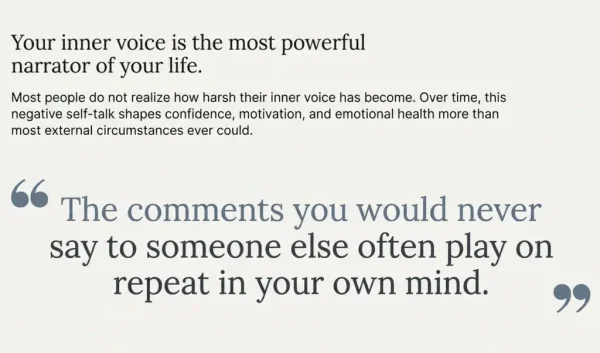
Most people do not realize how harsh their inner voice has become. The comments you would never say to someone else can play on repeat in your own mind. Over time, this pattern of negative self talk can influence confidence, motivation, stress, and the way you respond to setbacks.
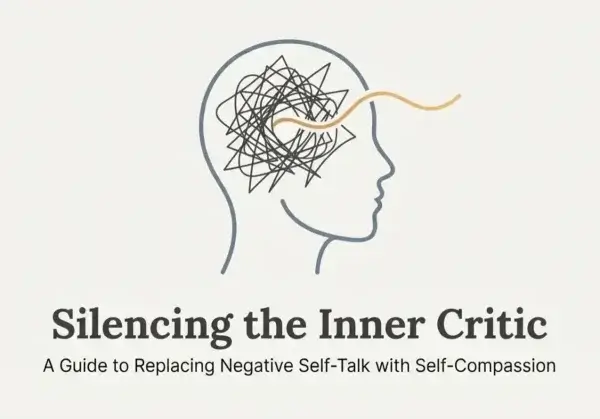
Overcoming Negative Self Talk: From Critic to Guide
Learning to quiet the inner critic does not mean ignoring mistakes or pretending everything is fine. It means learning to respond to yourself with greater understanding instead of automatically turning every mistake into a judgment about who you are.
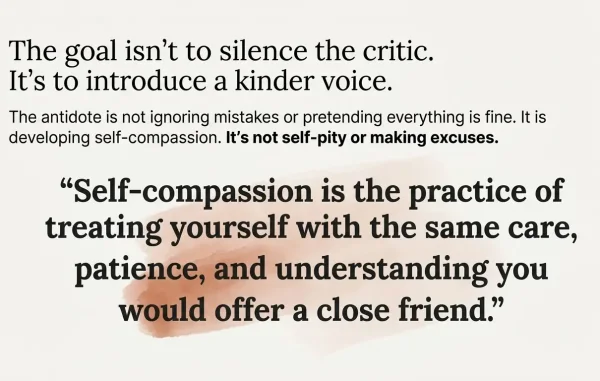
Self compassion is the ability to treat yourself with the same basic kindness, patience, and understanding you would offer someone you care about.
The goal is not to eliminate self criticism overnight. It is to notice the pattern, understand what is happening, and gradually develop a healthier inner dialogue.
What Is Negative Self Talk?
Negative self talk is an internal dialogue that criticizes, doubts, or undermines you. It can sound like a harsh narrator pointing out flaws, predicting failure, replaying past mistakes, or assuming the worst about the future.
Everyone experiences negative thoughts from time to time. The problem is not having an occasional critical thought. The problem is when those thoughts become frequent, automatic, and difficult to challenge.
Taking bout oneself negatively can develop through past experiences, learned patterns, unrealistic expectations, comparison with others, and the way we have learned to respond to mistakes.
Common Forms of Negative Self Talk
- All or nothing thinking: "If I fail once, I always fail."
- Catastrophizing: "This mistake ruins everything."
- Mind reading: "Everyone thinks I am incompetent."
- Harsh self labeling: "I am lazy, stupid, or broken."
- Overgeneralizing: "This went badly, so everything will go badly."
- Discounting the positive: Focusing on one mistake while ignoring everything that went well.
These patterns can feel convincing because they happen quickly and often become familiar. But a thought can feel true without being an accurate or complete description of reality.
Why Negative Self Talk Can Be So Powerful
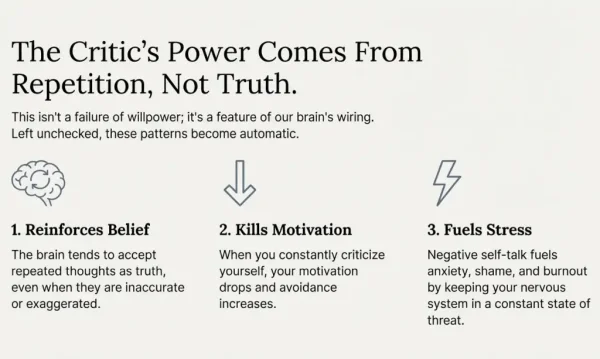
Repeated Thought Patterns Can Become Automatic
The more frequently we respond to situations in the same way, the more familiar that response can become. A recurring self critical thought may eventually appear automatically, especially in situations that trigger fear, uncertainty, embarrassment, or disappointment.
This does not mean the brain simply accepts every repeated thought as fact. Rather, familiar thought patterns can become easier to access and harder to notice as patterns.
It Can Influence Behavior and Motivation
Harsh self criticism can make mistakes feel threatening rather than informative. When every setback becomes evidence of personal failure, it can become easier to avoid difficult tasks, give up prematurely, or hesitate to try again.
A more balanced internal response can make it easier to treat mistakes as information and continue moving forward.
It Can Increase Emotional Distress
Persistent self criticism is associated with greater emotional distress and can contribute to patterns of shame, anxiety, and low self-worth.
The important distinction is that negative self talk is not necessarily the sole cause of these experiences. Thoughts, emotions, behavior, circumstances, and past experiences can influence one another in complicated ways.
What Self Compassion Actually Means
Self compassion is not self pity, weakness, or making excuses.
It means responding to yourself with understanding while still taking responsibility for your choices and behavior.
If you make a mistake, self compassion does not require you to say, "It does not matter."
Instead, it allows you to say something closer to:
"I made a mistake. I do not like what happened, but I can learn from it and decide what to do differently next time."
That distinction matters.
Self compassion does not remove accountability. It changes the way you approach yourself while being accountable.
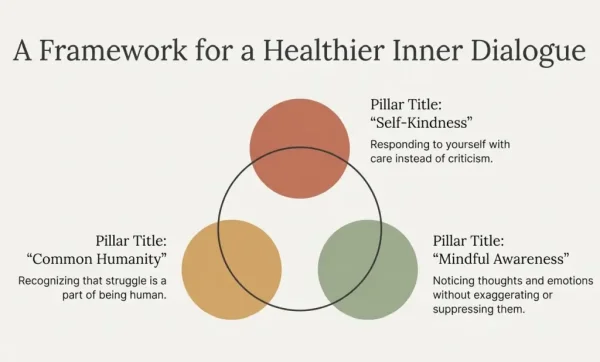
The Three Core Elements of Self Compassion
- Self kindness: Responding to yourself with care rather than unnecessary harshness.
- Common humanity: Recognizing that mistakes, setbacks, and difficult emotions are part of being human.
- Mindful awareness: Noticing difficult thoughts and emotions without exaggerating them or trying to suppress them.
How to Start Rewriting Your Inner Dialogue
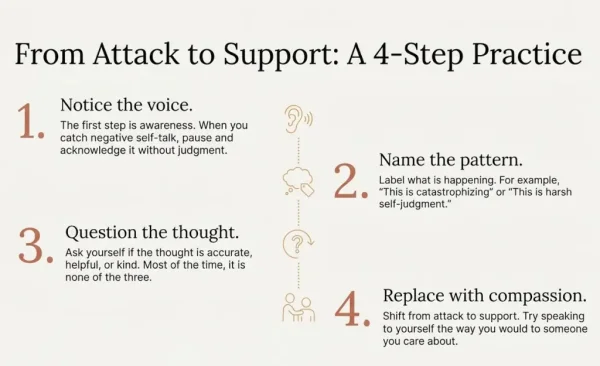
Changing negative self talk begins with awareness. You cannot change a pattern you do not notice.
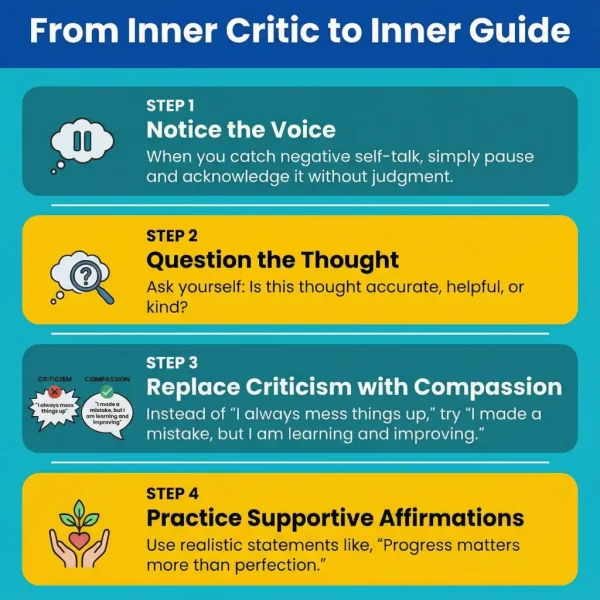
1. Notice the Voice
The first step is simply recognizing what is happening.
When you catch yourself thinking something harsh, pause for a moment.
Instead of immediately accepting the thought as truth, notice it:
"I am having a very critical thought about myself right now."
That small distinction creates some distance between you and the thought.
2. Name the Pattern
Try identifying the type of thinking involved.
For example:
- "This is catastrophizing."
- "I am overgeneralizing."
- "I am assuming I know what everyone else thinks."
- "I am turning one mistake into a judgment about my entire identity."
Naming the pattern can make an automatic reaction easier to examine.
3. Question the Thought
Ask yourself:
- Is this thought completely accurate?
- What evidence supports it?
- What evidence does not support it?
- Am I exaggerating one event?
- Would I speak this way to someone I care about?
- What would be a more balanced way to describe what happened?
The goal is not to force yourself into positive thinking.
The goal is to become more accurate.
4. Replace Criticism with Compassion
Once you recognize the critical thought, practice responding to it in a more constructive way.
For example:
- Instead of: "I always mess things up."
- Try: "I made a mistake. I can learn from it and improve."
Another example:
- Instead of: "I am terrible at this."
- Try: "I am struggling with this right now, but struggling does not mean I cannot improve."
The replacement thought should be believable.
You do not have to tell yourself, "I am amazing at everything."
Sometimes a much more useful thought is simply:
"This is difficult, but I can take the next step."
Simple Self Compassion Practices
The Self Compassion Pause
When you notice yourself becoming highly self critical, stop for a moment.
Take a slow breath and acknowledge what is happening.
You might say:
"This is difficult right now. I am not the only person who struggles. I can respond to myself with patience while I figure out what to do next."
The purpose is not to make the problem disappear. It is to interrupt the automatic cycle of criticism and create room for a more balanced response.
Write a Compassionate Response
If your thoughts are difficult to sort through mentally, write them down.
First write the critical thought exactly as it appears.
Then imagine someone you care about had the same experience.
What would you say to them?
Write that response down.
You may discover that your natural advice to another person is considerably more reasonable than the advice you give yourself.
Practice Supportive Affirmations
Affirmations tend to be more useful when they feel realistic rather than forced.
Instead of repeating statements you do not believe, try grounded reminders such as:
- I am allowed to learn at my own pace.
- Progress matters more than perfection.
- I can make a mistake without defining myself by it.
- I can be kind to myself while still working to improve.
- I do not have to solve everything at once.
Common Mistakes When Working with Self Talk
Trying to Silence the Voice Completely
The goal is not to eliminate every negative thought.
Critical thoughts are part of normal human experience. The goal is to recognize them without automatically believing or obeying them.
Think of the inner critic as a voice you can listen to without allowing it to run the entire conversation.
Replacing Criticism with Fake Positivity
If a replacement thought feels completely unrealistic, it may be difficult to accept.
You do not have to go from:
"I am a complete failure."
to:
"I am the greatest person who has ever lived."
A more believable middle ground might be:
"I did not handle that well, but one mistake does not define me."
Compassion works better when it is grounded in reality.
Expecting Instant Change
Long standing patterns of self talk usually do not disappear after a few positive statements.
The process is more like building a new habit.
Notice the thought.
Question it.
Respond differently.
Repeat.
Consistency matters more than perfection.
Building Long Term Emotional Resilience
Self compassion is not simply about feeling better after a bad day. Over time, practicing a more balanced inner dialogue may help you respond to setbacks with greater flexibility.
Instead of interpreting every mistake as proof that something is wrong with you, you can begin to see mistakes as experiences that provide information.
You can still feel disappointed.
You can still acknowledge when you did something wrong.
You can still make changes.
But you do not have to attack yourself in order to grow.
Over time, the inner voice can begin shifting from a constant critic toward a more supportive guide.
When Negative Self Talk Feels Overwhelming
Everyone experiences self critical thoughts, but persistent or overwhelming negative thoughts can sometimes be a sign that additional support would be helpful.
If negative self talking is interfering significantly with daily life, relationships, work, sleep, or your ability to function, consider talking with a qualified mental health professional.
Seeking support is not a failure of self compassion.
It can be an expression of it.
Final Takeaway
Overcoming negative self talk is not about becoming perfect, fearless, or endlessly positive.
It is about learning to stand on your own side.
You can acknowledge your mistakes without becoming your mistakes.
You can recognize weaknesses without defining yourself by them.
You can want to improve without believing you are fundamentally broken.
The next time your inner critic speaks, you do not have to fight it or blindly believe it.
Pause.
Listen.
Question the story.
Then choose a response that is honest, constructive, and compassionate.
Sometimes the most important voice you can change is the one you hear when no one else is listening.