
Is your pool chlorine level NOT registering after shock treatment? If your free chlorine levels PPM (Parts Per Million) are not rising with your test strips after extensive shocking, you're not alone. This is a common problem that many pool owners face at some point, usually early on and often within the first year or two of ownership.
Why Pool Chlorine Level Not Going Up After Shocking
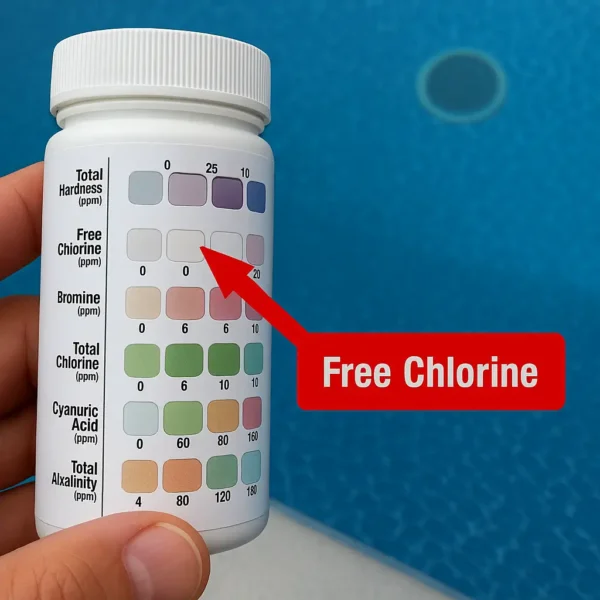
Wondering why your pool chlorine level isn't registering or holding or going up (even after shocking multiple times)? You would not believe how many new pool owners think that they simply need to shock and vacuum a pool to keep it maintained throughout the season (I used to be one of them). In reality, there are many other factors that come into play to help you maintain clean, safe, and sparkly water.
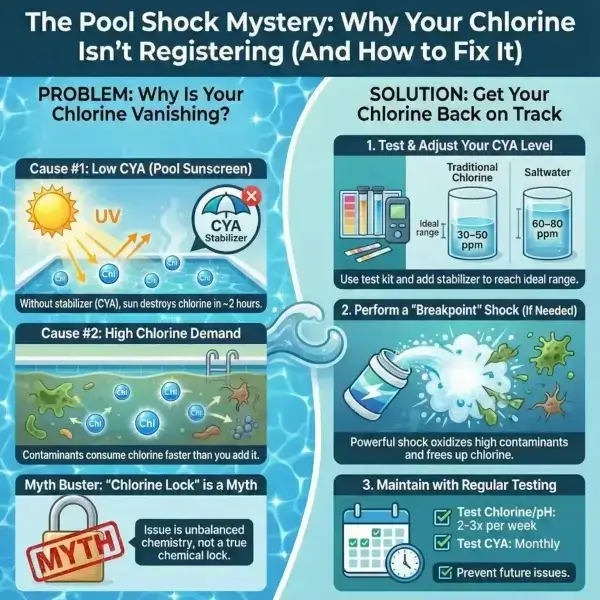
For example, if your chlorine level is not increasing on your test strips after multiple shock attempts, the number one reason is most likely that your pool needs a conditioner or stabilizer that contains Cyanuric Acid (CYA). Without this stabilizer, water will lose chlorine very quickly to the sun. A pool with no cyanuric acid can lose nearly all of its chlorine within just two hours. Cyanuric Acid works much like sunblock does to protect our skin from damaging UV rays. In the case of your pool, this stabilizer keeps UV rays from breaking down the chlorine.
Another possible reason your pool chlorine won't register is that your pool water has a high chlorine demand due to contaminants like algae, organic debris, ammonia, or high levels of combined chlorine (chloramines). These contaminants can consume chlorine faster than it can accumulate. If this is the case, you may need to calculate a breakpoint chlorination dose (about 10 times the combined chlorine level) to fully oxidize the contaminants.

Quick Summary
- If chlorine won't register or pool chlorine is not going up after shock, test cyanuric acid (CYA) levels first.
- Low CYA means chlorine is quickly destroyed by sunlight; add stabilizer to 30–50 ppm (traditional pools) or 60–80 ppm (saltwater pools).
- High chlorine demand from contaminants can also consume chlorine, consider breakpoint chlorination.
- Regular testing of chlorine, pH, and CYA levels helps maintain balanced water chemistry.
- Chlorine lock is a myth; issues are due to unbalanced chemistry, not a true lock.
Why Your Pool Chlorine Reads Zero After Shocking
If your chlorine level still reads zero after shocking, the issue usually comes down to one of three causes:
- No stabilizer (low CYA): Chlorine is destroyed by sunlight within hours
- High chlorine demand: Algae, ammonia, or debris are consuming chlorine instantly
- Testing too soon: Chlorine may not have fully circulated yet
Steps to Fix Zero Chlorine After Shocking a Pool
The following simple steps should be performed when a pool has been shocked, but the chlorine level never rises, or when the chlorine level doesn't remain stable (pool chlorine not holding) for more than a couple of days.
- First, test your cyanuric acid (CYA) level using either CYA test strips or, for better accuracy, a digital CYA test kit.
- Next, assuming the cyanuric acid level is low, add a pool conditioner until reaching the ideal range:
- 30-50 ppm for traditional chlorine pools
- 60-80 ppm for saltwater pools
- Then, test your chlorine level again after the stabilizer is well circulated. You will likely notice chlorine suddenly registering on the test strip. In fact, the chlorine level might register a bit high, and you may not need to add any more.
- If the water is still not holding chlorine and you suspect a high organic load or ammonia, consider performing a breakpoint chlorination shock. Multiply the combined chlorine level by 10 to determine the correct dose.
- Finally, continue to test your cyanuric acid level once a month throughout the season, and your chlorine and pH levels at least 2–3 times per week, to keep your water balanced and sanitized.
Notes: If you are using dichlor or trichlor as your primary chlorine source, you are already introducing cyanuric acid along with chlorine. In that case, low chlorine may be caused by high demand or overstabilization rather than lack of stabilizer.
Is Chlorine Lock Real or Just a Myth?
Some pool owners refer to this problem as chlorine lock, but that's actually a myth. In most cases, the issue is not a true chemical lock. It's caused by unbalanced water chemistry, particularly high CYA, low CYA, or high organic contamination. Chlorine is still working; it's just being overwhelmed or broken down faster than it can accumulate.
Chlorine Lock vs Chlorine Demand: What's the Difference?
| Feature | Chlorine Lock (Myth) | Chlorine Demand (Real) |
|---|---|---|
| Definition | A rumored condition where chlorine becomes "stuck" and won't register | When contaminants consume chlorine faster than it can accumulate |
| Scientific Basis | None (myth) | Real, measurable chemical reaction |
| Symptoms | Chlorine shows 0 on tests even after shocking | Same, chlorine shows 0 due to high demand |
| Solution | Believed to require drastic measures | Perform breakpoint chlorination |
| Prevention | N/A | Maintain proper CYA, shock as needed, clean pool |
How to Reduce High CYA (Cyanuric Acid) in a Pool
If you find the cyanuric acid level is too high, you can reduce it (lower CYA) by replacing a portion of your pool water with fresh water. This is the most effective method for residential pools.
Here's how to determine how much water to replace to reach your target level:
- Current cyanuric acid level: 80 ppm
- Desired cyanuric acid level: 40 ppm
Calculate Amount of Water to Be Replaced to Lower Cyanuric Acid Level
- Find the difference between current and desired levels:
80 ppm (current) - 40 ppm (desired) = 40 ppm (difference) - Divide the difference by the current level:
(40 / 80) * 100 = Replace 50%
So, in this example, you would need to drain and refill approximately 50% of your pool's water with fresh water in order to bring the cyanuric acid level down from 80 ppm to 40 ppm.
By addressing the stabilizer and chlorine demand issues together, you'll get your pool chemistry back under control, and keep your water safe, clean, and sparkling all season long.
Calculate Your CYA Needs
Use the simple calculator below to determine how much stabilizer (CYA) you should add to your pool based on its volume and current CYA level.
Cyanuric Acid (CYA) Pool Calculator
Use this calculator to determine how much stabilizer (CYA) to add to your pool.
Chlorine Not Going Up in Pool - FAQs
Here are some of the most commonly asked questions that are asked for Pool Chlorine not increasing:
What is the ideal pool chlorine level?
The ideal free chlorine level for most pools is between 1 and 3 ppm. This range keeps water sanitized while minimizing irritation to swimmers.
Why is my pool chlorine not registering after shock?
The most common cause is low cyanuric acid (CYA), which allows sunlight to destroy chlorine quickly. High chlorine demand from algae, ammonia, or debris can also prevent levels from rising.
What does cyanuric acid do in a pool?
Cyanuric acid acts as a stabilizer that protects chlorine from UV rays. Without it, chlorine can dissipate within hours under direct sunlight.
How do I raise cyanuric acid levels?
Add a pool stabilizer or conditioner containing CYA. Maintain levels around 30 to 50 ppm for standard pools and 60 to 80 ppm for saltwater pools.
What is breakpoint chlorination?
Breakpoint chlorination means adding enough chlorine, typically 10 times the combined chlorine level, to fully eliminate contaminants like chloramines and organic waste.
Is chlorine lock real?
No, chlorine lock is a myth. When chlorine reads zero, it is usually being consumed too quickly due to poor water balance or contamination.
How do I lower cyanuric acid in a pool?
The most effective method is to partially drain and refill your pool with fresh water to dilute the CYA concentration.
Final Take on Pool Chlorine Not Holding (CYA Testing)
I hope this guide helped you understand how to test and adjust cyanuric acid levels, and why pool chlorine may fail to register, rise, or hold even after shocking.
If you're still having trouble balancing your water chemistry, especially when alkalinity is high but pH appears normal, check out this pool chemistry guide: Pool pH Is Normal but Alkalinity Is High?
