Every worldview creates its own heroes and villains. From the quiet space behind thought, the world of conflict can look very different. Heroes and villains begin to lose their sharp edges, and right and wrong become more complicated. Not because morality disappears, but because the observer begins to see how identity, fear, experience, and meaning shape the way people interpret one another.
We often speak of heroes and villains as though they are fixed roles. In stories, however, the hero of one character's narrative may be the villain of another's. The same thing happens in real life. People interpret events through the worldview they have developed, and that worldview influences who they trust, who they fear, and who they believe is causing harm.
This exploration looks at why people create enemies, why people can justify actions that others consider wrong, how perspective shapes our understanding of morality, and what can happen when awareness shifts from defending a story to simply observing it.
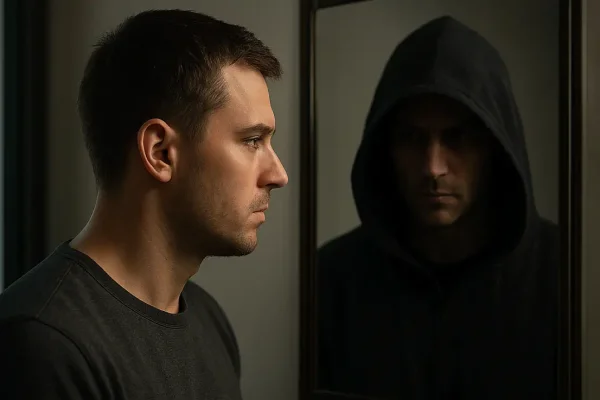
Heroes and Villains: The Mirrored Shadow
Every viewpoint feels like the center of its own story.
From inside that story, our choices tend to make sense. We understand our motives. We know what we fear. We remember what happened to us. We know what we believe we are protecting.
But we do not have the same access to another person's inner world.
This is where the hero and villain archetype begins to emerge.
A person sees themselves protecting something important. Someone else sees that same person as a threat. Each interprets the other through a different collection of experiences, assumptions, values, and fears.
The result can be remarkably simple:
One person becomes the hero. Another becomes the villain.
Yet both may believe they are responding to a problem rather than creating one.
From an observer's perspective, the "enemy" is therefore more complicated than the person standing on the other side. The mind adds meaning to that person. It interprets their actions through identity, memory, fear, and the need to make sense of an uncertain world.
How the Idea of an Enemy Begins
The sense of an enemy often begins with a distinction between "self" and "other."
We naturally categorize people and situations. We decide what feels familiar and what feels unfamiliar, what feels safe and what feels threatening. These judgments can be useful for navigating the world, but they can also become rigid.
Once identity becomes strongly attached to a particular group, belief, role, or cause, disagreement can begin to feel personal.
The internal story may sound something like this:
I am the one who understands.
I am protecting what matters.
I can see what others refuse to see.
There is nothing inherently wrong with believing something strongly. The difficulty begins when certainty turns another person into a threat simply because they see the world differently.
The mind does not necessarily need to consciously decide, "I am the hero." Instead, the role can emerge naturally from the way we interpret our own motives.
We see our intentions from the inside.
We see everyone else's behavior from the outside.
That asymmetry matters.
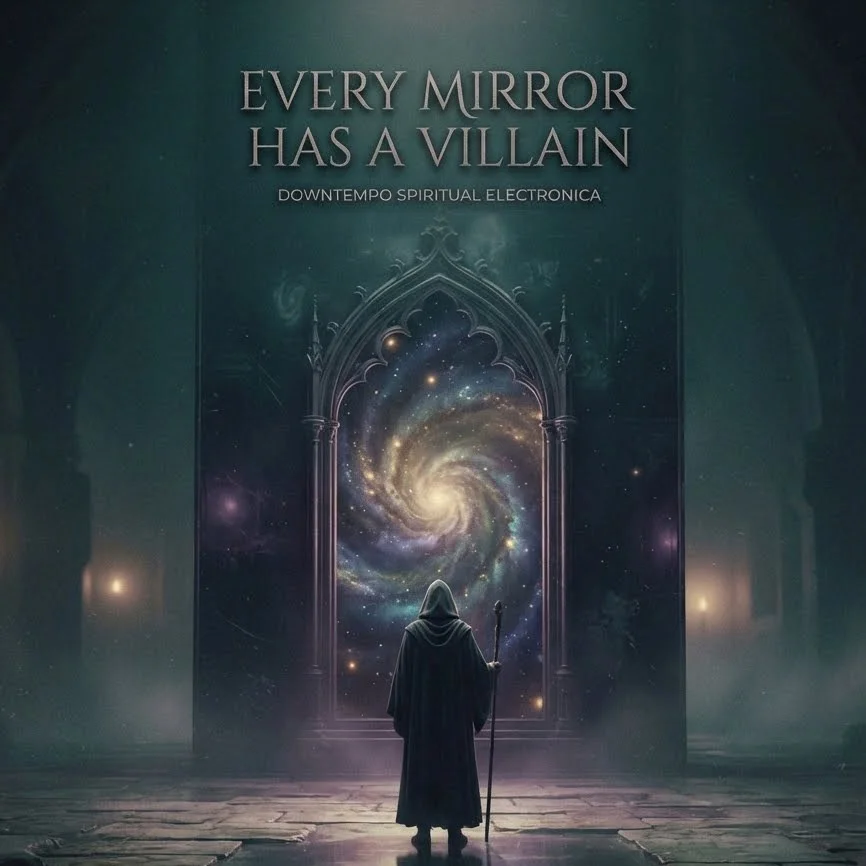
Every Mirror Has a Villain
The song:
From the quiet space behind my mind
I watch the war I built to feel alive
Every shadow wearing my own face
Every villain standing in my place
I called it truth, I called it right
Never saw I was the other side of light
Two mirrors facing, neither one will bend
Both convinced the story has to end
But who's the hero when the story turns?
Who's the enemy that never learns?
Maybe it was never you or me
Maybe it was just a way to see
Every worldview builds its throne
Every hero fights alone
But look a little closer at the eyes you fear
You'll find a mirror standing here
Every mirror has a villain
Every villain has a heart
We're the same light, torn and spilling
Playing every single part
The parent and the child, the border and the flame
Nations drawing lines to hide the same old pain
I am the one who understands, I said
But so did every ghost inside my head
Thanos, Loki, every trickster, king, and thief
Never saw themselves the villain underneath
Cain didn't wake up wanting to be cruel
Just a wounded heart that no one saw or knew
So who's the hero when the story turns?
Who's the enemy that never learns?
Maybe it was never you or me
Maybe it was just a way to see
Every worldview builds its throne
Every hero fights alone
But look a little closer at the eyes you fear
You'll find a mirror standing here
Every mirror has a villain
Every villain has a heart
We're the same light, torn and spilling
Playing every single part
One consciousness behind the mask
One story wearing a thousand names at last
Put the sword down, put the story down
Watch it dissolve without a sound
Every worldview builds its throne
Every hero fights alone
But look a little closer at the eyes you fear
You'll find a mirror standing here
No enemy, no hero left to be
Just the light, remembering it's free
Just the light... remembering... it's free...
Why Worldviews Create Hero and Villain Stories
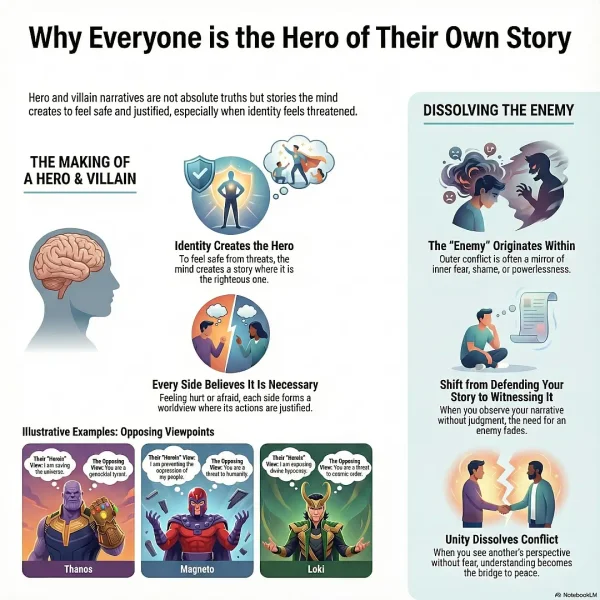
The Shadow Behind the Enemy Archetype
The idea of an enemy is rarely just about the other person's actions. It also involves the meaning we assign to those actions.
The same behavior can look like courage to one person and recklessness to another. A demand for freedom can look like independence from one perspective and irresponsibility from another. Defending tradition can look like preserving stability or resisting necessary change.
The behavior is real.
But interpretation is where the story begins.
Identity Needs a Sense of Difference
Identity is partly built through distinction. We understand ourselves by recognizing what we value, what we believe, and what we are not.
This can become especially powerful at the group level.
"I am this" naturally creates a contrast with "I am not that."
When the contrast becomes emotionally charged, the other side can stop being viewed as a collection of individuals and instead become a symbol of everything the group fears or rejects.
The Mind Resists Powerlessness
Powerlessness is uncomfortable.
When people feel unable to control circumstances, the mind often searches for explanations. A clearly defined enemy can provide a sense of order. If someone or something is responsible, then the problem has a name.
The story can become:
There is a problem. Someone caused it. Someone must stop it.
Sometimes that interpretation is accurate. Sometimes it is incomplete. Sometimes the search for a villain simply makes an uncertain situation easier to understand.
Cultures and Groups Define Themselves Through Contrast
Groups often strengthen their identity by defining shared values and boundaries.
"We believe this."
"They believe that."
"We protect this."
"They threaten it."
This process can help groups organize themselves, but it can also create stereotypes and reduce complicated human beings to simple categories.
Once a group becomes "the enemy," individual differences within that group become harder to see.
Inner Conflict Can Become Outer Conflict
Psychological projection is one way people can interpret uncomfortable feelings as belonging primarily to someone else.
Fear, shame, insecurity, resentment, or a sense of powerlessness can influence how we interpret other people's behavior.
This does not mean every conflict is merely a projection of our inner world. Real wrongdoing, injustice, abuse, and genuine threats exist.
The deeper point is that our internal state can influence how we perceive and respond to those external realities.
The Spiritual Perspective
From a unity based or non-dual perspective, the separation between "self" and "other" can appear less absolute.
In that view, the enemy may be understood as another expression of the same underlying existence rather than something fundamentally separate.
This is a spiritual interpretation, not a scientific conclusion. Its value lies in what it invites us to examine:
What happens when the person we fear is no longer seen as completely separate from ourselves?
The conflict may not immediately disappear, but our relationship to the conflict can change.
Why People Can See Themselves as the Hero: The Psychology of Subjective Morality
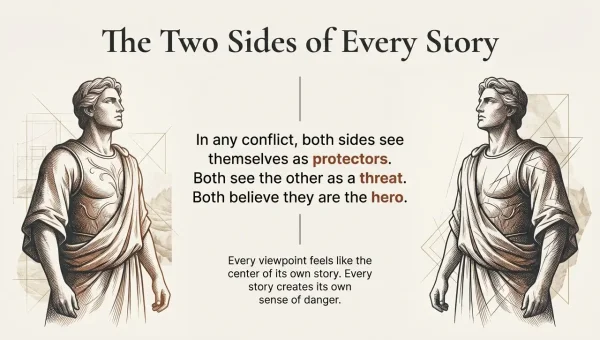
What People Mean When They Say the Villain Thinks They Are the Hero
The phrase even the villain thinks they are the hero points to a recognizable pattern in storytelling and human behavior.
Most people do not experience themselves as the villain of their own lives.
Even when someone behaves destructively, they may explain their actions through a personal framework that makes those actions feel necessary, justified, defensive, or unavoidable.
This does not make harmful behavior acceptable.
Understanding someone's reasoning is not the same as approving of it.
It simply helps explain how two people can look at the same event and reach completely different moral conclusions.
Subjective morality: A person may judge an action according to the values and assumptions they hold.
Protagonist mindset: People generally experience their own lives from the inside, which makes their intentions and struggles especially visible to them.
Self serving or misguided reasoning: People can construct explanations that protect their identity, justify their choices, or make painful circumstances easier to accept.
This is one reason fictional characters such as Thanos, Magneto, Killmonger, Light Yagami, and other morally complicated antagonists can be so compelling.
They do not necessarily understand themselves as destroyers.
They believe they are responding to a problem. Thinking they are doing what is necessary.
And that is precisely what makes the every hero has a villain story so interesting.
Two mirrors, each believing the reflection is the enemy.
Real Life Examples of the Hero vs. Villain Mindset
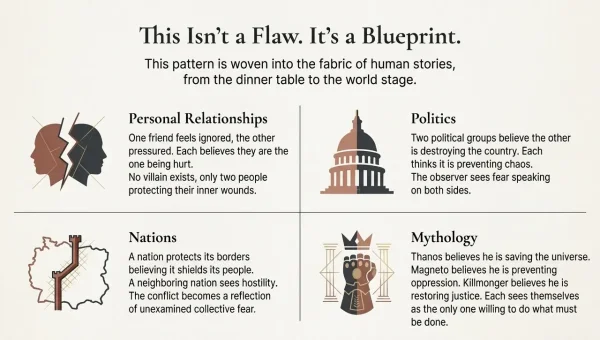
Personal Relationships
Two friends argue.
One feels ignored.
The other feels pressured.
Each person may have a completely different explanation for what happened. One sees themselves as defending the relationship. The other sees themselves as defending personal boundaries.
There may be no conscious villain on either side. There may simply be two people interpreting the same situation through different experiences.
Families
A parent may enforce rules because they believe those rules provide safety, structure, and guidance.
A child may resist because they experience those same rules as control.
Both may believe they are protecting something important.
Politics
Political disagreements often demonstrate the hero vs villain pattern particularly clearly.
One group may believe it is preventing disorder. Another may believe it is protecting individual freedom. Each may sincerely believe the opposing position creates danger.
This does not mean every political position is equally correct or that harmful policies should not be criticized.
It means that understanding why another person believes they are right can be useful even when we strongly disagree with their conclusions.
Nations and Cultures
One nation may describe military action as defense. Another may experience the same action as aggression.
One culture may see a tradition as sacred. Another may see it as restrictive.
Perspective does not automatically determine truth, but it strongly influences how events are interpreted.
Stories and Fiction
Fiction makes this dynamic easier to see because we can step outside the characters' perspectives.
Thanos believes his actions will save the universe.
Magneto sees himself as protecting mutants from persecution.
Killmonger believes extreme action is necessary to confront injustice.
Light Yagami believes he can create a better world by eliminating those he considers criminals.
Their reasoning does not make their actions morally correct. Instead, it reveals something important about the human mind:
A person can construct a coherent story in which destructive actions appear necessary.
Good vs. Evil Through Myth and Religious Tradition
Stories of good and evil appear throughout human cultures. These traditions do not all teach the same moral framework, and it is important not to reduce complex religions and mythologies to a simple "everyone sees themselves as the hero" formula.
Still, myths can provide powerful examples of how perspective, identity, duty, order, rebellion, and transformation shape our understanding of heroes and villains.
Satan in Abrahamic Traditions
The figure of Satan has been interpreted in different ways across Jewish, Christian, and Islamic traditions, as well as across different periods of religious thought.
In some Christian interpretations, Satan represents rebellion against God and the forces of evil. In other theological discussions, particularly those examining the biblical figure of "the satan" in older texts, the figure can be understood more as an accuser, adversary, or tester within a divine framework.
These interpretations should not be collapsed into the claim that Satan is simply a misunderstood hero.
The more useful observation is that the meaning of the figure changes depending on the theological framework through which the story is interpreted.
One lens sees cosmic rebellion.
Another emphasizes testing and accusation.
The role changes because the framework changes.
The Pharisees and Jesus
The relationship between Jesus and the Pharisees is often presented in simplified modern retellings as a conflict between good and evil.
Historically and religiously, the picture is considerably more complicated.
The Pharisees were a Jewish movement concerned with religious law, interpretation, and communal practice. Jesus was also operating within the Jewish religious world of his time.
The Gospel narratives describe significant disagreements between Jesus and some Pharisees concerning law, purity, authority, and interpretation.
Rather than turning the Pharisees into cartoon villains, the story can be viewed as a conflict between competing understandings of religious faithfulness.
That makes the example more useful for understanding worldview.
Arjuna in the Bhagavad Gita
The Bhagavad Gita presents Arjuna facing a battlefield filled with relatives, teachers, and friends.
He is overwhelmed by the moral consequences of fighting.
Krishna responds by teaching Arjuna about duty, dharma, action, knowledge, devotion, and the nature of the self.
The story is not simply a case of two sides believing they are equally righteous. It is a deeper exploration of what happens when personal emotion conflicts with perceived duty and cosmic order.
Arjuna's crisis demonstrates how a person's worldview can determine what they believe they must do, even when the action carries profound emotional and moral consequences.
Hera and Heracles
In Greek mythology, Hera's hostility toward Heracles is connected to Zeus's infidelity and Heracles' status as the son of Zeus and Alcmene.
Heracles experiences suffering and performs extraordinary feats, becoming one of Greek mythology's great heroes.
From his perspective, his trials become part of a heroic journey.
But from Hera's perspective within the myth, Heracles represents a reminder of Zeus's betrayal and the consequences of that betrayal.
This does not make Hera's actions morally equivalent to Heracles' actions. Instead, it might illustrate how relationships, injury, loyalty, and identity can shape opposing perspectives within a story.
Maui in Polynesian Mythology
Maui appears in numerous Polynesian traditions, and the stories differ significantly between cultures.
He is often portrayed as a trickster, culture hero, or powerful demigod whose actions benefit humanity. Stories associated with Maui include slowing the sun, obtaining fire, fishing up islands, and challenging established limits.
From a human centered perspective, these acts can appear heroic and transformative.
The trickster archetype, however, often complicates simple ideas of good and evil. Breaking rules can create either liberation or disorder depending on the circumstances and the storyteller's perspective.
Loki in Norse Mythology
Loki is another character who resists a simple hero versus villain classification.
In Norse mythology, Loki can help the gods, deceive them, create problems, and contribute to events that ultimately lead toward Ragnarok.
Modern portrayals sometimes turn Loki into a misunderstood hero or straightforward villain, but the older myths are more complicated.
He occupies an unstable space between order and chaos.
That makes Loki particularly useful as an archetype. The figure who disrupts an established order may be viewed as a threat by those who benefit from that order, while others may interpret disruption as necessary or revealing.
Mara and Siddhartha
In Buddhist tradition, Mara is associated with forces that obstruct awakening, including temptation, attachment, fear, and death.
During the Buddha's awakening narrative, Mara attempts to prevent Siddhartha from reaching liberation.
It can be tempting to interpret Mara psychologically as a character protecting a world from destruction, but this goes beyond the basic traditional narrative.
A more careful interpretation is that Mara represents the forces of attachment and delusion that keep beings bound to samsara.
From this perspective, the conflict is not simply between two competing political or moral viewpoints. It is a symbolic representation of the struggle between awakening and attachment.
Cain and Abel
The story of Cain and Abel in Genesis presents jealousy, rejection, anger, and violence.
Cain's offering is not regarded favorably, while Abel's is accepted. Cain becomes angry, and the story ultimately leads to Abel's murder.
It would be misleading to say Cain simply "does not want to be evil."
The biblical account presents his actions as destructive and morally consequential.
Yet the story also gives us a glimpse into the emotional progression that can precede violence: comparison, wounded pride, anger, and resentment.
The tragedy is not only the final act. It is the escalation that happens before it.
Projection, Judgment, and the Creation of Threat
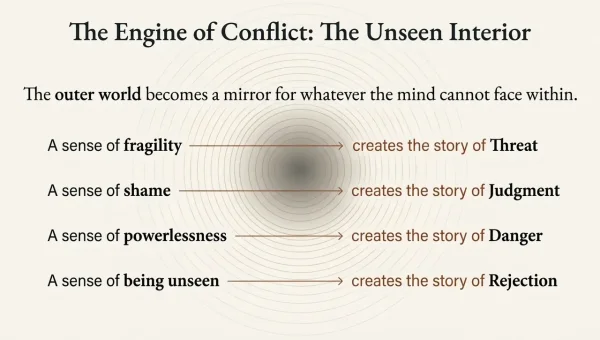
Our perception of other people is influenced by more than what they actually do.
Fear can make ambiguous behavior look threatening.
Shame can make neutral observations feel judgmental.
Powerlessness can make uncertainty feel dangerous.
Feeling unseen can make disagreement feel like rejection.
This does not mean the threat is imaginary. Sometimes people really are dangerous, unjust, abusive, or destructive.
The important distinction is between observing what is happening and adding an entire story about what it means.
The mind is constantly interpreting.
That interpretation can protect us.
It can also distort what we see.
When Does the Enemy Story Become Dangerous?
The hero and villain framework becomes especially powerful when it removes complexity.
If someone is simply "bad," there is no need to understand them.
If an entire group is "dangerous," there is no need to distinguish between individuals.
If disagreement proves that someone is malicious, there is no need to examine our own assumptions.
This is where an enemy narrative can become self reinforcing.
Every action by the other side becomes evidence that the original story was correct.
The person is no longer being encountered directly.
They are being encountered through the story we have created about them.
What Happens When We Stop Defending the Story?
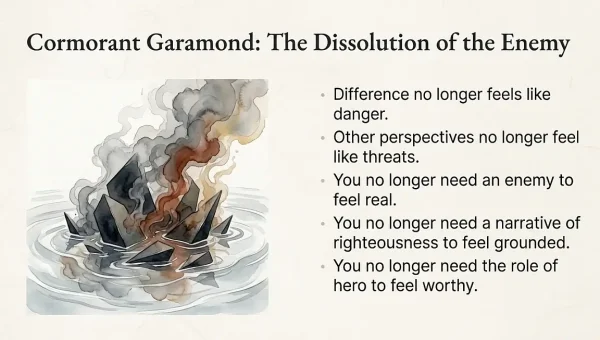
Awareness does not require us to abandon judgment completely.
There are situations where judgment is necessary.
We need to recognize danger. We need boundaries. We need to distinguish harmful behavior from healthy behavior. We need to hold people accountable for what they do.
The shift happens when we become aware that our interpretation is an interpretation.
Instead of immediately asking:
"Who is the villain?"
we can also ask:
"What story am I telling about this person, and how much of that story is based on what I actually know?"
That question creates space.
In that space, we may be able to see:
- Someone's fear without automatically absorbing it.
- Someone's perspective without automatically agreeing with it.
- Someone's motives as possibilities rather than unquestionable facts.
- Our own emotional reaction without immediately acting from it.
- The difference between protecting ourselves and creating an enemy.
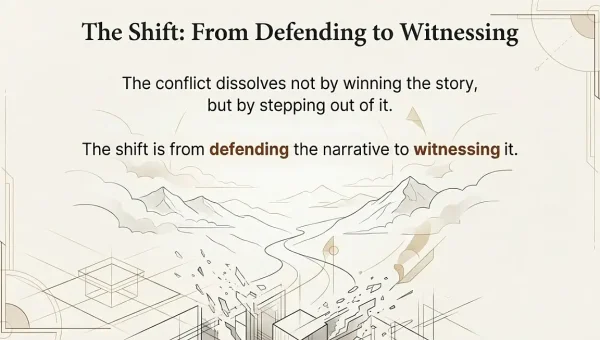
The Observer and the Changing Story
There is a profound difference between being completely identified with a story and observing the story as it unfolds.
When we are identified with it, we may experience every disagreement as a threat to ourselves.
When we observe it, we can begin to notice the thoughts, emotions, assumptions, and memories that shape our interpretation.
This does not make us passive.
It makes us more aware.
The observer does not necessarily say, "Everyone is right."
The observer asks, "What am I seeing, and through what lens am I seeing it?"
That distinction can change everything.
What This Means for the Hero vs. Villain Story in Real Life
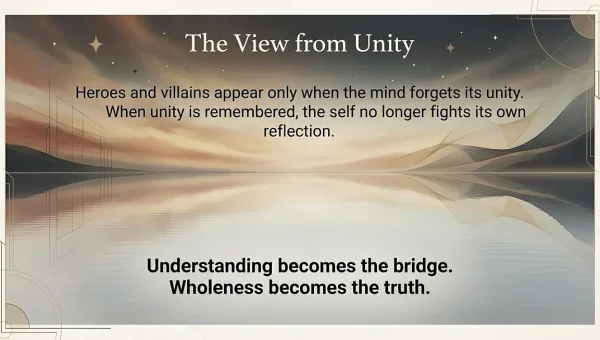
The hero-versus-villain story is powerful because it simplifies a complicated world.
Sometimes that simplicity is useful.
Sometimes it becomes a trap.
People are rarely only one thing. A person can be compassionate in one situation and selfish in another. A leader can protect one group while harming another. Someone can genuinely believe they are doing good while causing tremendous damage.
Human beings contain contradictions.
That is why understanding another person's perspective does not require us to excuse their actions.
We can reject harmful behavior while still trying to understand how someone arrived at their worldview.
We can maintain boundaries without creating hatred.
We can disagree without turning disagreement into dehumanization.
And we can recognize that our own perspective is also shaped by a history we did not consciously choose.
From Separation to Understanding
The deeper lesson is not that heroes and villains do not exist.
It is that the labels are often less complete than we imagine.
A worldview determines what becomes visible and what remains hidden. It tells us what matters, what threatens us, who deserves trust, and who deserves blame.
Change the lens and the story can change.
From a psychological perspective, this means becoming more aware of the assumptions and emotional reactions that influence perception.
From a philosophical perspective, it means questioning the certainty with which we divide the world into opposing categories.
From a spiritual or non-dual perspective, it can become an invitation to look beyond separation altogether.
In that final perspective, the apparent conflict between self and other begins to soften. The many perspectives are still real as experiences, but the boundary between them may no longer feel as absolute.
The observer begins to see the possibility that what appears to be a world of opposing selves may also be understood as a shared field of experience.
That is not a claim that conflict is unreal.
It is an invitation to see conflict differently.
The Villain May Be the Hero From Another Doorway
Perhaps this is why the hero and villain archetypes remain so powerful.
We recognize ourselves in the hero.
We recognize our fears in the villain.
And sometimes, when we look closely enough, we discover that both characters are being shaped by the same human forces: fear, desire, identity, belonging, memory, love, pain, and the need to find meaning.
The story changes when awareness enters the room.
The enemy may still be there.
The disagreement may still be real.
The consequences may still matter.
But the observer is no longer required to see another human being as a two dimensional villain in order to understand their own role as the hero.
Perhaps the deepest form of awareness is not choosing the right side of every story.
Perhaps it is becoming capable of seeing the story itself.
And from that vantage point, the distance between hero and villain may not disappear, but it becomes something we can finally observe rather than something we are compelled to become.