
Use the free tire diameter calculator below to find the overall height of any P-metric or LT/flotation tire in seconds. Enter a size like 225/55R17 or 33x12.50R20 (or fill in the three fields manually) and instantly get the overall diameter, sidewall height, circumference, and revolutions per mile and per kilometer in both inches and millimeters. Need to swap sizes? Use the built-in comparison tool to see the difference between two tires side by side, including speedometer error percentage.
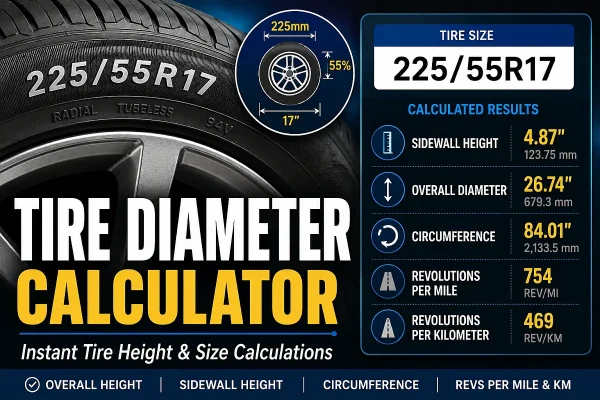
Knowing your tire's overall diameter is important when changing wheel sizes, installing a lift kit, recalibrating your speedometer, or comparing replacement tires. Even a small change in diameter can affect vehicle clearance, gearing, fuel economy, and the accuracy of your speedometer. Use the tire size calculator below to instantly determine the diameter, sidewall height, circumference, and revolutions per mile for virtually any P-metric or LT/flotation tire size.
Tire Diameter Calculator
Enter a P-metric size (225/55R17) or LT/flotation size (33x12.5R20), or fill in the fields manually.
Results for
| Measurement | Inches | Millimeters |
|---|---|---|
| Overall Diameter | — | — |
| Sidewall Height | — | — |
| Circumference | — | — |
| Revs per Mile | — | |
| Revs per Km | — | |
Compare with another size
vs
| Measurement | Size A (in) | Size A (mm) | Size B (in) | Size B (mm) | Δ Inches | Δ mm |
|---|---|---|---|---|---|---|
| Overall Diameter | — | — | — | — | — | — |
| Sidewall Height | — | — | — | — | — | — |
| Circumference | — | — | — | — | — | — |
| Revs per Mile | — | — | — | |||
| Revs per Km | — | — | — | |||
| Speedometer Error (B vs A) | — | |||||
How to Read a P-Metric Tire Size
The number molded into the sidewall of every passenger tire follows a standard three-part format. Take 225/55R17 as an example:
- 225 - Section width in millimeters. This is the widest point of the tire from sidewall to sidewall when mounted on the specified rim.
- 55 - Aspect ratio, expressed as a percentage. The sidewall height equals 55% of the section width - in this case 123.75 mm (roughly 4.87 inches).
- R17 - Radial construction; the rim diameter the tire is designed to fit, in inches.
Some sizes carry a prefix letter - P (passenger), LT (light truck), or ST (special trailer). The calculator strips any prefix automatically, so you can paste the full size string as it appears on the sidewall.
How to Read an LT / Flotation Tire Size
Light truck and off-road tires often use a flotation sizing format that leads with the overall diameter rather than the section width. Take 33x12.5R20 as an example:
- 33 - Overall diameter in inches. This is the finished height of the mounted, inflated tire.
- 12.5 - Section width in inches. This is the widest point of the tire from sidewall to sidewall.
- R20 - Radial construction; the rim diameter in inches.
The calculator accepts both formats interchangeably. Type either style into the tire size field and it will detect the format automatically - no need to convert manually.
Tire Size Calculator Formula
P-Metric Formula
Overall tire diameter is calculated from first principles using the three values above:
- Sidewall height (mm) = Section width × (Aspect ratio ÷ 100)
- Overall diameter (mm) = (Rim diameter × 25.4) + (Sidewall height × 2)
- Overall diameter (in) = Overall diameter (mm) ÷ 25.4
For a 225/55R17: sidewall = 225 × 0.55 = 123.75 mm (4.87″). Overall diameter = (17 × 25.4) + (123.75 × 2) = 431.8 + 247.5 = 679.3 mm (26.74″).
LT / Flotation Formula
For flotation sizes, the overall diameter is stated directly, so the calculator works backward to derive the equivalent aspect ratio for the core calculation:
- Sidewall height (in) = (Overall diameter − Rim diameter) ÷ 2
- Section width (mm) = Section width (in) × 25.4
- Aspect ratio (%) = (Sidewall height (in) × 25.4) ÷ Section width (mm) × 100
For a 33x12.5R20: sidewall = (33 − 20) ÷ 2 = 6.5″. Section width = 12.5 × 25.4 = 317.5 mm. That feeds the same diameter, circumference, and revolutions math used for P-metric sizes.
How to Compare Two Tire Sizes
After calculating your first tire, a Compare with another size field appears below the results. Enter any second size - P-metric or LT/flotation - and hit Compare. The comparison table shows both sizes side by side with color-coded deltas (green = larger, red = smaller) for overall diameter, sidewall height, circumference, and revolutions per mile and per kilometer. It also calculates the speedometer error percentage so you know exactly how much your speedo will be off before you buy.
What Each Result Means
Overall Diameter
The total height of the mounted, inflated tire from the ground to the top of the tread. This is the number that matters most for fitment - clearance in the wheel well, lift kit calculations, and speedometer accuracy all depend on it.
Sidewall Height
The distance from the rim edge to the outer tread face. A taller sidewall absorbs more road shock; a shorter sidewall improves steering response and handling feel. When you "plus size" to a larger rim, the aspect ratio typically drops to keep the overall diameter - and therefore the speedometer reading - consistent.
Circumference
The distance the tire travels in one complete revolution. Circumference = π × overall diameter. This figure feeds directly into the revolutions-per-mile and revolutions-per-kilometer calculations.
Revolutions per Mile / per Kilometer
How many full rotations the tire completes per mile (or per km) of distance traveled. These numbers are used when programming aftermarket speedometers, differential gear ratios, and ABS or traction-control systems after a tire size change. A larger tire has a longer circumference, so it completes fewer revolutions per mile - which causes a stock speedometer to read low if no recalibration is done.
How Much Diameter Change Is Safe?
The general guideline is to stay within ±3% of the factory overall diameter. Go beyond that and you risk:
- Speedometer error - a speedometer that consistently reads high or low, which can affect cruise-control accuracy and traffic-law compliance.
- ABS and traction-control calibration issues - the wheel speed sensors report revolutions, not actual speed; a significant diameter change shifts those readings.
- Transmission and differential wear - especially relevant on AWD vehicles, where all four tires must remain within a very tight diameter tolerance to avoid binding in the center differential.
- Clearance problems - a taller tire can contact the inner fender or suspension components under full steering lock or suspension compression.
To check your percentage difference: ((new diameter − original diameter) ÷ original diameter) × 100. If that number falls between −3 and +3, you're in a safe range for most vehicles. Always cross-check with a fitment guide specific to your year, make, and model. The comparison tool above calculates this automatically as the speedometer error percentage.
Note: I've pushed closer to 4% on full-sized trucks and haven't personally encountered any issues other than the speedometer reading a few mph off at higher speeds.
Common Tire Sizes - Quick Reference
The table below lists calculated overall diameters for frequently encountered P-metric and LT/flotation sizes:
| Tire Size | Format | Sidewall (in) | Overall Diameter (in) | Overall Diameter (mm) | Revs / Mile |
|---|---|---|---|---|---|
| 195/65R15 | P-metric | 4.99″ | 24.99″ | 634.7 mm | 806 |
| 205/55R16 | P-metric | 4.45″ | 24.89″ | 632.0 mm | 809 |
| 215/55R17 | P-metric | 4.66″ | 26.32″ | 668.5 mm | 765 |
| 225/45R17 | P-metric | 3.98″ | 24.97″ | 634.1 mm | 808 |
| 225/50R17 | P-metric | 4.43″ | 25.86″ | 656.8 mm | 780 |
| 225/55R17 | P-metric | 4.87″ | 26.74″ | 679.3 mm | 754 |
| 235/45R18 | P-metric | 4.16″ | 26.33″ | 668.5 mm | 765 |
| 245/40R18 | P-metric | 3.86″ | 25.71″ | 652.9 mm | 785 |
| 265/70R17 | P-metric | 7.31″ | 31.61″ | 803.0 mm | 639 |
| 275/55R20 | P-metric | 5.95″ | 31.91″ | 810.5 mm | 633 |
| 285/75R16 | P-metric | 8.43″ | 32.85″ | 834.3 mm | 614 |
| 305/70R18 | P-metric | 8.39″ | 35.79″ | 909.0 mm | 563 |
| 31x10.50R15 | LT/flotation | 5.50″ | 31.00″ | 787.4 mm | 651 |
| 33x12.50R17 | LT/flotation | 6.50″ | 33.00″ | 838.2 mm | 611 |
| 33x12.50R20 | LT/flotation | 6.50″ | 33.00″ | 838.2 mm | 611 |
| 35x12.50R17 | LT/flotation | 7.50″ | 35.00″ | 889.0 mm | 576 |
| 35x12.50R20 | LT/flotation | 7.50″ | 35.00″ | 889.0 mm | 576 |
| 37x13.50R20 | LT/flotation | 8.50″ | 37.00″ | 939.8 mm | 545 |
Plus Sizing and Keeping Diameter Consistent
Plus sizing means increasing wheel diameter (going from 17″ to 18″, for example) while reducing the tire aspect ratio so the overall diameter stays close to the original. It is popular for improving handling feel and fitting larger brake calipers.
A typical progression keeping diameter near 26.7″:
- 225/55R17 → 26.74″
- 225/50R18 → 26.83″
- 225/45R19 → 26.91″
Each step up in rim size is offset by a lower aspect ratio (shorter sidewall), preserving the overall diameter. Run the sizes through the comparison tool above to confirm before purchasing, and it will show you delta and speedometer error at a glance.
Frequently Asked Questions
Does tire diameter affect speedometer reading?
Yes. Your vehicle's speedometer is calibrated to a specific number of tire revolutions per mile. A taller tire covers more ground per revolution, so the wheel spins fewer times per mile, causing the speedometer to read lower than your actual speed. A shorter tire does the opposite. Staying within 3% of the factory diameter keeps the error negligible for most drivers. Use the comparison tool above to calculate the exact speedometer error percentage before swapping sizes.
Is overall diameter the same as overall height?
Yes. The terms "overall diameter" and "overall height" are used interchangeably. When a tire is standing upright on flat ground, its height from the ground to the top of the tread is exactly its overall diameter.
Why does the calculator show results in both inches and millimeters?
Tire width and sidewall height are specified in metric units (millimeters), while wheel diameters, lift heights, and many fitment measurements in North America are typically given in inches. Displaying both units makes it easier to compare specifications and avoid conversion errors.
How accurate are these calculations?
The results are based on the standard P-metric and LT/flotation geometry formulas used throughout the tire industry and represent nominal dimensions. Actual mounted tire dimensions can vary slightly depending on the manufacturer, tread design, approved rim width, and inflation pressure. For critical fitment decisions, always verify dimensions against the tire manufacturer's published specifications.
Can I use this for LT or flotation tires?
Yes. The calculator supports both P-metric sizes (such as LT265/75R16) and flotation sizes (such as 33x12.5R20 or 35x12.50R17). Type either format directly into the tire size field - the calculator detects the format automatically and handles the conversion.
How do I compare two different tire sizes?
Calculate your first tire size using the tool above. Once results appear, a Compare with another size field will appear below. Enter a second size in either P-metric or LT/flotation format and hit Compare. The table shows both sizes alongside color-coded differences for diameter, sidewall, circumference, revolutions per mile, and speedometer error percentage.
How do I calculate tire diameter manually?
First, calculate the sidewall height by multiplying the tire width by the aspect ratio. Then multiply the sidewall height by two and add the wheel diameter converted to millimeters. For example, a 225/55R17 tire has a sidewall height of 123.75 mm and an overall diameter of approximately 679.3 mm or 26.74 inches. For a flotation size like 33x12.5R20, the overall diameter is already stated - 33 inches - so no calculation is needed.
What happens if I increase tire diameter?
Increasing tire diameter raises ground clearance and changes your vehicle's effective gearing. A larger tire covers more distance per revolution, causing the speedometer to read lower than your actual speed. Larger tires can also affect acceleration, fuel economy, and wheel well clearance.
Find the Right Tire Size with Confidence
Whether you're checking speedometer accuracy, planning a plus-size wheel upgrade, comparing replacement tires, or verifying clearance before installing larger tires on a truck or 4x4, knowing your tire's overall diameter is essential.
Use the tire diameter calculator above to quickly determine overall height, sidewall size, circumference, and revolutions per mile for virtually any P-metric or LT/flotation tire size. Use the built-in comparison tool to check two sizes against each other before you buy.
If you're considering changing tire sizes, always verify fitment with your vehicle manufacturer and try to stay within ±3% of your original tire diameter to avoid unwanted speedometer and drivability issues.