
Are you considering using an electric car for delivery gig work, food delivery, rideshare, pizza delivery, pharmaceutical delivery, or medical courier work? An EV for delivery can be surprisingly economical for high mileage drivers, but the savings depend on how you charge, how much you drive, and what it costs to own the vehicle.
Using an Electric Car for Delivery | EV Delivery
Quick Answer
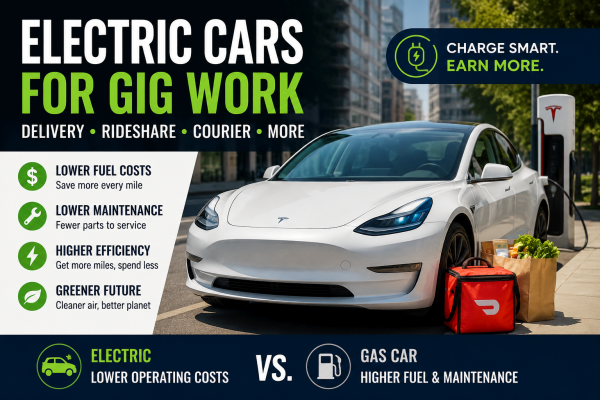
An electric vehicle, whether it's a Tesla Model 3, Ford Mustang Mach-E, Hyundai Ioniq 5, or another efficient EV, can be a smart choice for a delivery driver doing gig work if you already own one, can charge at home overnight, and drive substantial mileage each year. Home charging can dramatically reduce energy costs compared with gasoline, while lower routine maintenance and regenerative braking can further reduce operating expenses.
These advantages apply to more than food delivery. EVs can be used for DoorDash, Uber Eats, Uber, Lyft, Instacart, Amazon Flex, pizza delivery, pharmaceutical delivery, medical courier routes, and other gig driving jobs. But higher insurance costs, tire wear, depreciation, charging downtime, and the vehicle's purchase price can offset some of those savings.
So, is an EV actually cheaper for gig work than a gasoline vehicle? Let's compare the real-world costs, advantages, hidden expenses, and warranty considerations to find out.
Electric vs. Gas Car: Annual Savings Calculator
This calculator uses these default assumptions unless you change them below: gas priced at $3.40 per gallon, a 30 MPG gas car, a Tesla using 250 Wh per mile, home charging at $0.14 per kWh, Supercharging at $0.28 per kWh, 70% of charging done at home, and an extra $500 per year in Tesla insurance costs. Open “Advanced options” below to adjust any of these for your own numbers.
Why Drivers Choose EVs for Gig Work
Gig platforms like DoorDash, Uber, Uber Eats, Lyft, Instacart, Spark Driver, Amazon Flex, and independent medical courier contracts all reward drivers who can keep their per mile costs low while staying comfortable during long shifts. An EV checks several of those boxes at once, regardless of which badge is on the hood. Electricity is typically cheaper than gasoline, especially when charged at home overnight on an off peak rate. There is no oil to change, no spark plugs to replace, and no transmission fluid to service. Regenerative braking reduces how often brake pads wear down, since the motor does much of the slowing instead of the brake calipers.
There is also a less obvious appeal: predictability. Gas prices swing week to week based on regional supply, seasonal demand, and broader market conditions, which makes it hard for a driver to know their true cost per mile from one month to the next. A home electricity rate, by contrast, tends to stay relatively stable, which makes budgeting and profit tracking simpler for drivers treating gig work as a real side business rather than a casual side hustle.
Comfort matters more than people expect during an eight hour shift. Most EVs offer near-instant cabin heating and cooling, heated seats, and the ability to sit in a parking lot with the climate control running without idling an engine or burning fuel. Instant torque also makes city driving noticeably more responsive than a comparable gas car, which is part of why so many gig drivers describe EVs as simply more enjoyable to drive through a full shift of stop and go traffic.
Beyond Tesla: Other EVs Worth Considering
Tesla remains the most common EV choice for gig work because of its charging network and resale familiarity, but it is far from the only option worth cross-shopping.
- Ford Mustang Mach-E: A genuinely fun vehicle to drive, with strong acceleration and a more traditional SUV-style interior. Cargo space rivals the Model Y, and Ford's BlueCruise driver assistance system is a solid highway companion between delivery zones.
- Hyundai Ioniq 5 and Kia EV6: Both offer extremely fast charging speeds thanks to an 800-volt architecture, which can meaningfully cut charging downtime for drivers who cannot charge at home. Roomy, boxy interiors also make the Ioniq 5 a strong pick for grocery and retail delivery work.
- Chevrolet Equinox EV and Bolt EUV: Lower purchase prices make these some of the most budget-friendly ways into EV gig work, though range and charging speed trail the premium options.
- Nissan Leaf: An affordable entry point for lower-mileage, part-time drivers, though older CHAdeMO-based fast charging infrastructure is becoming harder to find in some regions.
The core economics discussed throughout this article, home charging savings, reduced maintenance, and higher insurance and tire costs, apply broadly across all of these vehicles, not just Tesla. Where they differ most is cargo layout, charging speed, and the driver assistance features available for long highway stretches between jobs.
EV vs. Gas Vehicle: Real Cost Comparison
The clearest way to evaluate whether an EV makes sense for gig work is to compare a typical mid-size EV against a typical 30 MPG gas sedan across two common annual mileage levels: 20,000 miles (part-time to moderate gig driving) and 40,000 miles (full-time delivery or rideshare driving).
Annual Operating Cost Comparison
| Expense (40,000 miles/year) | Typical EV (Model 3, Mach-E, Ioniq 5) | 30 MPG Gas Sedan |
|---|---|---|
| Fuel / Electricity | Roughly $1,800 (home charging) | Roughly $4,700 |
| Oil Changes | $0 | Roughly $350 |
| Transmission Service | $0 | Possible, varies by mileage |
| Spark Plugs | $0 | Roughly $200 periodically |
| Brake Wear | Low, due to regenerative braking | Moderate |
| Tire Replacement | Higher, due to weight and torque | Lower |
| Insurance | Typically higher | Typically lower |
| Total Operating Cost | Usually lower overall | Usually higher overall |
These are just rough estimates that assume consistent home charging. Drivers who rely heavily on public fast charging during shifts will see their electricity costs rise substantially, which can erase much of the fuel savings advantage, regardless of which EV they drive.
Real Cost Per Mile
At home charging rates, many drivers pay somewhere between 3 and 8 cents per mile in electricity, depending on local utility rates and the vehicle's efficiency. A comparable 30 MPG gas car, at national average gas prices, typically runs closer to 10 to 14 cents per mile in fuel alone. The gap narrows considerably for drivers who fast-charge frequently, since public charging pricing during peak hours can approach or occasionally exceed the per-mile fuel cost of an efficient hybrid.
EV Home Charging vs. Public Fast Charging
This is one of the most important variables in the entire decision, and it applies to every EV brand, not just Tesla. A driver with access to a Level 2 home charger can plug in overnight and start every shift at full range for a fraction of the cost of gasoline. A driver without home charging access, who depends on public fast chargers throughout the day, faces a very different financial picture. Public charging rates vary by network, location, and time of day, and frequent fast charging also adds unproductive downtime to a shift, time that could otherwise be spent completing deliveries or rides.
If you cannot charge at home, the math rarely favors any EV for full-time gig work. This single factor often matters more than any other line item on this list, and it is worth testing honestly before committing to a purchase.
Electric Vehicle Insurance Costs
Electric Vehicle insurance premiums are consistently higher than comparable gas vehicles, due to expensive parts, specialized repair facilities, and higher replacement costs after collisions. For gig work specifically, there is a more important issue than price: most personal auto policies exclude commercial delivery and rideshare activity entirely. Before accepting delivery orders, ride requests, or courier contracts, check with your insurer and add the appropriate rideshare or delivery endorsement. Driving for DoorDash, Uber, or a pharmacy courier service without the correct coverage can leave you personally liable in an accident, regardless of what vehicle you drive.
Electric Vehicle Tire Wear
EVs wear through tires faster than most gas vehicles used for similar driving. Three factors combine to cause this: heavier vehicle weight due to the battery pack, instant torque from the electric motor, and the tendency of that torque to encourage quicker acceleration from stops. Frequent stop-and-go delivery driving accelerates this further. Budgeting for more frequent tire replacement is a realistic part of EV gig-work ownership costs across every model.
Electric Vehicle Depreciation
High annual mileage reduces resale value regardless of what vehicle you drive, but the dollar impact is often larger with an Electric simply because the purchase price tends to be higher to begin with. Electric vehicle resale values have also fluctuated significantly in recent years due to manufacturer price cuts and shifts in the broader used EV market. A driver who racks up 40,000 delivery or rideshare miles a year should expect any EV's resale value to decline meaningfully over a few years of heavy use, similar to how any vehicle used for high-mileage work depreciates faster than one driven casually.
Electric Vehicle Maintenance Savings
EVs eliminate several traditional maintenance costs: oil changes, spark plug replacement, and transmission servicing are simply not part of EV ownership, whether it's a Tesla, a Mach-E, or an Ioniq 5. That said, no EV is maintenance-free. Drivers still need cabin air filter replacements, tire rotations, windshield washer fluid, occasional suspension component service, and periodic brake service. Brakes on an EV are used less often thanks to regenerative braking, but that reduced use can actually lead to corrosion buildup if the brakes sit unused for long stretches, so periodic inspection still matters.
EV Warranty Coverage
One advantage that rarely gets discussed in gig-work comparisons is battery warranty coverage, which can meaningfully offset maintenance risk for high-mileage drivers across every EV brand.
| Vehicle | Basic Warranty | Battery & Drive Unit Warranty |
|---|---|---|
| Tesla Model 3 / Model Y | 4 years / 50,000 miles | 8 years / 100,000 to 120,000 miles |
| Ford Mustang Mach-E | 3 years / 36,000 miles | 8 years / 100,000 miles |
| Hyundai Ioniq 5 | 5 years / 60,000 miles | 10 years / 100,000 miles |
| Chevrolet Equinox EV / Bolt EUV | 3 years / 36,000 miles | 8 years / 100,000 miles |
For a driver logging 35,000 to 50,000 miles per year, the basic vehicle warranty on most EVs expires quickly, sometimes within a single year of full-time gig work. The battery and drive unit warranty, however, continues to cover one of the vehicle's most expensive components for several more years across every brand listed above. This is a genuine financial cushion that gas vehicles cannot match, since it protects against the single costliest repair an EV owner could face. It does not, however, cover normal wear items like tires, suspension parts, or brake components, which remain the owner's responsibility.
Driver Comfort and Practical Features
Beyond the numbers, day-to-day comfort affects how sustainable gig work feels over long shifts, and this is where the "fun factor" of EVs genuinely shows up in practice.
- Instant cabin heating and cooling, useful for extreme weather shifts
- Ability to wait for orders or ride requests with climate control running without idling an engine or burning fuel
- Heated seats and steering wheel for cold-weather comfort
- Quiet cabin, which reduces fatigue over multi-hour shifts and improves the experience for rideshare passengers
- Instant, smooth acceleration that makes stop-and-go city driving noticeably less tedious than in a gas car
- Front trunk storage (on Tesla and Mach-E models), which keeps food odors out of the main cabin, helps separate hot and cold orders, and frees up rear seats for larger deliveries
Delivering Pharmaceuticals and Medical Courier Work
Medical and pharmaceutical courier work is a growing but often overlooked corner of gig driving, covering everything from local pharmacy delivery apps to independent contracts with labs, clinics, and specialty pharmacies. It comes with its own set of practical considerations that differ from food delivery or rideshare.
Temperature control matters more here than almost any other delivery category. Many pharmaceuticals and lab specimens require a stable, moderate cabin or cargo temperature during transport. An EV's ability to run climate control continuously without idling an engine, and without the exhaust and noise concerns of a gas vehicle sitting outside a clinic or pharmacy, is a genuine advantage for this type of work.
Security and chain of custody are also bigger concerns than in typical food delivery. A locked frunk, in vehicles that have one, provides a separate, enclosed space for sensitive or high-value packages away from the main cabin, which some couriers find useful for controlled substances or specimens that require limited handling. Whatever vehicle you use for this work, confirm the specific security, temperature logging, and chain-of-custody requirements with the contracting pharmacy, lab, or courier platform before accepting routes, since these requirements vary significantly and are usually stricter than standard food delivery expectations.
Insurance is worth double checking separately for this category as well. Medical courier work sometimes falls under different commercial insurance classifications than food delivery or rideshare, and not every delivery-specific endorsement automatically covers it.
Cold Weather Range
Cold temperatures can reduce an EV's usable range by roughly 20 to 30 percent, primarily due to battery chemistry and cabin heating demands. This matters for delivery and rideshare drivers because it directly affects how many hours you can work between charges during winter months, and it matters even more for pharmaceutical couriers who also need to run climate control for cargo temperature stability rather than just cabin comfort. Planning for more frequent charging stops in cold weather, or relying more heavily on home charging before and after a shift, helps offset this seasonal drop in range.
Driver Assistance Features Across EV Brands
Every major EV maker now offers some form of highway driver assistance, Tesla's Autopilot and Full Self-Driving, Ford's BlueCruise, GM's Super Cruise, and Hyundai's Highway Driving Assist among them. These systems can reduce fatigue during longer highway stretches between delivery zones or rideshare pickups, but none of them are designed for the reality of most gig delivery work. Tight apartment complex parking, frequent stops, narrow neighborhood streets, and constant multi-drop navigation are exactly the conditions where these systems offer the least benefit and require the most driver attention. These features work best as a supplement on longer connecting drives, not as a primary tool during active delivery or pickup routes, and drivers should remain fully attentive regardless of which assistance features are engaged.
EV Charging Downtime
Every minute spent charging during a shift is a minute not spent earning, whether you're delivering food, driving rideshare, or running courier routes. Home charging overnight avoids this problem entirely, since the vehicle starts each shift already full. Drivers who depend on public charging during the day need to factor unpaid charging time into their hourly earnings calculations, since a 20 to 40 minute fast-charging stop has a real opportunity cost on a platform that pays per completed order or ride.
The impact of charging downtime scales with how many hours you drive. A driver doing a two hour evening shift a few times a week can usually work around a single midweek charging stop without much disruption. A full time driver logging eight or more hours a day cannot absorb multiple charging breaks without a noticeable drop in completed deliveries and total earnings. This is one more reason why home charging access is such a dividing line between drivers who see strong EV economics and drivers who do not. Vehicles with 800 volt fast charging architecture, like the Ioniq 5 and EV6, help narrow this gap for drivers who cannot charge at home.
Cargo Capacity for Delivery Work
Cargo space matters differently depending on which platform you drive for. Food delivery on DoorDash or Uber Eats rarely requires much room, since most orders fit easily in a front trunk or on the back seat. Instacart, Amazon Flex, grocery delivery, and pharmaceutical courier work are a different story, since a single run can involve multiple large bags, boxes, coolers, or bins that need to stay upright, temperature-stable, and separated.
SUV-style EVs like the Model Y, Mustang Mach-E, and Ioniq 5 have a clear advantage here. Their hatchback design and flat rear cargo floors make it easier to load bulky or irregularly shaped items than a traditional sedan trunk. Folding rear seats add even more usable space when a large batch order or multi-stop courier run needs to go in at once. Drivers who plan to mix food delivery with grocery, retail, or medical courier work often find the extra cargo room pays for itself in fewer trips and less time spent repacking orders mid-route.
Over the Air Software Updates
Most modern EVs, not just Teslas, receive periodic over-the-air software updates that can add features, adjust range estimates, or refine driver assistance behavior without a trip to a service center. For gig drivers, this has a couple of practical implications. New efficiency improvements can occasionally extend real-world range slightly, which matters when trying to stretch a shift between charges. Updates can also change how certain features behave, including climate control presets or driver assistance systems, so it is worth reviewing update notes when they arrive rather than assuming the car behaves exactly as it did the day before.
One caveat worth planning around is that updates sometimes install while the vehicle is parked and can take the car temporarily out of service for a short period. Scheduling updates for downtime between shifts, rather than letting them install unexpectedly before a busy delivery window, helps avoid losing active driving time.
Best EVs for Gig Work
| Model | Why It Works for Gig Work |
|---|---|
| Tesla Model 3 (Rear Wheel Drive) | Lowest purchase price in the lineup, efficient range, easiest to justify financially for delivery use |
| Tesla Model Y | More cargo space for Instacart, Amazon Flex, or larger grocery and courier deliveries |
| Ford Mustang Mach-E | Strong performance and comfort, good cargo space, BlueCruise for highway stretches |
| Hyundai Ioniq 5 / Kia EV6 | Fastest public charging speeds, useful for drivers without home charging |
| Chevrolet Equinox EV | Lower purchase price, solid cargo room, good entry point into EV gig work |
Advantages and Disadvantages at a Glance
| Advantages | Disadvantages |
|---|---|
| Lower energy costs with home charging | Higher insurance premiums |
| Reduced routine maintenance | Faster tire wear |
| Extended brake life via regenerative braking | Higher mileage-driven depreciation |
| Battery and drive unit warranty coverage | Reduced range in cold weather |
| Comfortable, quiet, fun-to-drive long shifts | Charging downtime without home access |
| No idling needed while waiting for orders or rides | Higher upfront purchase price |
When an EV Makes Financial Sense
- You already own one and are looking to earn extra income
- You can charge at home every night
- You drive more than 20,000 miles a year for gig, rideshare, or courier work
- Electricity rates in your area are relatively low
- You plan to keep the vehicle for several years
When It Doesn't Make Sense
- You are buying one solely for occasional DoorDash, Uber Eats, or pizza delivery
- You will depend on public fast charging every day
- Your insurance quote is significantly higher than a comparable gas vehicle
- You only drive a few hours a week
- You do not have consistent access to home charging
When a Hybrid Vehicle May Be the Better Option
For drivers without home charging access, or those who deliver only part-time, a reliable hybrid sedan often makes more practical sense. Hybrids offer strong fuel economy without any dependence on charging infrastructure, lower insurance premiums, lower purchase prices, and slower depreciation relative to their cost. For occasional gig drivers, the simplicity of refueling at any gas station, combined with lower upfront and insurance costs, frequently outweighs the per-mile savings an EV could offer.
Real-World Driver Scenarios
Numbers on a page are useful, but seeing how they play out for different types of drivers makes the decision easier to apply to your own situation.
The full-time delivery or rideshare driver. Someone driving 45,000 miles a year across DoorDash, Uber Eats, and Uber, with a Level 2 home charger installed in their garage, is close to the ideal EV gig work candidate. Their fuel savings alone can run into the thousands annually compared to a gas sedan, and the battery warranty still has years of coverage left even at that mileage. The tradeoffs, faster tire wear and higher insurance, are real but proportionally smaller next to the fuel savings at that volume.
The pharmaceutical or medical courier. A driver running scheduled pharmacy or lab specimen routes benefits less from raw mileage savings and more from the reliability of continuous climate control, quiet operation outside clinics, and the added security of front trunk storage on models that offer it. For this driver, matching the vehicle's cargo and temperature-control capabilities to the contract's requirements matters as much as the cost-per-mile math.
The weekend side-hustle driver. Someone driving 6,000 to 8,000 miles a year to earn extra cash on weekends will rarely see enough fuel savings to offset an EV's higher purchase price and insurance premium, especially if they do not already own the vehicle. A used, reliable hybrid is almost always the more financially sound choice for this driver profile.
The apartment-dwelling driver without home charging. This is the toughest scenario for EV economics regardless of brand. Without a dedicated home charger, this driver is pushed toward public charging networks, which erodes much of the cost advantage and adds unpaid downtime to every shift. Unless a workplace or nearby charging option offers meaningfully cheaper rates than public fast charging, a gas or hybrid vehicle is typically the more practical choice here.
Long-Term Ownership Considerations
Gig work puts a vehicle through a different kind of wear than typical commuting. Frequent short trips, constant stop-and-go movement, and long idle periods while waiting for orders or rides all add up differently than steady highway miles. Over a multi-year ownership period, this affects any EV in a few specific ways worth planning for.
Battery degradation is gradual and, for most drivers, modest over the life of the warranty period, but very high annual mileage will accelerate it somewhat compared to light personal use. Suspension components, including control arms and bushings, tend to wear faster under constant stop-and-go city driving than they would under highway-heavy commuting. Cabin air filters should be replaced more often than the standard interval if you are frequently parked near restaurant kitchens, pharmacies, or busy loading areas, since airflow through the cabin system runs more heavily during climate-control-heavy waiting periods. None of these are dealbreakers, but budgeting for them keeps the long-term cost picture realistic rather than optimistic.
Tax Deductions for Gig Drivers
Gig drivers in the United States can generally deduct vehicle expenses using either the standard mileage rate or actual expense method, though EV owners should track charging costs, not gas receipts, if using the actual expense method. Keep detailed mileage logs separating personal, delivery, rideshare, and courier driving, and consult a tax professional familiar with gig work and EV ownership, since deduction rules can change and vary based on individual circumstances.
Frequently Asked Questions
Is an electric car worth it for DoorDash or Uber Eats?
It depends heavily on your mileage and charging setup. High-mileage drivers with inexpensive home charging can see significant savings on energy and routine maintenance. Occasional drivers or those who rely heavily on public charging may not save enough to offset higher insurance, depreciation, and upfront vehicle costs.
Can I use an electric car for Uber or Lyft?
Yes. Many rideshare drivers use electric vehicles. Lower energy costs can be particularly valuable for rideshare because drivers may spend many hours and hundreds of miles behind the wheel. EVs also provide a quiet, smooth ride that can be comfortable for both drivers and passengers.
Is the Ford Mustang Mach-E a good choice for delivery work?
Yes. The Mustang Mach-E offers useful cargo space, a comfortable cabin, and good highway driving capability, making it a practical alternative to a Tesla for drivers who prefer a crossover SUV. Its suitability will depend on purchase price, insurance, charging costs, and local electricity rates.
Are EVs good for pharmaceutical or medical courier delivery?
They can be. EVs can provide low operating costs and allow the cabin to remain heated or cooled without idling a gasoline engine. Models with a frunk or additional cargo storage can also provide useful separation for equipment or packages. However, pharmaceutical and medical courier work may have specific temperature-control, security, handling, and chain-of-custody requirements, so always confirm the requirements of the contracting company or delivery service.
Does an EV require special insurance for delivery or rideshare driving?
It depends on the type of gig work and your insurance provider. Personal auto policies may exclude commercial delivery or rideshare activity unless the appropriate coverage is added. Some platforms provide limited coverage in certain circumstances, but drivers should understand the limits and exclusions rather than assuming the platform's insurance covers everything. Medical and pharmaceutical courier work may require different commercial coverage.
How much does it cost to charge an EV for gig work?
The cost depends on the vehicle's efficiency and your electricity rate. A driver paying relatively low residential electricity rates may spend only a few cents per mile on home charging, while frequent use of public fast chargers can substantially increase the cost. The best way to compare an EV with a gas vehicle is to calculate the actual energy cost per mile for both.
Do EVs need more maintenance than gas cars for delivery driving?
No. EVs generally require less routine powertrain maintenance because they do not have engine oil, spark plugs, or conventional transmissions. However, EV drivers still need to budget for tires, cabin air filters, brake inspections, windshield washer fluid, suspension components, and other normal vehicle maintenance.
How much range do I lose in winter?
Cold weather can significantly reduce EV efficiency and usable driving range. The exact reduction varies with temperature, driving speed, heating use, battery condition, and vehicle model. A temporary reduction of 20% to 30% can occur in cold conditions, although the impact varies considerably. Drivers working long shifts should plan for additional charging during winter.
Should I use Autopilot, BlueCruise, or Super Cruise for deliveries?
Driver-assistance systems can be useful on longer highway stretches between delivery areas, but they provide limited benefit during actual pickup and delivery work, which often involves frequent stops, tight parking areas, apartment complexes, and neighborhood driving. These systems do not replace an attentive driver, and you should always follow the manufacturer's requirements and keep your attention on the road.
Which EV has the best cargo space for grocery or courier delivery?
Electric crossovers and hatchback-style vehicles generally provide more practical cargo space than sedans. Models such as the Tesla Model Y, Ford Mustang Mach-E, and Hyundai Ioniq 5 can be useful for grocery, courier, and larger delivery orders. The best choice depends on the type of work, cargo requirements, purchase price, and local charging options.
Do tires wear out faster on an EV?
They can. EVs are often heavier than comparable gasoline vehicles, and their instant torque can increase tire wear when drivers accelerate aggressively. Delivery drivers who accumulate high mileage should expect tires to be a significant operating expense and should rotate and inspect them regularly.
Does an EV's warranty cover normal wear and tear?
No. Manufacturer warranties generally cover specified defects and major components for a defined period or mileage, but normal wear items such as tires and brake pads are typically excluded. Battery and electric drive unit coverage varies by manufacturer, model, battery configuration, and warranty terms, so check the specific vehicle's warranty before purchasing.
Is buying a brand-new EV just for gig work a good idea?
Usually, it requires careful calculation. A new EV may make sense for a driver who expects to accumulate very high mileage, has inexpensive home charging, and plans to keep the vehicle for many years. For occasional gig work, however, depreciation, insurance, financing, and the initial purchase price can overwhelm the savings on electricity and maintenance. An existing vehicle or efficient used hybrid may be more economical.
Can I write off EV charging costs on my taxes as a gig driver?
Potentially, if you use an applicable actual-expense method and meet the tax rules for deducting business vehicle expenses. The treatment of vehicle expenses can be complicated, particularly when a vehicle is used for both personal and business driving. Keep accurate mileage and charging records and consult a qualified tax professional about the rules that apply to your situation.
Does an EV hold up well under high-mileage delivery driving?
An EV can be well suited to high-mileage driving because its electric drivetrain has fewer moving parts than a conventional engine and transmission. However, high mileage still accelerates wear on tires, suspension components, interior parts, and other systems. Battery capacity can also decline over time. The vehicle's warranty, battery design, maintenance history, driving conditions, and charging habits all affect long-term ownership costs.
Final Thoughts and Recommendations
An electric vehicle is not a universal answer for gig work, but it can be a genuinely strong choice under the right conditions, whether that work is food delivery, rideshare, or pharmaceutical courier routes. Drivers who already own one, can charge at home consistently, and put in high annual mileage tend to come out ahead on operating costs, aided by lower energy prices, reduced maintenance, and solid battery warranty protection. Drivers without home charging, those planning to buy a vehicle solely for occasional delivery work, or those facing high insurance quotes are usually better served by a dependable hybrid.
Before committing either way, get an actual insurance quote for delivery, rideshare, or courier coverage, calculate your realistic home charging costs, and be honest about how many hours a week you actually plan to drive. Those three numbers will tell you more about whether an EV makes sense for your situation than any general pros and cons list ever could.