
Are All in One AI Platforms Worth It? The Truth About AI Credits, Hidden Costs, and Why Your Subscription Runs Out So Fast. You signed up for an all in one AI platform promising access to thousands of tools for $15 a month. The first week felt amazing. Then your credits ran out. Completely.
In some cases, people report burning through their entire monthly allocation in 25 minutes of normal use.
Now you're staring at options to buy more credits on top of the subscription you already paid for, and a question gnaws at you: Is this platform actually worth it, or did I just fall for clever marketing?
You're not imagining things. The AI credit system that powers these platforms creates a gap between what's advertised and what you actually get. Understanding this gap is the difference between finding genuine value and feeling perpetually frustrated by usage limits you didn't see coming.
This analysis is based on review of public user feedback, platform documentation, and reported user experiences across multiple all in one AI subscription services.
All in One AI Platforms: The $15 Promise vs. The $150 Reality
The pitch is irresistible. One subscription replaces ChatGPT Plus, Midjourney, ElevenLabs, video generators, and dozens of other tools. Everything consolidated into a single dashboard. No more juggling logins. No more managing multiple billing cycles. Just pure, unlimited AI access for the cost of two cups of coffee.
Except it's not unlimited. And for many users, it's not even close.
Platforms like Galaxy AI, Magai, and similar services advertise millions of credits included with each subscription. The number sounds astronomical; 5 million, 15 million, even 50 million credits per month. Your mind registers abundance. Freedom. Permission to explore without worry.
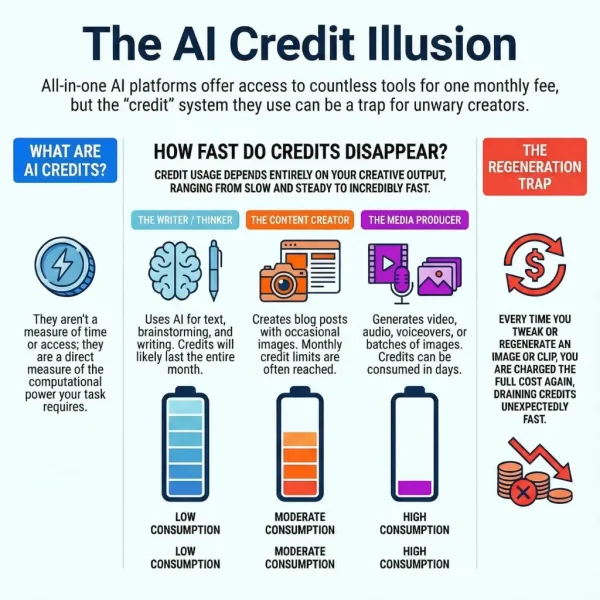
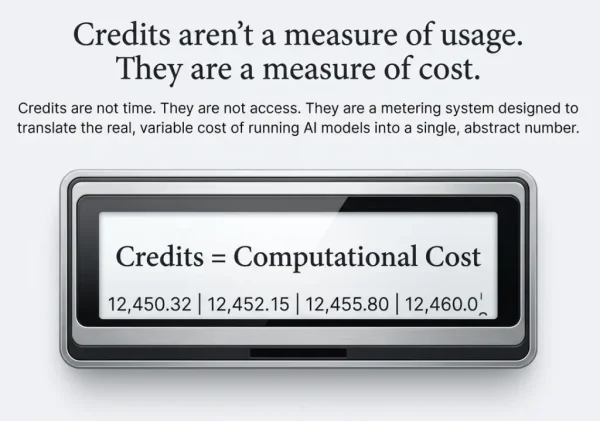
But AI credits aren't what they seem. They're not a generous bonus. They're a metering system that translates computational costs into an abstracted currency most users don't understand until they've already spent it.

How Fast Do Credits Actually Run Out? Real User Experiences
Search "all in one AI platform credits run out too fast" and you'll find hundreds of frustrated users sharing nearly identical stories. Here's what typical usage actually looks like:
A content creator subscribed to Galaxy AI with 15 million monthly credits. After generating 10 images, creating a few short videos, and experimenting with voice synthesis, they hit 50% of their monthly allowance in hours, not weeks. The remaining credits disappeared within days of normal creative work.
A developer tried an AI coding assistant with generous credit allowances. Twenty minutes into their first project, the credits were gone. They switched back to their previous tool immediately.
A marketing professional needed AI headshots for their team. One batch consumed 3 million credits - 20% of their entire monthly budget for a single feature. High-resolution video creation drained AI credits even faster.
These aren't edge cases. They're the norm. And they reveal something crucial about how these platforms actually work.

Why All in One AI Platforms Use Credits Instead of Transparent Pricing
Credits exist because computational costs for AI vary wildly by task. Text generation is cheap. Image generation costs significantly more. Video, voice synthesis, and advanced media tools consume massive processing power.
If platforms showed you the real cost of each action, you'd immediately understand your limitations. "You have 47 image generations left this month" is clear. "You have 5,000,000 credits" requires calculation, estimation, and guesswork.
The abstraction benefits platforms in three ways:
It makes limitations feel like abundance. Large numbers create psychological permission to use features freely, even when usage is actually quite restricted.
It allows flexible pricing without renegotiating. When a new AI model costs more to run, platforms can adjust credit consumption rates without changing subscription prices or alerting users.
It obscures the real cost per action. Most platforms don't show credit costs before you use a feature. You discover how expensive something was after you've already spent the credits.
This isn't necessarily malicious. Running AI infrastructure is genuinely expensive, and costs vary unpredictably. But the system transfers complexity and uncertainty from the platform to you.
The Credit Consumption Hierarchy: What Actually Drains Your Balance
Not all AI tasks cost the same. Understanding this hierarchy is essential to managing credit budgets effectively.
Text Generation: The Cost Effective Foundation
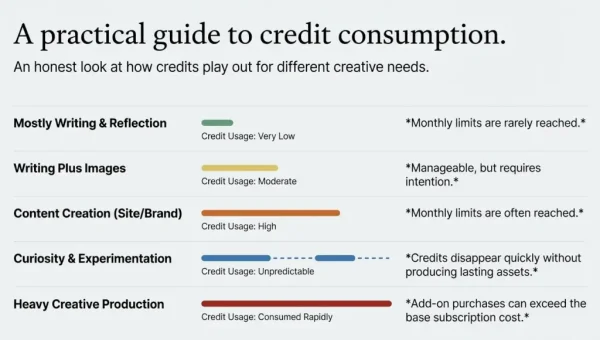
Writing, conversations, code generation, and text-based work consume minimal credits. You can have extensive ChatGPT-style conversations, write long articles, and generate detailed analyses while barely touching your credit balance.
If your primary use is thinking tools, writing assistance, and text based AI, all in one platforms deliver legitimate value. Your credits will likely expire unused each month.
Image Generation: The Middle Ground
Images cost significantly more than text but remain manageable in moderation. A single image generation might consume 50,000 to 800,000 credits depending on the model and quality settings.
The challenge isn't the first generation—it's the iterations. Creative work requires refinement. You regenerate for better composition, adjust lighting, modify colors, and test different styles. Each regeneration costs the same as the original.
What feels like creating one image actually consumes credits for four, six, or eight images. This is where many users first feel credit scarcity.
Video, Voice, and Advanced Media: The Credit Killers
Video generation, voice synthesis, avatar creation, and high resolution media production drain credits with shocking speed. A 30 second video might cost 500,000 to 1,000,000 credits. Voice overs for a five minute presentation can match a week's worth of image work.
AI headshot generation (a feature many platforms highlight in marketing) can consume 3 million credits for a single batch. That's 20% of some plans' entire monthly allocation for one use of one feature.
If your workflow includes regular video or audio creation, credits become the defining constraint of your experience, not the subscription price.
Is Galaxy AI Worth It? What Reviews Actually Reveal
Galaxy AI has become the poster child for all in one AI platforms, both praised and criticized in equal measure. Real user reviews reveal a consistent pattern:
The honeymoon phase is real. New users love the interface, the variety of tools, and the apparent value. Everything works smoothly. The credit balance feels unlimited.
Reality hits within days. Heavy feature users discover their credits deplete far faster than expected. Video creators, designers doing batch work, and anyone using advanced features hit limits quickly.
The add-on economy kicks in. Users buy additional credits to continue their work. A $15 subscription becomes $50, then $100, then $150 per month once add-ons are factored in.
Customer support frustration emerges. Multiple reviews mention slow support responses, difficulty getting refunds, and feeling trapped by subscription terms.
Some users find genuine value. Those using Galaxy AI primarily for text work, occasional images, and exploring AI capabilities often report satisfaction. The platform works well for light to moderate use.
But anyone doing serious content production—creating videos, generating large image sets, producing audio regularly—consistently reports that credits run out too fast and costs exceed expectations.
All in One AI Platform Reviews: Common Complaints Across Services
Galaxy AI isn't alone. Across all in one subscription platforms, user reviews reveal recurring themes:
"Credits expire before I can use them meaningfully." High computational costs for advanced features mean casual users never touch certain tools. The thousands of advertised features become irrelevant because using them depletes credits immediately.
"I can't see costs before using features." The lack of transparent pricing before execution creates anxiety. Every action becomes a question: "Can I afford to try this?"
"Customer service is terrible." When issues arise, slow support responses and automated replies dominate the experience. Getting refunds or resolving problems feels like fighting the system.
"I'm paying more than I would for separate tools." Once add-on credits are included, many users realize they're spending more than individual subscriptions would cost—without the quality advantages of dedicated tools.
"The credit system is confusing." Even technically savvy users struggle to predict usage. The abstraction creates cognitive overhead that interferes with creative work.
When All in One AI Platforms Actually Make Sense
These platforms aren't universally bad. They serve specific use cases exceptionally well.
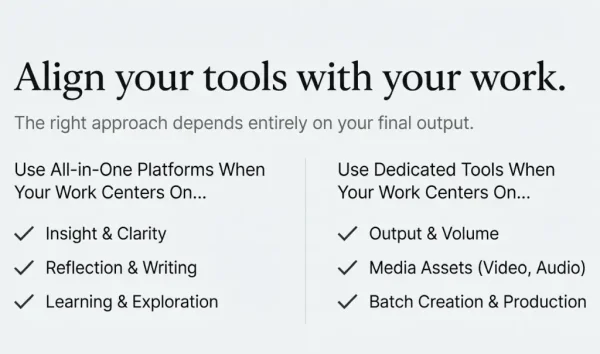
You work primarily with text and thinking tools. Writers, researchers, strategists, and anyone focused on text-based AI will find genuine value. Credits stretch far, costs remain low, and consolidation offers real convenience.
You're exploring AI capabilities. If you're learning what AI can do, experimenting with different models, and discovering your preferred tools, all in one AI platforms provide a cost-effective sandbox.
You need occasional access to diverse tools. Creating a social media post that needs an image, some text, and a quick edit? Perfect. Generating a presentation that requires a few graphics and some voice-over? Manageable.
You're a solopreneur managing multiple small projects. When your work involves varied but moderate AI needs across different clients and projects, consolidation can simplify workflows.
You have genuinely light usage patterns. If you use AI a few times per week rather than daily, credits stretch easily and the platform delivers value.
When Dedicated Tools Win Every Time
For certain users, all in one platforms create more problems than they solve.
You produce video content regularly. Dedicated video tools offer better quality, more features, and predictable pricing. All in one AI platforms can't compete here.
You need batch image generation. Creating hundreds of product images, marketing graphics, or design variations exhausts credits rapidly. Dedicated image tools with flat monthly rates become cheaper.
You require professional-grade output. Specialized tools still outperform all in one AI platforms in quality. A professional designer will get better results from Midjourney than from any aggregator.
You value predictable costs. If your work requires knowing exactly what you'll spend each month, credit systems create unwanted variability.
You're already frustrated by credit management. If you find yourself constantly calculating whether you can afford to use a feature, the cognitive overhead isn't worth the supposed savings.
The Hidden Costs: What "Affordable" Actually Means
A $15 subscription sounds cheap. But that's rarely what users actually pay.
One comprehensive review tracked real costs for Galaxy AI users. Light users paid $15-30 monthly. Moderate users averaged $50-75 when factoring in credit top ups. Heavy users spent $100-200 per month which is more than buying individual subscriptions to specialized tools.
The platform advertises savings of $180+ monthly by replacing multiple tools. For text-focused users, this is accurate. For media-heavy users, the math inverts. They end up paying more for less capable tools than dedicated services would provide.
Add on credits are priced to feel reasonable - $10 for 500,000 credits, $25 for 1.5 million, $50 for 3.5 million. But these deplete quickly under regular use, transforming a predictable subscription into variable monthly costs that creep upward.
Making Smart Decisions: Questions to Ask Before Subscribing
Before committing to an all in one AI platform, honest self assessment matters more than marketing promises.
What will I actually use most? If the answer is "writing and text work," these platforms can be excellent. If the answer is "video, audio, and high-resolution images," proceed carefully.
How often will I use advanced features? Occasional use works fine. Daily production work doesn't. Be realistic about your patterns.
What's my budget for AI tools? Include both base subscription and likely add on costs. Don't compare the advertised price to specialized tools—compare the real total.
Do I value convenience over optimization? Consolidation is genuinely convenient. But specialized tools perform better. Which matters more to your work?
Can I tolerate usage anxiety? If constantly wondering whether you can afford to regenerate an image sounds frustrating, credit systems will drive you crazy.
Alternatives Worth Considering
If these all in one AI subscription based platforms don't align with your needs, several alternatives offer better value for specific users.
Hybrid approach: Use free AI tools for exploration (Claude, ChatGPT free tier) and pay for one specialized tool where you need professional quality. This often costs less while delivering better results.
Model aggregators without credit systems: Tools like Poe or similar services offer access to multiple AI models with clearer usage limits and transparent pricing.
Direct API access: Technical users can access AI models directly through APIs. This requires more setup but offers the most cost-effective usage at scale.
Specialized subscriptions: ChatGPT Plus ($20), Midjourney ($10-60), ElevenLabs ($5-330) together might cost more but provide unlimited usage within each tool's limits.
The Bottom Line: Are All in One AI Platforms Worth It?
All in one AI platforms solve a real problem; subscription overload and fragmented access. For the right user, they deliver genuine value.
But they're not the universal solution their marketing suggests. The AI credit system that enables their business model creates friction, uncertainty, and hidden costs that undermine the simplicity they promise.
These platforms work best for: Text focused users, AI explorers, light users, and people who value convenience over optimization.
These platforms struggle with: Video creators, batch producers, professionals needing consistent quality, and anyone requiring predictable costs.
The real question isn't "Are these platforms good or bad?" It's "Does this specific platform match my specific usage pattern?"
Track your first month carefully. Monitor credit consumption. Note which features you actually use. Calculate your real costs including add-ons. Then decide based on data, not promises.
For some users, all in one AI platforms are revolutionary an helpful. For others, they're expensive middlemen between you and the tools you actually need.
Know which category you fall into before your AI credits run out.