
You signed up for an all in one AI platform promising access to thousands of tools for around $15 a month. The first week feels amazing. Text generation, image creation, video, voice, research, coding, and other AI tools are all sitting in one dashboard.
Then the credits start disappearing.
Before long, you may find yourself wondering why a subscription that looked so affordable suddenly requires additional credit purchases.
So are all in one AI platforms actually worth it, or does the pricing model make them more expensive than they first appear?
The answer depends heavily on what you use, how often you use it, and how the platform converts different AI tasks into credits.
This analysis is based on publicly available platform information, user reviews, and reported experiences across all in one AI subscription services. Credit systems, pricing, limits, and model availability can change, so always check the current terms of the specific service before subscribing.
Are All in One AI Platforms Worth It?
Sometimes, yes.
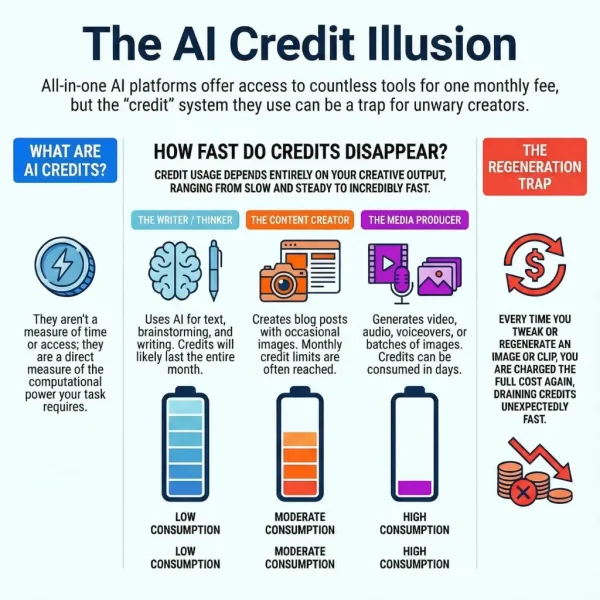
All in one AI platforms can provide real value when you want convenient access to multiple AI capabilities without paying for several separate subscriptions. The catch is that the advertised number of credits does not necessarily tell you how much actual work you can accomplish. A few million credits can sound enormous until you discover that different tools consume very different amounts.
For example:
- Text generation may use relatively few credits.
- Image generation generally consumes more.
- Video generation can consume credits much faster.
- Voice, avatars, and other advanced media tools may also use substantial amounts.
That means a subscription can be excellent value for someone who mainly writes and researches, while the same subscription may become expensive for someone generating large amounts of video or images.
AI Credits Explained: What Are You Actually Buying?
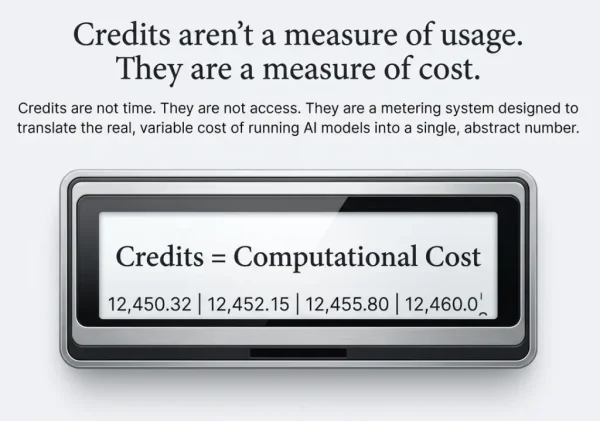
The first thing to understand is that AI credits are usually a metering system, not a universal unit of AI usage.
One platform may charge a certain number of credits for an image. Another may use a different number. Video generation can have entirely different rates based on duration, resolution, model, or other settings.
So when an AI service advertises something like 5 million, 15 million, or 50 million credits, that number does not tell you how many images, videos, voice generations, or text requests you can actually produce.
Think of credits more like an internal currency.
The important question isn't:
"How many credits do I get?"
It's:
"What does my typical workflow cost in credits?"
That distinction is where many subscription comparisons become confusing.

AI Credits vs. Tokens: They Are Not the Same Thing
One important distinction is often overlooked when comparing AI platforms: credits and tokens are not the same thing.
Tokens are generally a unit used by AI models to measure text processed by a model. Depending on the service, you may be charged based on the number of tokens used for your input, the model's output, or both. Token-based pricing is especially common when using AI models through an API.
Credits are different. An AI platform can create its own credit system and use credits to meter access to many different features, including text, images, video, voice, avatars, and other tools.
That means:
- Tokens generally measure model text usage.
- Credits are a platform-defined usage currency.
- One credit does not universally equal one token.
- Credit values can vary dramatically between platforms and features.
This is important because an all in one AI subscription may put many different AI models and tools behind a single credit balance.
You may never see the underlying token, image, video, or processing costs. Instead, the platform simply deducts a certain number of credits from your account.
So don't compare AI subscriptions by credits alone, and don't assume credits are equivalent to tokens. Look at what the platform actually charges for the specific tasks you plan to perform.
For consumers, the practical question is still the same:
"How much useful work can I get from my monthly allowance?"
Why AI Credits Can Run Out Faster Than Expected
The biggest surprise for many new subscribers is that AI tasks do not consume resources equally.
A short text response and a generated video may both appear as a single action to the user, but the computational work involved can be dramatically different.
This creates a rough usage hierarchy:
| AI Task | Typical Credit Impact | Why It Matters |
|---|---|---|
| Text | Lower | Writing, questions, research, and coding can often be performed repeatedly before credits become a major concern. |
| Images | Moderate | Multiple generations and revisions can quickly increase consumption. |
| Voice | Moderate to high | Longer audio and advanced voice features can consume substantially more resources than simple text. |
| Video | High | Video generation can require significant computing resources, especially at higher quality or longer durations. |
| Advanced media | Variable | Avatars, animation, high-resolution output, and specialized models can have their own credit rates. |
The exact credit cost varies from one service to another, but the basic principle is simple:
The more computationally expensive the task, the faster a usage-based credit balance can disappear.
Why One Image Can Turn Into Six
Image generation is a good example of why advertised credit amounts can be misleading.
Suppose you need one image.
You generate it.
The composition isn't quite right.
So you try again.
The lighting is better, but the subject isn't positioned correctly.
Generate again.
Now the subject is right, but you want a different style.
Generate again.
What started as "one image" has become several generations.
This is normal creative workflow.
The same thing happens with video. You may generate a five-second clip, decide the motion isn't right, change the prompt, try another model, adjust the settings, and generate several more versions.
AI credits are consumed by the process of creating the final result, not simply by the number of finished files you keep.
That is an important distinction for anyone comparing AI subscriptions.
Why Video and Voice Can Drain AI Credits So Quickly
Text generation is generally much easier to repeat than computationally intensive media generation.
Video generation can involve processing many frames, maintaining visual consistency, generating motion, and applying increasingly sophisticated models.
Voice and avatar systems can involve additional processing as well.
For that reason, someone who primarily uses an AI platform for:
- Writing articles
- Brainstorming
- Research
- Summarizing information
- Writing or reviewing code
may experience the credit system very differently from someone producing:
- AI videos
- Large batches of images
- AI-generated avatars
- Long-form voice content
- High-resolution media
This is why simply comparing the number of credits included with two subscriptions can produce a misleading conclusion.
Why AI Platforms Use Credits Instead of Simply Saying "You Get X Images"
Credits give AI platforms a flexible way to meter different types of computing.
Text, image, audio, and video generation have different resource requirements. A single universal allowance would make it difficult to balance those costs.
Credits allow a platform to assign different costs to different operations.
For the provider, that creates flexibility.
For the customer, it creates another problem:
You have to understand what those credits actually represent.
"5,000,000 credits" sounds simple.
"An image costs X credits, a video costs Y credits per second, and another model has a different rate" is much more useful, but also much harder to communicate in a marketing headline.
This doesn't automatically mean a credit system is deceptive. AI infrastructure genuinely costs money, and different models can require very different amounts of computing power.
The problem is primarily one of transparency and predictability.
Why Some Users Feel Misled by AI Credit Systems
The frustration usually begins when the advertised credit balance creates an expectation of abundant usage, while actual usage is much lower than expected.
Imagine seeing:
"15 million credits included every month."
That sounds like a huge amount.
But if your primary workflow involves expensive video generation, those credits may represent far fewer usable generations than you initially imagined.
The same subscription could feel extremely generous to someone using it mostly for text.
This creates an important distinction:
A large credit balance does not necessarily equal a large amount of usable AI output.
What matters is the relationship between:
- Your monthly credit allowance
- The credit cost of the features you actually use
- How often you use those features
- Whether unused credits roll over or expire
- The cost of purchasing additional credits
The Credit Consumption Hierarchy
Understanding what actually consumes your allowance is probably the most useful thing you can do before subscribing.
Text Generation: Usually the Most Efficient Use of Credits
Writing, conversations, brainstorming, summarization, research assistance, and coding can often consume relatively few credits compared with media generation. If your primary use is text and thinking tools, an all in one AI subscription may provide substantial value because you can access many capabilities without repeatedly paying for expensive media generation.
Image Generation: The Middle Ground
Images generally require more resources than simple text generation. The bigger issue is iteration. Creative work rarely stops after the first generation. Users commonly create multiple versions before arriving at an image they actually want. So your practical image budget may be much smaller than the number of credits initially suggests.
Video, Voice, and Advanced Media: Where Usage Can Accelerate
Video generation, voice synthesis, avatars, animation, and other advanced media features can consume credits significantly faster. For professional or high-volume creators, this can turn credits into the most important part of the subscription. A service that looks inexpensive on paper may become much more expensive if you regularly need additional credits.
Is Galaxy AI Worth It?
Galaxy AI is one example of the broader all in one AI subscription model, a multi-tool AI platform where multiple AI capabilities are brought together under one service.
The important question isn't simply whether Galaxy AI is "worth it."
The better question is:
What do you actually use it for?
If you mainly use an AI platform for text generation, research, brainstorming, and occasional creative tasks, the convenience of having many tools under one subscription may make sense.
If you regularly generate large amounts of video, images, voice content, or other expensive media, credit consumption becomes much more important.
Public reviews and user discussions can be useful for identifying recurring complaints, but individual experiences can vary considerably because two subscribers may use exactly the same service in completely different ways.
All in One AI Platform Reviews: What Users Commonly Complain About
Across reviews and public discussions about AI subscription services, several recurring concerns appear:
- Credits are consumed faster than expected.
- Credit costs are difficult to understand before using a feature.
- Advanced features use substantially more credits than basic features.
- Additional credit purchases can increase the real monthly cost.
- Users may have difficulty estimating how much work their monthly allowance represents.
- Customer support and billing experiences can vary between services.
These complaints don't necessarily mean that an entire platform is poor value.
They do show why the advertised subscription price should not be treated as the complete cost of using an AI platform.
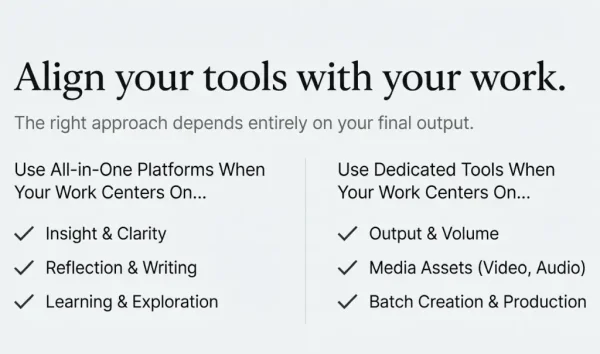
When an All in One AI Platform Makes Sense
All in one platforms can solve a very real problem: subscription overload.
Instead of paying for several different services, you may be able to access multiple capabilities from one dashboard.
That can be particularly useful if:
- You primarily work with text.
- You want access to several AI models.
- You occasionally generate images or other media.
- You are experimenting with different AI tools.
- You prefer one subscription and one interface.
- Your overall usage is relatively light.
For these users, convenience itself has value. You aren't just paying for output. You're also paying for access, consolidation, experimentation, and simplicity.
When a Dedicated AI Tool May Make More Sense
An all in one platform isn't necessarily the best fit for every workflow.
A dedicated service may be worth considering when you:
- Generate large amounts of video.
- Create images in high volume.
- Need professional-grade output from a particular model.
- Require predictable monthly costs.
- Use one specific AI capability far more than everything else.
- Don't want to constantly monitor a credit balance.
In these situations, the important comparison isn't simply subscription price.
Compare the amount of actual work you receive for that price.
The Hidden Cost of "Affordable" AI Subscriptions
A low monthly subscription can be genuinely inexpensive.
But your actual cost may be higher if you routinely purchase additional credits.
For example:
| Usage Pattern | Possible Cost Pattern |
|---|---|
| Light user | Subscription only |
| Moderate user | Subscription plus occasional credit purchases |
| Heavy media user | Subscription plus frequent additional credits |
| Professional creator | Potentially multiple subscriptions or specialized services |
The important word here is potentially.
There is no universal "true cost" because everyone uses AI differently.
Someone who never generates video may have no reason to purchase additional credits.
Someone producing dozens of video generations every week may reach their limits much faster.
How to Calculate the Real Cost of an AI Subscription
Instead of looking only at the monthly subscription price, track your actual usage for the first month.
Write down:
- How many credits you started with
- How many credits each major feature consumed
- How many generations you typically needed to get a usable result
- How many days or weeks your credits lasted
- Whether you purchased additional credits
- Your total monthly spending
Then calculate your approximate cost per useful result.
For example, if a $15 subscription gives you plenty of text generation but you spend another $50 on video credits, your real monthly cost for that workflow is not $15.
It's $65.
That simple calculation can completely change how you compare AI services.
A Better Way to Compare AI Platforms
Rather than asking:
"Which AI platform gives me the most credits?"
ask:
"Which platform gives me the amount of AI output I actually need at a predictable cost?"
Here is a useful comparison checklist:
| Question | Why It Matters |
|---|---|
| How many credits are included? | Establishes your starting allowance. |
| What does each feature cost? | Shows how far those credits actually go. |
| Which models are included? | Different models may have different capabilities and costs. |
| Do credits expire? | Unused credits may not provide lasting value. |
| Do credits roll over? | Rollover policies can materially change the value of a plan. |
| What do additional credits cost? | This reveals the potential cost after the included allowance is exhausted. |
| What do you actually use? | Your personal workflow matters more than the size of the marketing headline. |
Alternatives to the All in One AI Model
There isn't just one way to pay for AI.
1. The Hybrid Approach
Use free AI tools where they are sufficient and pay for one specialized service that you use heavily. This can reduce subscription overlap while still giving you access to advanced capabilities.
2. Dedicated AI Subscriptions
Instead of paying for dozens of tools you rarely use, subscribe directly to the service that handles your primary workflow. This can make sense when one particular model or application is central to your work.
3. Model Aggregators
Some services provide access to multiple AI models through a single interface. These can be convenient, but you still need to understand their usage limits and pricing structure.
4. Direct API Access
For technically inclined users, direct API access can provide more control over usage and spending. It can also require more technical knowledge and may not offer the convenience of a consumer focused multi AI tools dashboard. The right approach depends on how much control, convenience, variety, and predictability you want.
Frequently Asked Questions About AI Credits
What are AI credits?
AI credits are a usage-based system that AI platforms use to measure consumption of their services. Different features can consume different numbers of credits depending on the model, media type, resolution, duration, or other factors.
Why do AI credits run out so quickly?
AI credits can disappear quickly when you use computationally intensive features such as video generation, image generation, voice synthesis, avatars, and other advanced media tools. These tasks generally require more computing resources than basic text generation.
Are millions of AI credits really a lot?
Not necessarily. The number of credits alone does not tell you how much usable AI output you will receive. You need to know how many credits your specific tools and workflows consume.
Do images use more AI credits than text?
Generally, image generation requires more computational resources than simple text generation, so many platforms assign a higher credit cost to images. Exact pricing varies by service and model.
Why does AI video use so many credits?
Video generation can require substantial computing resources because the system must generate and process multiple frames while maintaining visual consistency, motion, and other characteristics. Longer or higher-quality videos can therefore consume credits quickly.
Are all in one AI platforms cheaper than separate subscriptions?
It depends on your usage. Someone who uses several different AI capabilities occasionally may benefit from consolidation, while someone who heavily uses one particular capability may find a dedicated service more predictable or cost-effective.
Can an all in one AI subscription actually save money?
Yes. Consolidating several occasional AI needs into one subscription can reduce the number of separate services you pay for. The savings depend on how much of the included functionality you actually use.
What should I check before subscribing to an AI platform?
Check the monthly price, included credits, credit costs for the features you plan to use, model availability, expiration and rollover rules, additional credit prices, and any usage limits or restrictions.
What is the biggest mistake people make when comparing AI subscriptions?
Comparing the number of included credits without checking what those credits can actually buy is one of the easiest ways to misjudge a plan's value.
So, Are All in One AI Platforms Worth It?
All in one AI platforms solve a genuine problem: too many AI tools, too many subscriptions, and too many separate interfaces.
For the right user, that consolidation can be extremely convenient.
But the number of tools included and the number of credits advertised don't tell the entire story.
The same subscription can produce completely different experiences for different people.
Light text-focused user: You may have plenty of credits and rarely think about your usage.
Creative image user: You may use a significant portion of your allowance through repeated generations and revisions.
Heavy video creator: You may discover that your included credits disappear much faster than expected.
Professional user: You may care more about predictable costs, output quality, model access, and workflow reliability than the number of tools included.
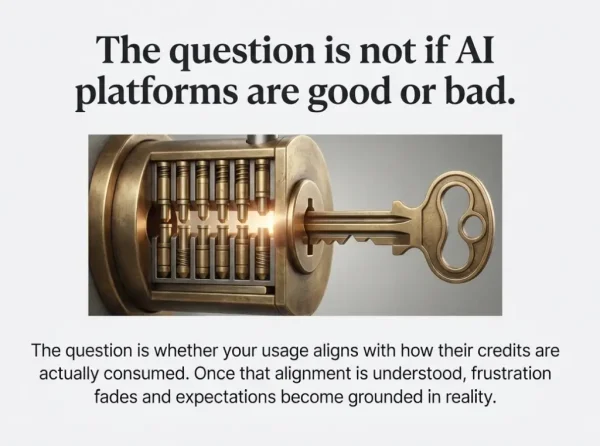
So rather than asking whether all in one AI platforms are universally worth it, ask a more useful question:
Does this particular platform fit the way I actually use AI?
How to Decide Before You Subscribe
Before paying for an multi tool AI service, figure out your actual workflow.
Ask yourself:
- What will I use most?
- Will I primarily generate text, images, audio, or video?
- How many generations do I realistically need each month?
- How many attempts do I usually need before getting a usable result?
- How much do additional credits cost?
- Do unused credits expire?
- Would I actually use the other tools included in the subscription?
- Would one specialized service be enough?
Then try the service for a month if possible.
Track your usage.
Watch how quickly your credits disappear.
Most importantly, calculate your real monthly cost, including any additional credits you purchase.
The Real Value of an AI Subscription
The best AI subscription isn't necessarily the one with the most tools.
It isn't necessarily the one with the largest credit balance either.
And it isn't always the cheapest monthly plan.
The real value comes from the relationship between:
Price + Features + Usage + Output + Convenience
If an inexpensive subscription gives you everything you need, that's valuable.
If a larger subscription includes hundreds of tools you never use, those tools may have little practical value to you.
If an inexpensive plan repeatedly forces you to purchase additional credits, the advertised monthly price may no longer represent your actual cost.
That's why your own usage pattern matters so much.
Final Thoughts: Don't Buy the Credit Number
AI platforms are changing rapidly.
New models appear. Features change. Credit costs change. Subscription tiers change. Tools that seem expensive today can become cheaper tomorrow, while previously inexpensive features can become more restricted.
That makes it difficult to judge an AI subscription from its marketing headline alone.
A huge credit balance may look impressive.
Thousands of AI tools may sound incredible.
But what really matters is whether those tools help you accomplish what you actually want to accomplish.
Don't buy the credit number. Buy the workflow.
Track what you use.
Track what it costs.
Pay attention to how many attempts you need to create something useful.
Then compare that real-world experience with the alternatives.
An all inclusive AI platform can be an excellent way to consolidate your AI toolkit.
It can also become surprisingly expensive if your workflow depends heavily on credit-intensive features.
The difference isn't necessarily the platform.
It's the alignment between the platform's pricing model and the way you actually use AI.
And once you understand how AI credits work, that $15 subscription becomes a much easier decision to evaluate.