
Bing vs Google: Which Search Engine Is Better for Users and Publishers? Google has dominated search for decades, but Bing has quietly evolved into a serious alternative. With AI-powered answers, changing search layouts, and growing concerns about privacy and traffic loss, more people are asking a simple question: is Bing better than Google?
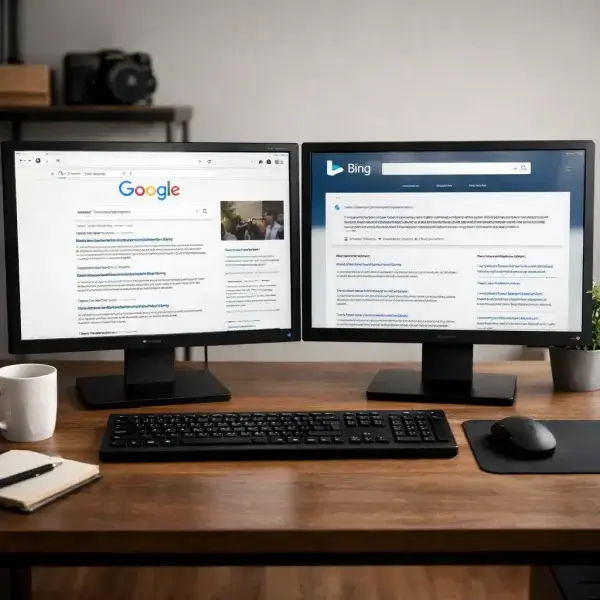
Which Search Engine is Best? The answer depends on who you are. This guide breaks down Bing vs Google from two perspectives:
- Everyday users searching for answers, products, and local businesses
- Publishers and website owners who rely on search traffic
If you only want the quick answer, start here.
This post explores my take on the evolving competition between Bing and Google, evaluating their performance for both everyday searchers and digital publishers. While Google remains the premier choice for local discovery and complex queries, Bing has emerged as a formidable rival through its advanced AI integration and superior visual search capabilities. For content creators, I highlight that Bing often provides more transparent SEO tools and higher quality user engagement compared to Google's high volume but ad heavy displacement ecosystem. Ultimately, the two platforms do have different strengths, making a hybrid approach the most effective strategy for navigating the modern web. The analysis concludes that while Google maintains market dominance, Bing offers a less cluttered and more publisher friendly alternative.
Why People Are Comparing Bing and Google Again
For years, Google was the default choice with little competition. Bing existed, but it was rarely taken seriously by everyday users or publishers.
That has changed. AI powered search, zero click results, and growing frustration among website owners have forced users to look more closely at how search engines actually behave. Bing has invested heavily in AI search experiences, while Google has focused on keeping users inside its own ecosystem.
The result is a meaningful difference in how search works depending on which platform you use.
Quick Verdict: Bing vs Google Showdown
- Best for everyday search: Google still delivers the most consistent results, especially for local search and niche queries.
- Best for publishers: Bing often sends higher-quality traffic, is more transparent, and can be easier to optimize for.
Now let us break down why.
Bing vs Google for Everyday Users
Search Result Quality and Relevance
Google remains the gold standard for relevance. Its index is larger, fresher, and better at understanding complex or ambiguous queries. For things like medical questions, technical problems, or obscure topics, Google usually surfaces stronger results.
Bing performs very well for:
- Product searches
- Visual searches like images and videos
- General informational queries
However, Bing can struggle with very new content and long tail niche searches where Google excels.
When Bing Is Better Than Google for Everyday Searches
While Google is still the default for many people, there are situations where Bing can be the better choice.
- Product research and comparison shopping
- Image and video discovery
- Conversational or exploratory searches
- Users who prefer fewer ads above the fold
Bing also integrates deeply with Windows and Microsoft Edge, making it convenient for users already in that ecosystem.
When Google Is Still the Better Option
- Local business discovery and navigation
- Highly technical or medical topics
- Very recent news and trending content
- Niche or obscure queries
In practice, many users benefit from using both search engines depending on the task.
AI Search and Answer Quality
Bing was first to aggressively integrate AI through Bing Copilot. It provides conversational answers, summaries, and cited sources directly in search results.
Google followed with AI Overviews, which now appear for many informational searches.
Here are some key differences:
- Bing Copilot tends to cite sources more clearly
- Google AI Overviews are faster and more tightly integrated
- Bing feels more exploratory, Google feels more authoritative
For users who like conversational search, Bing has an edge. For fast answers, Google still feels smoother.
Local Search and Maps
This is where Google clearly wins. Google Maps is more accurate, has more reviews, better business data, and deeper integrations with Android and mobile devices. Bing Maps works, but it feels secondary. If you rely on local search, directions, or nearby recommendations, Google is still the better choice.
Shopping and Product Searches
Bing performs surprisingly well for shopping searches. Product comparisons, images, and pricing are often clearer and less cluttered with ads. Google Shopping results are powerful but increasingly ad-heavy, which can make organic comparisons harder to spot.
Ads and SERP Clutter
Google search results are more crowded with ads, shopping units, and AI panels. Bing typically shows:
- Fewer ads above the fold
- Clearer organic listings
- Less aggressive monetization
For users who value clean results, Bing can feel calmer.
Privacy and Data Collection
Neither search engine is privacy first. Google collects more user data across more services, including Gmail, YouTube, Android, and Chrome. Bing is tied to Microsoft, but many users already trust Microsoft with Windows, Office, and Edge. If privacy matters but you still want mainstream search, Bing is slightly less invasive.
Bing vs Google for Publishers and Website Owners
This is where the best search engine comparison gets interesting.
Crawling and Indexing Speed
Google still crawls and indexes faster overall, especially for news and high authority sites. Bing is slower but more predictable. When Bing indexes a page, it tends to stay indexed with fewer unexplained drops.
Traffic Quality and User Intent
Many publishers report that Bing traffic converts better. Here are some common observations:
- Higher time on site
- Lower bounce rates
- Stronger buyer intent
Google delivers more traffic, but Bing often delivers better traffic.
Impact of AI Answers on Organic Clicks
Google AI Overviews frequently answer questions directly, reducing clicks to publishers. Bing Copilot also summarizes content, but it is more likely to show citations that actually get clicked. This makes Bing feel more publisher friendly, at least for now.
Bing Webmaster Tools vs Google Search Console
Google Search Console is powerful but limited and increasingly opaque. Bing Webmaster Tools offers:
- Clear crawl data
- SEO reports that actually explain issues
- Indexing insights Google no longer shares
Many site owners are surprised by how useful Bing Webmaster Tools is once they actually use it.
SEO Differences That Matter
Bing SEO tends to reward:
- Exact match keywords
- Clear site structure
- Strong on-page optimization
Google SEO relies more heavily on:
- Authority signals
- Brand trust
- User behavior data
Smaller sites often find it easier to gain visibility on Bing.
Should Publishers Optimize for Bing and Google Differently?
Yes, but not in the way most people think. Good SEO fundamentals work on both platforms, but Bing places more weight on clear relevance and traditional signals. For publishers, this often means:
- Titles and headings that closely match search intent
- Clear internal linking and site hierarchy
- Less reliance on brand authority
Google, on the other hand, increasingly favors established brands, engagement data, and entity based trust signals. This is why smaller and independent sites often see faster results on Bing.
Ads, RPM, and Monetization
Bing traffic frequently produces higher RPMs for display ads and affiliate content.
Some reasons might include:
- Older, higher income demographics
- Desktop heavy users
- Stronger commercial intent
Google traffic is larger but more diluted.
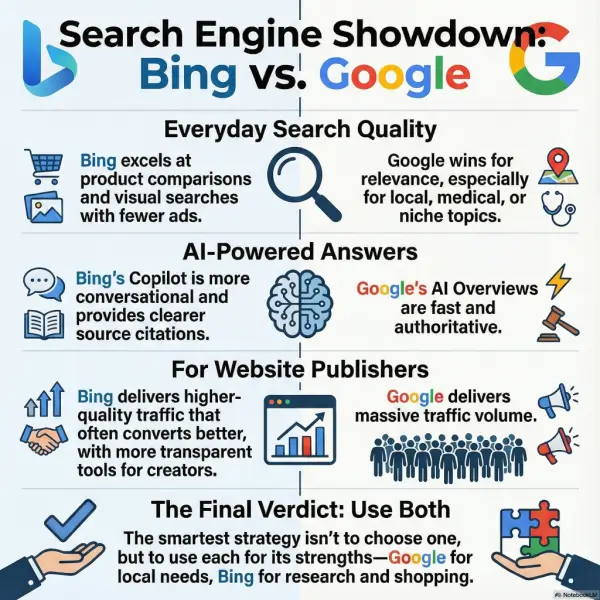
Bing vs Google Comparison Table
Here's a Bing vs Google quick comparison chart highlighting strengths and weaknesses of each per category. There might not be a best search engine. Perhaps the better question is which search engine is better for you?
| Category | Bing | |
|---|---|---|
| Everyday search quality | Good | Excellent |
| AI answers | Conversational, cited | Fast, authoritative |
| Local search | Average | Best Search Engine in class |
| Publisher friendliness | High | Declining |
| SEO difficulty | Lower | Higher |
| Traffic volume | Lower | Much higher |
Is Bing replacing Google?
No. Google still dominates search volume, but Bing is growing in relevance, especially for AI assisted search and publisher traffic.
Does Bing steal content for AI answers?
Both search engines summarize content using AI. Bing is currently more transparent with citations, while Google often keeps users inside its own results.
Is Bing worth using in 2026?
Yes. For both users and publishers, Bing offers unique advantages that make it a valuable complement to Google rather than a replacement.
Why does Bing traffic convert better?
Bing users tend to be older, desktop focused, and more intentional in their searches, which often leads to stronger engagement and higher monetization.
Using Bing and Google Together
You do not have to choose one search engine exclusively. Many users and publishers get the best search engine results by:
- Using Google for local and urgent searches
- Using Bing for research, shopping, and AI assisted discovery
- Tracking traffic and performance separately for each engine
For publishers, this approach reduces dependence on a single platform and creates more stable traffic over time.
Final Verdict: Should You Use Bing or Google?
For everyday users: By default, Google is probably still the best search engine, especially for local search and complex queries. Bing is a solid alternative if you want cleaner results and stronger AI interaction.
For publishers and site owners: Don't leave it out ~ Ignoring Bing is a mistake. While Google dominates volume, Bing offers easier wins, better tools, and traffic that often converts better.
The smartest approach for both users and publishers is not choosing one, but understanding how each search engine behaves, which search engine is better for your use case, and applying that knowledge to your advantage.