Every Worldview Creates Its Own Heroes and Villains: From the quiet space behind thought, the world of conflict looks completely different. Heroes and villains lose their sharp edges. Right and wrong begin to blur. Not because morality disappears, but because the observer sees how every character is shaped by the perspective conditioned lens they look through.
We talk about heroes and villains as if they are fixed roles. In truth, these roles shift based on worldview, identity, fear, and meaning. This exploration looks at why people create enemies, why villains believe they are right, how perspective shapes morality, and how conflict dissolves when awareness shifts.
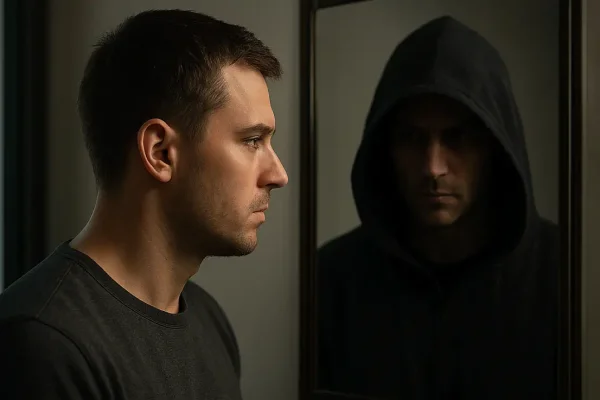
Heroes and Villains | The Mirrored Shadow
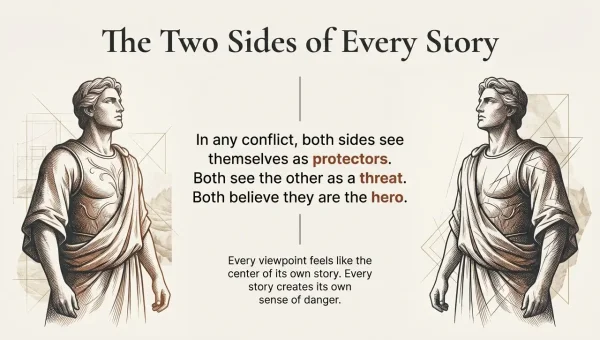
Every viewpoint feels like the center of its own story. Every story creates a sense of danger. Every sense of danger gives birth to a hero. And whenever someone becomes a hero in their own mind, an enemy is formed by contrast.
The observer sees that the enemy is never a person. It is a meaning created by a mind trying to feel safe.
How the Idea of an Enemy Begins
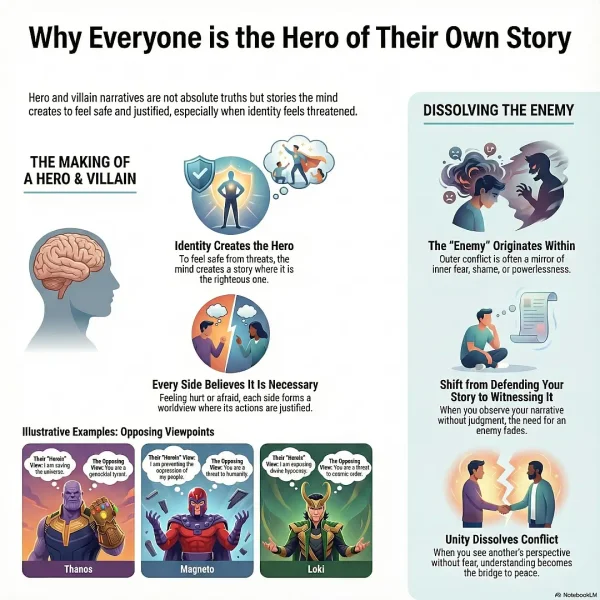
A mind experiences itself as separate. Once there is a sense of self, anything unfamiliar feels like a possible threat. To protect itself, the mind creates a narrative by saying:
I am the one who understands.
I am the one who defends what matters.
I am the one seeing what others refuse to see.
Almost instantly, identity casts itself as the hero. The observer sees this not as an error, but as a natural stage of awareness. A mind simply doing what it knows to survive.
Why Every Worldview with an Enemy Creates a Hero Story
The Shadow Behind the Enemy Archetype
The idea of an enemy does not come from the outer world. It comes from a mind trying to define itself. Identity forms through contrast. Once a villain is named, the hero identity strengthens.
Identity Needs Contrast
A sense of self requires a sense of not self. The moment an opponent is defined, the self becomes the defender of truth. The enemy becomes the scaffolding identity clings to.
The Mind Resists Powerlessness
Powerlessness stings. So the mind invents stories where it stands strong. Even when the enemy is imaginary, the mission feels real.
Cultures Create Themselves by Naming a Villain
Every culture defines its identity by declaring who it is and who it is not. The group labeled not becomes the threat. The collective shadow gets projected outward.
Inner Conflict Becomes Outer Conflict
Unmet grief, fear, shame, and insecurity are pushed onto the world. The enemy becomes a mirror for the inner wound.
The Spiritual Angle
From a unity based perspective, enemies are forgotten fragments of the self. When forgotten, they appear as other. Once they appear as other, they can be blamed. Blame offers the illusion of innocence.
The mind ends up fighting itself while believing it is fighting someone else.
Why Every Villain Sees Themselves as the Hero: The Psychology of Subjective Morality
What People Mean When They Say Even the Villain Thinks They are the Hero
The phrase even the villain thinks they are the hero points to a pattern found in stories, psychology, and real life. Antagonists do not act from pure malice. They justify their choices through a personal logic that feels necessary from inside their worldview.
Subjective morality: From their viewpoint, their actions feel justified or essential for their goals.
Protagonist mindset: They see themselves as the center of their narrative, making choices that feel meaningful or righteous.
Self serving or misguided logic: Some believe they are saving the world. Others simply protect their own desires over others well being.
This is why characters like Thanos, King Canute, Angstrom Levy, Magneto, Killmonger, and Miquella feel compelling. They do not see themselves as destroyers. They see themselves as necessary forces driven by their own truth.
No person believes they are the villain. They feel threatened, judged, misunderstood, or abandoned. These emotions become the lens through which they interpret the world.
- Each side feels attacked.
- Each side believes it is right.
- Each side believes the other is causing harm.
Two mirrors, each believing the reflection is the enemy.
Real Life Examples of the Hero vs Villain Mindset
Personal Relationships
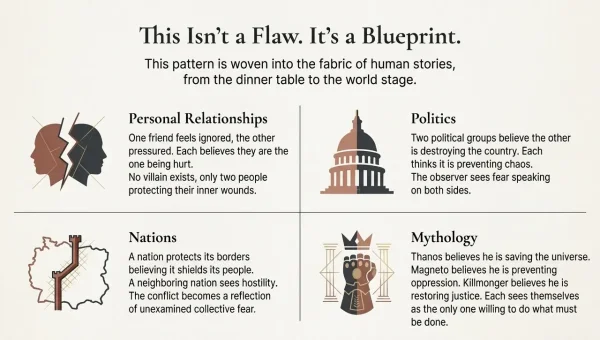
Two friends argue. One feels ignored. The other feels pressured. No villain exists. Only two people protecting their own wounds.
Families
A parent enforces rules believing they offer structure. A child resists believing they protect their freedom. Each sees themselves as the one preserving what matters.
Politics
Each political group believes it prevents chaos. Each believes it protects the nation. Each calls the other dangerous.
Nations and Cultures
One nation protects its borders to feel safe. Another sees aggression. Both believe they seek peace.
Stories and Fiction
Thanos believes he is saving the universe. Magneto believes he defends mutants from oppression. Killmonger believes he restores justice. Light in Death Note believes he purifies the world.
Each sees themselves as the only one willing to do what is necessary.
Good vs Evil Through Myth and World Religion
Across world religions and mythic traditions, the idea of good vs evil is shaped by perspective, not purity. Characters who appear as villains in one telling often see themselves as protectors in another. These stories reveal how morality, identity, and meaning depend on the lens that interprets them.
Satan in Abrahamic Stories
In many interpretations, humans see Satan as the archetype of rebellion, disobedience, and cosmic defiance. But within older threads of theological thought, Satan can be seen as a loyal challenger, a being who tests humanity not out of hatred but out of devotion to divine order. He becomes the examiner of integrity. To him, he is not the villain but the enforcer of truth. The meaning shifts depending on which side of the story you stand inside. Two meanings. Two truths. One lens sees corruption. The other sees duty.
The Pharisees and Jesus
The Pharisees believed they protected sacred law, identity, and the fabric that held their community together. Jesus believed he revealed the deeper core of that same sacred truth. Both cared about holiness. Both believed they defended what mattered most. From one side, Jesus breaks tradition. From the other, the Pharisees cling to form instead of essence. Each side sees itself upholding the real good. Each sees the other as the threat.
Arjuna in the Bhagavad Gita
Arjuna stands in a battlefield facing relatives, teachers, and friends. He sees horror and moral collapse and refuses to act. Krishna reveals that duty, dharma, and cosmic order are far larger than his personal anguish. Meanwhile the opposing side also believes it defends righteousness, honor, and rightful authority. Each army thinks it preserves truth. The conflict arises from competing views of the same virtue.
Hera and Heracles
Hera views Heracles as a living reminder of betrayal and injustice. Her actions come from wounded meaning and a desire to restore order as she understands it. Heracles sees himself combating cruelty, chaos, and trials meant to break his spirit. He sees heroism. She sees correction. Neither is operating from pure malice. Each acts from a worldview shaped by pain, pride, and the need to balance the scales.
Maui in Polynesian Myth
Maui steals fire, slows the sun, fishes up islands, and bends cosmic rules to empower humanity. From the human perspective, he is a liberator and culture hero. From the divine perspective, he disrupts sacred order and creates imbalance. The same action becomes empowerment or desecration depending on who tells the story. His trickster energy reveals how good and evil shift with the eye of the storyteller.
Loki in Norse Myth
Loki exposes hypocrisy, challenges the gods, and reveals the cracks in their power. To some he is a truth teller, a figure who reveals what others refuse to see. To the gods he destabilizes the cosmos, undermining the order they fight to maintain. Loki becomes hero or villain depending on who benefits from his chaos. He believes he is necessary. They believe he is dangerous. In the end one could say the villain is the hero from another doorway.
Mara and Siddhartha
Mara represents desire, identity, and the world of becoming. He tries to stop Siddhartha from awakening not out of cruelty but out of fear that enlightenment will unravel the world Mara rules. Siddhartha sees Mara as illusion. Mara sees Siddhartha as annihilation of what gives experience meaning. Each one protects a world. Each one believes they guard truth. The conflict is not between good and evil but between two interpretations of what must be preserved.
Cain and Abel
Cain experiences rejection, shame, and the pain of feeling unseen. Abel gives devotion with an open heart. The conflict grows not from malice but from misperception and emotional wound. Cain does not act because he wants to be evil. He acts because he feels forgotten. The tragedy is born from a cracked lens, not from a black heart.
Projection Psychology and the Creation of Threat
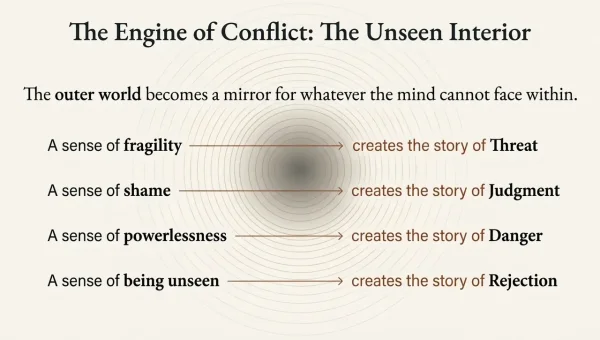
- A sense of fragility creates the story of threat.
- A sense of shame creates the story of judgment.
- A sense of powerlessness creates the story of danger.
- A sense of being unseen creates the story of rejection.
The outer world becomes a mirror of what the mind cannot face within.
What Dissolves the Enemy Story and Ends the Hero vs Villain Cycle
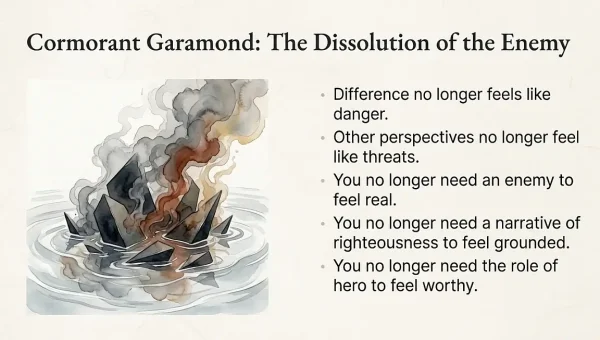
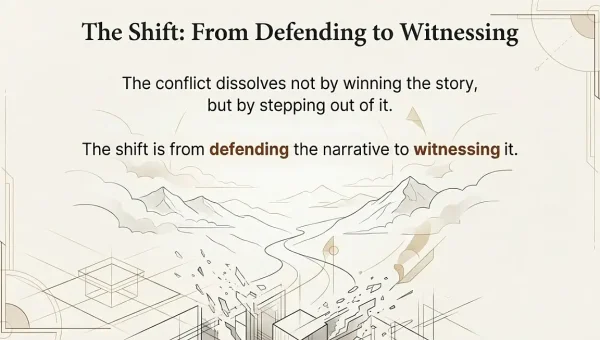
When awareness shifts from defending the story to witnessing it, everything softens. Difference no longer feels like danger.
- You can see someone's fear without absorbing it.
- You can see their meaning without reacting.
- You no longer need an enemy to feel real.
- You no longer need a hero identity to feel worthy.
The observer sees that the world has only ever been one consciousness exploring itself through countless perspectives.
What This Means for the Hero vs Villain Story in Real Life
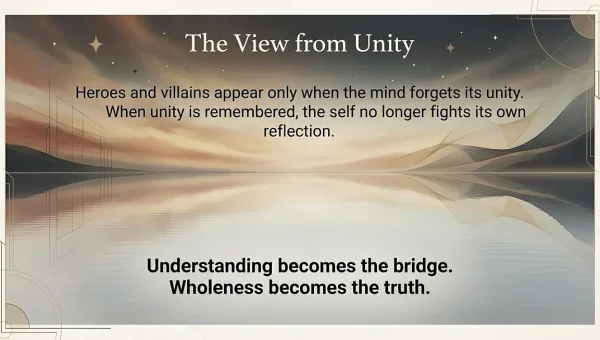
When unity is remembered, the conflict thins. The enemy dissolves. The self stops fighting its own reflection. Understanding becomes the bridge. Wholeness becomes the truth, and the story of division fades in the light of awareness.
Frequently Asked Questions
Do villains really believe they are the hero?
Yes. Most antagonists interpret their actions through a personal logic that feels righteous or necessary. Their morality is shaped by their worldview, not by an objective standard of good or evil.
Why do heroes and villains see the same situation differently?
They filter reality through different beliefs, wounds, and survival strategies. Each side interprets threat, meaning, and morality through its own lens, which makes the same event look completely different depending on the observer.
What is the psychology behind villains thinking they are right?
This pattern comes from subjective morality, identity protection, and the mind's need to feel safe. People justify their actions to avoid seeing themselves as wrong, powerless, or harmful.
How does perspective shape heroes and villains in real life?
In real relationships, politics, or culture, each side feels threatened in a different way. Conflict often forms around wounds, unmet needs, or misunderstood intentions rather than true malice.
Is the idea of an enemy just projection?
Often yes. When the mind cannot face certain emotions within itself, it projects them outward. The external enemy becomes a mirror for inner fear, shame, or insecurity.
How can someone dissolve the enemy mindset?
Shifting from defending a story to observing it allows fear and judgment to soften. When awareness becomes spacious, other perspectives no longer feel dangerous and the need for an enemy disappears.
What does unity or nondual awareness say about heroes and villains?
From a unity perspective, heroes and villains are different expressions of one consciousness exploring itself. Conflict arises from forgetfulness, not from true separation.