
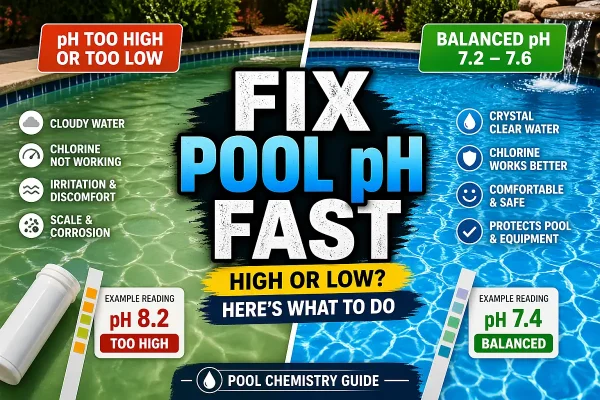
Is your pool pH too high or too low? If your pool water suddenly looks cloudy, chlorine no longer seems effective, or swimmers are complaining about burning eyes and skin irritation, unbalanced pH is often the hidden cause.
Proper pool pH balance is one of the most important parts of maintaining clean, clear, and safe swimming water. This guide explains how to test pool pH, how to lower or raise it correctly, and how to keep your water balanced throughout the swimming season.
What Is Pool pH and Why Does It Matter?
Pool pH measures how acidic or basic your pool water is on a scale from 0 to 14. A balanced pH level keeps water comfortable for swimmers, protects pool equipment from damage, and allows chlorine to sanitize effectively.
When pH levels move too far outside the ideal range, several problems can quickly appear, including cloudy water, scale buildup, corrosion, skin irritation, and poor chlorine performance.
Ideal Pool pH Range
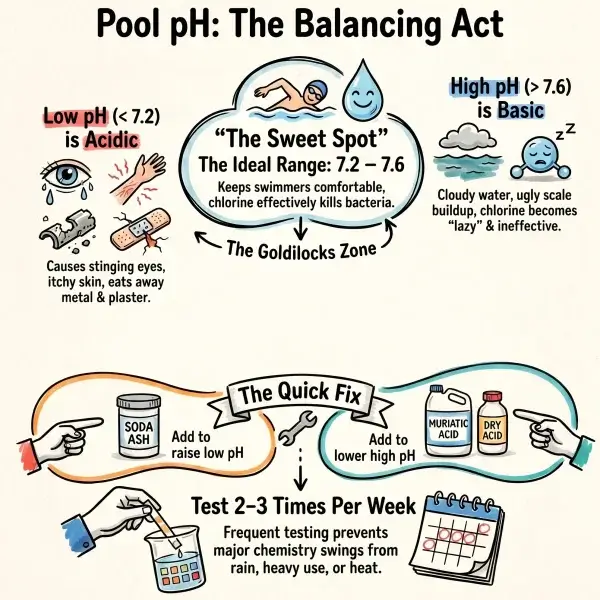
The ideal pH level for most swimming pools is between 7.2 and 7.6.
- Below 7.2: Pool water becomes too acidic
- Above 7.6: Pool water becomes too basic (alkaline)
Keeping your pH within this range helps chlorine work properly while preventing damage to pool surfaces, liners, heaters, pumps, and metal components.
Quick Answer: How to Fix Pool pH
If your pool pH is too high, lower it using muriatic acid or dry acid. If your pool pH is too low, raise it using soda ash (sodium carbonate). The ideal pH range is 7.2 to 7.6 for clean, comfortable, and properly sanitized water.
Signs Your Pool's pH Is Too High
High pH is one of the most common reasons pool water becomes cloudy even when chlorine levels appear normal.
Common symptoms of high pool pH include:
- Cloudy, dull, or hazy water
- Scale buildup on pool surfaces or equipment
- Reduced chlorine effectiveness
- Skin or eye irritation
- White residue around tile lines or fixtures
- Difficulty keeping algae away
In many cases, chlorine may still test present in the water, but high pH significantly weakens its sanitizing power.
Signs Your Pool pH Is Too Low
Low pH makes pool water overly acidic, which can damage equipment and irritate swimmers.
Common signs of low pool pH include:
- Burning eyes or itchy skin
- Corrosion of metal ladders, rails, or heaters
- Etching or damage to plaster surfaces
- Rapid chlorine loss
- Fading pool liners or surfaces
- Strong chemical odor
If left untreated, low pH can shorten the lifespan of expensive pool equipment.
How to Lower Pool pH (High pH Fix)
If your pool pH is too high, you can lower it using:
- Muriatic acid
- Dry acid (sodium bisulfate)
Steps to Lower Pool pH
- Test your pool water using test strips or a liquid test kit
- Calculate the amount of acid needed based on pool size
- Add acid gradually in small amounts
- Allow the pool water to circulate for several hours
- Retest the pH before making additional adjustments
Tip: One of the biggest mistakes pool owners make is adding too much acid at once. Small adjustments are safer and easier to control.
Important: High pH is often connected to high alkalinity. If your alkalinity remains elevated while pH appears normal, see this guide: Pool pH Is Normal but Alkalinity Is High? Let’s Fix It.
How to Raise Pool pH (Low pH Fix)
If your pool pH is too low, it can usually be corrected using:
- Soda ash (sodium carbonate)
Steps to Raise Pool pH
- Test your pool water
- Add soda ash gradually based on pool size
- Run the circulation system for several hours
- Retest and adjust if necessary
Adding chemicals slowly helps prevent sudden swings in water chemistry.
Pool pH Adjustment Chart (Quick Reference)
Not sure how much chemical to add? Use this quick reference chart as a starting point. Always add chemicals gradually, allow water to circulate fully, and retest before adding more.
| Pool Size | To Lower pH (Muriatic Acid) | To Raise pH (Soda Ash) |
|---|---|---|
| 10,000 gallons | ~6-12 oz lowers pH by ~0.2 | ~6 oz raises pH by ~0.2 |
| 15,000 gallons | ~9-18 oz lowers pH by ~0.2 | ~9 oz raises pH by ~0.2 |
| 20,000 gallons | ~12-24 oz lowers pH by ~0.2 | ~12 oz raises pH by ~0.2 |
Important: These values are approximate. Actual chemical requirements vary depending on alkalinity, water temperature, pool surface type, and existing chemistry levels.
Tip: Higher alkalinity slows pH movement, while lower alkalinity allows pH to change more rapidly.
Calculate Exact pH Adjustment
For a more accurate adjustment based on your pool size and current chemistry, use the calculator below:
Pool pH Adjustment Calculator
Note: Baking soda primarily raises total alkalinity and has only a minor effect on pH.
How pH, Alkalinity, and Chlorine Work Together
Pool chemistry works as a connected system, which means pH, alkalinity, and chlorine all affect each other.
- High pH: Weakens chlorine effectiveness
- Low pH: Increases corrosion and irritation
- High alkalinity: Makes pH difficult to lower
- Low alkalinity: Causes unstable pH swings
For example, if your pool water tests at a pH of 8.0 and appears cloudy even after shocking, chlorine may still be present but unable to sanitize efficiently. Lowering the pH back into the proper range often restores chlorine performance and improves water clarity within 24 hours.
Why Your Pool's pH Keeps Changing
Pool pH naturally fluctuates over time due to several common factors:
- Rainwater and environmental debris
- Heavy swimmer use
- Aeration from waterfalls, fountains, or return jets
- High or unstable alkalinity levels
- Frequent chemical additions
- Hot weather and evaporation
Saltwater pools may also experience gradual pH increases because salt chlorine generators naturally create aeration inside the system.
Unbalanced pH is also one of the most common reasons chlorine stops working properly. If your chlorine level does not hold after shocking the pool, see this guide: Why Pool Chlorine Is Not Registering After Shock.
Common Pool pH Mistakes
Even experienced pool owners sometimes struggle with water balance. Some of the most common mistakes include:
- Adding too much acid or soda ash at one time
- Ignoring total alkalinity levels
- Retesting water too quickly after treatment
- Using baking soda when only pH needs adjustment
- Failing to run the circulation system long enough
- Trying to adjust multiple chemical levels simultaneously
Making smaller adjustments and testing regularly usually leads to much more stable water chemistry.
Quick Pool pH Balance Summary
- Ideal pool pH range: 7.2 to 7.6
- High pH reduces chlorine effectiveness and can cloud water
- Low pH may damage equipment and irritate skin
- Use muriatic acid or dry acid to lower pH
- Use soda ash to raise pH
- Always test and adjust water chemistry gradually
Final Thoughts on Keeping Pool pH in Balance
I've found that keeping a pool's pH balanced is one of the most important steps in maintaining clean, clear, and safe water throughout the swimming season.
By testing regularly and making small adjustments when needed, you can avoid many common pool problems such as cloudy water, algae growth, equipment corrosion, and weak chlorine performance.
For the best overall water chemistry, remember to also monitor alkalinity and chlorine levels regularly so everything stays balanced and working together properly.