
Standard and Metric Wrench Sizes and Socket Sizes | SAE to Metric Conversion | Wrench and Socket Sizes in Order: I used to have all of the SAE standard wrench and socket sizes in order memorized and could tell you instantly what size was next in order from small to large and which metric socket or wrench was equivalent. That was decades ago, back in my days as a mechanic and industrial technician.
SAE Standard and Metric Wrench Sizes
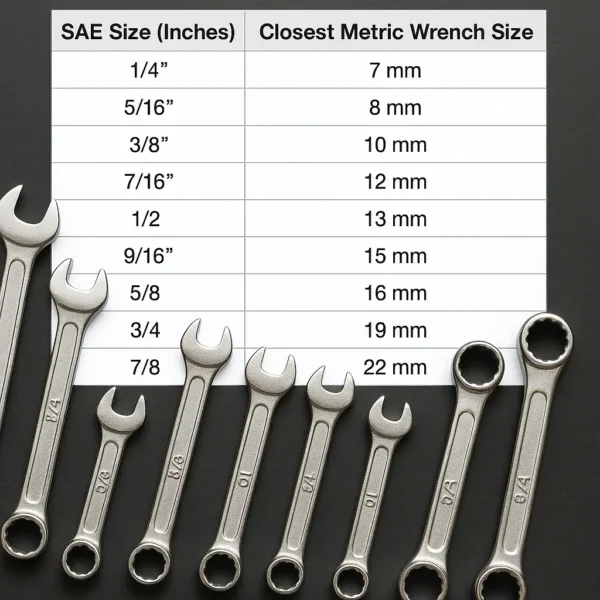
This post includes a printable standard wrench size chart, a bolt to wrench size chart, an interactive wrench size calculator, comprehensive drive size recommendations, mention of what size torque wrench to use for differing applications, and a SAE to metric conversion video.
Over the years, I've completely forgotten where some of the most common box end, open end wrench and socket sizes fit in. After a quick search yielding no real good results containing all of this information, I've decided to create a reference SAE (inches) + Metric (mm) page and size chart for myself and others to refer to. So without further ado, here are the results.
Take 7/16" and 9/16" for example; two of the most frequently used sizes in automotive work. The 7/16" wrench fits the head of common 1/4"-20 bolts, while the 9/16" wrench is standard for 3/8"-16 bolts. Back in the day, I used these so often that I could grab them blindfolded. But over time, those size-to-bolt relationships start to fade from memory, which is exactly why I decided to put together a comprehensive chart.
Wrench Sizes - SAE to Metric Conversion
SAE to Metric Conversion Chart
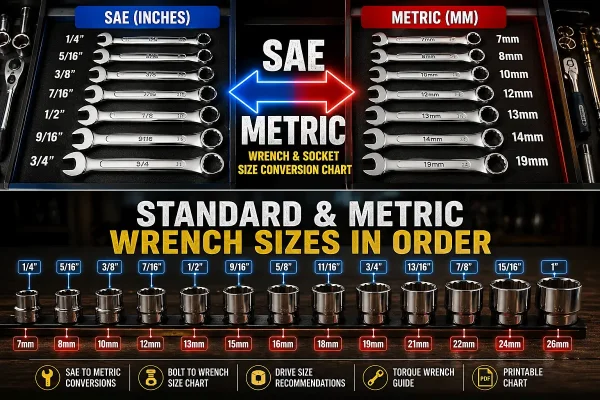
Standard Wrench Sizes Chart with SAE to Metric Conversions: The following chart lists the most common standard wrench and socket sizes, including their corresponding sizes one step smaller and larger, as well as the metric equivalents. For easy reference, you can also download the Wrench Sizes in Order - SAE Size and Metric Equivalent Conversion Chart as a PDF file.
📄 Print this wrench size chart to keep in your toolbox, garage, or glovebox.
SAE and Metric Sizes Compared in Ascending Order
The following shows standard SAE sizes in the left column, previous and next SAE size in the middle columns, and the smallest metric wrench that will fit that bolt head on the far right.
A note on how these metric equivalents are determined: a wrench must be at least as large as the bolt head it fits. Since SAE sizes rarely land on a whole millimeter, the metric equivalent listed is always the smallest whole-mm wrench that clears the bolt head - never rounded down, because a wrench that is even 0.1mm too small simply will not go on.
| SAE Size (Inches) | Previous Size | Next Size | Metric Equivalent |
|---|---|---|---|
| 1/4" | - | 5/16" | 7 mm |
| 5/16" | 1/4" | 3/8" | 8 mm |
| 3/8" | 5/16" | 7/16" | 10 mm |
| 7/16" | 3/8" | 1/2" | 12 mm (11 too snug) |
| 1/2" | 7/16" | 9/16" | 13 mm |
| 9/16" | 1/2" | 5/8" | 15 mm (14 too snug) |
| 5/8" | 9/16" | 11/16" | 16 mm |
| 11/16" | 5/8" | 3/4" | 18 mm |
| 3/4" | 11/16" | 13/16" | 20 mm |
| 13/16" | 3/4" | 7/8" | 21 mm |
| 7/8" | 13/16" | 15/16" | 23 mm |
| 15/16" | 7/8" | 1" | 24 mm |
| 1" | 15/16" | 1 1/16" | 26 mm |
| 1 1/16" | 1" | 1 1/8" | 27 mm |
| 1 1/8" | 1 1/16" | 1 1/4" | 29 mm |
| 1 1/4" | 1 1/8" | 1 5/16" | 32 mm |
| 1 5/16" | 1 1/4" | 1 3/8" | 34 mm |
| 1 3/8" | 1 5/16" | 1 7/16" | 35 mm |
| 1 7/16" | 1 3/8" | 1 1/2" | 37 mm |
| 1 1/2" | 1 7/16" | 1 9/16" | 39 mm |
| 1 9/16" | 1 1/2" | 1 5/8" | 40 mm |
| 1 5/8" | 1 9/16" | 1 11/16" | 42 mm |
| 1 11/16" | 1 5/8" | 1 3/4" | 43 mm |
| 1 3/4" | 1 11/16" | 1 13/16" | 45 mm |
| 1 13/16" | 1 3/4" | 1 7/8" | 47 mm |
| 1 7/8" | 1 13/16" | 1 15/16" | 48 mm |
| 1 15/16" | 1 7/8" | 2" | 50 mm |
| 2" | 1 15/16" | - | 51 mm |
SAE to Metric Wrench Size Conversion Calculator
Use this interactive SAE to metric wrench size conversion calculator to instantly convert standard Imperial fractional inch sizes into exact millimeters and find the closest matching tool. Simply enter or select your SAE wrench size below to get its decimal equivalent and find the safest compatible metric socket or wrench size.
Quick Size Relationships Summary
Each SAE wrench size typically increases by about 1/16". Here's a quick-reference list showing which size comes before and after, along with the smallest metric wrench that fits that bolt head:
- 1/4" → Smaller than 5/16", needs 7 mm
- 5/16" → Between 1/4" and 3/8", needs 8 mm
- 3/8" → Between 5/16" and 7/16", needs 10 mm
- 7/16" → Between 3/8" and 1/2", needs 12 mm
- 1/2" → Between 7/16" and 9/16", needs 13 mm
- 9/16" → Between 1/2" and 5/8", needs 15 mm
- 5/8" → Between 9/16" and 11/16", needs 16 mm
- 11/16" → Between 5/8" and 3/4", needs 18 mm
- 3/4" → Between 11/16" and 13/16", needs 20 mm
- 13/16" → Between 3/4" and 7/8", needs 21 mm
- 7/8" → Between 13/16" and 15/16", needs 23 mm
- 15/16" → Between 7/8" and 1", needs 24 mm
- 1" → Between 15/16" and 1-1/16", needs 26 mm
- 1-1/16" → Between 1" and 1-1/8", needs 27 mm
- 1-1/8" → Between 1-1/16" and 1-1/4", needs 29 mm
- 1-1/4" → Between 1-1/8" and 1-5/16", needs 32 mm
- 1-5/16" → Between 1-1/4" and 1-3/8", needs 34 mm
- 1-3/8" → Between 1-5/16" and 1-7/16", needs 35 mm
- 1-7/16" → Between 1-3/8" and 1-1/2", needs 37 mm
- 1-1/2" → Between 1-7/16" and 1-9/16", needs 39 mm
- 1-9/16" → Between 1-1/2" and 1-5/8", needs 40 mm
- 1-5/8" → Between 1-9/16" and 1-11/16", needs 42 mm
- 1-11/16" → Between 1-5/8" and 1-3/4", needs 43 mm
- 1-3/4" → Between 1-11/16" and 1-13/16", needs 45 mm
- 1-13/16" → Between 1-3/4" and 1-7/8", needs 47 mm
- 1-7/8" → Between 1-13/16" and 1-15/16", needs 48 mm
- 1-15/16" → Between 1-7/8" and 2", needs 50 mm
- 2" → Largest common SAE size, needs 51 mm
Tip: While many SAE and metric sizes are close, always use the exact match when possible to avoid rounding fasteners, especially under torque.
Bolt Size to Wrench Size (Common Matches)
Knowing which wrench fits which bolt can save you time and frustration. Below is a guide to common SAE and metric bolt sizes along with the correct wrench sizes to use.
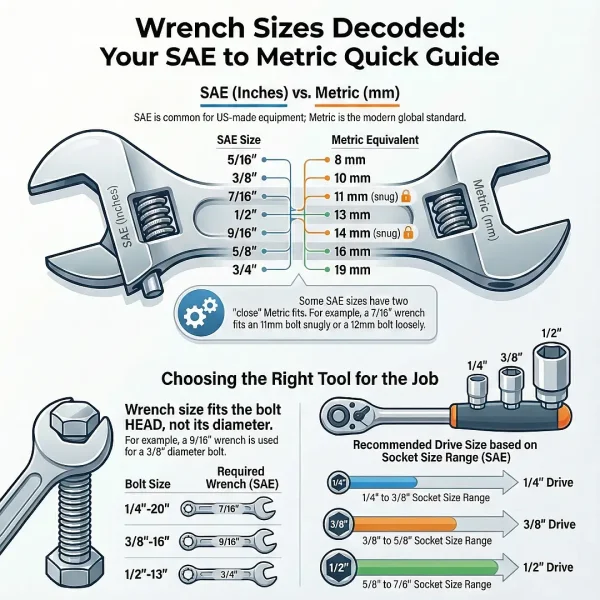
🔩 Wrench sizes refer to the bolt head size, not the bolt diameter. For example, a 9/16" wrench fits the head of a 3/8"-16 bolt. The metric column shows the smallest metric wrench that will fit the same bolt head.
| Bolt Size | Wrench Size (SAE) | Wrench Size (Metric) |
|---|---|---|
| 1/4"-20 | 7/16" | 12 mm |
| 5/16"-18 | 1/2" | 13 mm |
| 3/8"-16 | 9/16" | 15 mm |
| 7/16"-14 | 5/8" | 16 mm |
| 1/2"-13 | 3/4" | 20 mm |
| 5/8"-11 | 15/16" | 24 mm |
| 3/4"-10 | 1-1/8" | 29 mm |
| 7/8"-9 | 1-5/16" | 34 mm |
| 1"-8 | 1-1/2" | 39 mm |
As you can see, many metric and SAE sizes overlap. If you're in a pinch, a close metric equivalent can sometimes substitute for an SAE wrench - but always prefer the exact match to protect the fastener.
Understanding the 7/16" and 9/16" Metric Equivalents
These two sizes come up often in discussions about cross-system substitution, and there is a common misconception worth clearing up.
7/16" equals 11.113 mm. Because no standard metric wrench opens to exactly 11.113 mm, the smallest metric wrench that will actually fit a 7/16" bolt head is 12 mm. An 11 mm wrench - despite being commonly listed as "close" - has an opening of only 11.0 mm, which is smaller than the bolt head and will not go on. The 12 mm wrench fits with about 0.89 mm of play, which is workable in a pinch.
9/16" equals 14.288 mm. By the same logic, the smallest metric wrench that fits is 15 mm. A 14 mm wrench opens to only 14.0 mm and will not clear the bolt head. The 15 mm wrench fits with about 0.71 mm of play.
This is a good reminder that "close in millimeters" does not always mean "fits." When precision matters - especially with torque or rusted fasteners - always use the exact SAE size rather than a metric substitute.
Socket Drive Size Recommendations
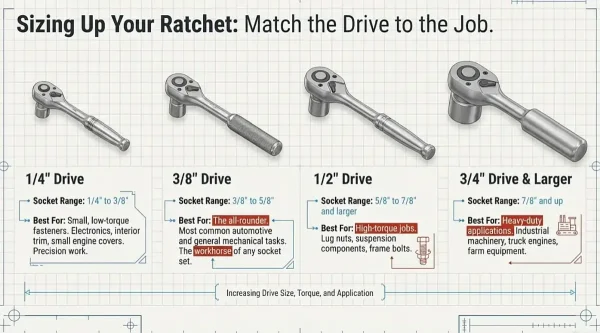
When selecting the appropriate ratchet or impact wrench, it's helpful to know which drive size matches the typical range of SAE socket or wrench sizes. Below is a general guide to help you match socket drive sizes with standard SAE ranges:
| SAE Size Range | Recommended Drive Size |
|---|---|
| 1/4" to 3/8" | 1/4" Drive |
| 3/8" to 5/8" | 3/8" Drive |
| 5/8" to 7/8" | 1/2" Drive |
| 7/8" and Larger | 3/4" Drive or Larger |
Tip: Using the correct drive size improves tool longevity and safety, especially when applying torque to larger fasteners.
Torque Wrench Drive Size Recommendations
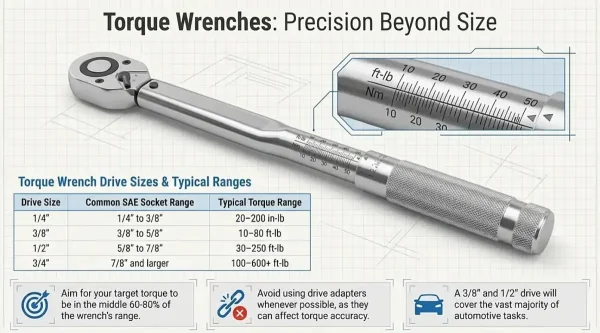
Torque wrenches follow the same basic drive size relationships as regular ratchets, but they're precision tools designed for specific torque ranges. Here's a general guide to help you choose the correct torque wrench drive size based on SAE socket sizes:
| SAE Socket Size Range | Torque Wrench Drive Size | Common Torque Range |
|---|---|---|
| 1/4" to 3/8" | 1/4" Drive | 20-200 in-lb (inch-pounds) |
| 3/8" to 5/8" | 3/8" Drive | 10-80 ft-lb |
| 5/8" to 7/8" | 1/2" Drive | 30-250 ft-lb |
| 7/8" and larger | 3/4" or 1" Drive | 100-600+ ft-lb |
Choosing the right torque wrench drive size not only ensures proper torque application but also helps prevent overtightening or damaging fasteners. Smaller drive sizes like 1/4" and 3/8" are ideal for light-duty applications such as engine covers or small suspension components, where precision at lower torque values is critical. For larger fasteners, like lug nuts, suspension bolts, or industrial hardware, 1/2" and 3/4" drive torque wrenches provide the strength and range needed to achieve accurate, high-torque output without overloading the tool. Always match the drive size to the task to maintain both tool accuracy and fastener integrity.
Tips for Choosing the Right Torque Wrench:
- Use a torque wrench where your target torque falls in the middle 60-80% of its range for best accuracy.
- Avoid using drive adapters when possible, as they may reduce torque accuracy.
- For most automotive tasks, a 3/8" or 1/2" drive torque wrench will cover everything from spark plugs to lug nuts.
Types of Wrenches and Sockets
In addition to knowing the size you need, it's important to understand the types of wrenches and sockets available. Common types include:
- Standard Wrenches: These are the traditional, open-ended wrenches you're probably used to seeing in any toolkit.
- Box Wrenches: These are closed-loop wrenches that fit securely around the nut or bolt, providing more torque and reducing the chance of stripping.
- Socket Wrenches: These are used with interchangeable sockets and allow for a greater range of motion, making them ideal for tight spaces.
- Torque Wrenches: A special tool that ensures fasteners are tightened to a specific torque value. This is particularly important for automotive work.
Socket and Wrench Sizes and Use Case
The socket and wrench sizes listed above are standard for most mechanical and automotive tasks. Here's a practical breakdown of typical use cases based on wrench size ranges:
- Small Sizes (1/4" to 3/8" / 7mm to 10mm): Best for light-duty tasks like working on electronics, bicycles, household furniture, and small appliances.
- Medium Sizes (7/16" to 3/4" / 12mm to 20mm): Frequently used in vehicle maintenance, motorcycles, general mechanical repairs, and lawn equipment.
- Large Sizes (13/16" and up / 21mm and up): Ideal for heavy-duty work such as industrial machinery, truck engines, farm equipment, and large plumbing connections. These often require more torque and may need a breaker bar or impact wrench.
In addition to size, the measurement system also affects your choice of tools:
- SAE (Society of Automotive Engineers): Used primarily in American-made products, older cars, and legacy equipment.
- Metric: Standard in European, Asian, and modern manufacturing. Increasingly common across all industries today.
Imperial to Metric Tool History & Fun Facts
Ever wondered where wrench sizes came from? Here are some interesting facts about SAE and Metric measurements:
- The SAE system was developed primarily for American-made vehicles and machinery.
- Metric tools became widely used in the U.S. after the 1980s, as foreign car manufacturers gained popularity.
- The adjustable wrench (also known as a "Crescent Wrench") was invented in 1892 by Johan Petter Johansson.
- The phrase "righty tighty, lefty loosey" is a mnemonic for remembering the standard threading direction.
- Some aircraft use a mix of SAE and metric fasteners, making proper tool selection critical for aviation mechanics.
Next time you pick up a wrench, remember that you're holding a piece of engineering history!
Frequently Asked Questions (FAQs)
Here are some commonly asked questions regarding metric vs standard SAE wrench and socket sizes:
Wrench and Ratchet FAQ
What's the difference between SAE & Metric wrench sizes?
SAE (Society of Automotive Engineers) wrench sizes are measured in inches and are mostly used in the United States, especially for older or American-made vehicles. Metric sizes, on the other hand, are measured in millimeters and are more commonly used worldwide.
Can I use a Metric wrench on an SAE bolt?
In some cases, metric and SAE sizes are close enough that one can work for the other in a pinch. For example, a 14mm wrench is very close to a 9/16" SAE bolt head and fits with only 0.29mm of play. However, for best results and to avoid stripping, always use the exact size match when possible.
How do I convert SAE sizes to Metric?
Use a conversion table like the one provided above. The key rule: multiply the SAE fraction by 25.4 to get the exact mm equivalent, then round up to the next whole mm to find the smallest metric wrench that will fit. Rounding down will give you a wrench that is too small to go on.
What are the most common wrench sizes?
Common SAE sizes: 7/16", 1/2", 9/16", 5/8", 3/4". Common Metric sizes: 10mm, 13mm, 15mm, 17mm, 19mm. These sizes are frequently used in automotive and home repair projects.
What type of wrench should I use for tight spaces?
A socket wrench with a swivel or a ratcheting box wrench works best for tight or hard-to-reach spaces. These tools provide flexibility and reduce knuckle-busting frustration.
What drive size ratchet should I use for a 1/2" socket?
A 3/8" drive ratchet is commonly used for 3/8" to 5/8" sockets, including 1/2".
What wrench size fits a 1/4"-20 bolt?
A 7/16" wrench fits the head of a 1/4"-20 bolt. The closest metric wrench that will fit is 12mm.
What are the two competing measurement systems for wrench sizes?
The two competing measurement systems for wrench sizes are SAE (Society of Automotive Engineers), which uses the Imperial system measured in inches, and the metric system, which is measured in millimeters.
Why does a toolbox often have both SAE and metric wrenches?
A toolbox often has both SAE and metric wrenches because American cars traditionally used SAE sizes, while the metric system became popular globally and in the US since the 1980s with the rise of European and Asian cars, so both systems are needed to work on different vehicles.
What are some common SAE and metric wrench sizes that can be used interchangeably?
Some of the closest cross-system pairs are: 11mm and 7/16" (11mm fits a 7/16" bolt with only 0.11mm of play), 14mm and 9/16" (14mm fits a 9/16" bolt with 0.29mm of play), and 19mm and 3/4" (19mm fits a 3/4" bolt with only 0.05mm of play - one of the tightest cross-system matches). In each case the metric wrench must be equal to or larger than the SAE bolt head to fit.
Which metric wrench sizes work on 7/16" and 9/16" bolt heads?
For a 7/16" bolt head (11.113mm), the smallest metric wrench that fits is 12mm - an 11mm wrench is 0.113mm too small and will not go on. For a 9/16" bolt head (14.288mm), the smallest metric wrench that fits is 15mm - a 14mm wrench is 0.288mm too small and will not clear the bolt head. Both are workable emergency substitutes with moderate play.
What does the size stamped on a wrench refer to?
The size stamped on a wrench refers to the distance across the flat sides of the bolt's head (the wrench opening), not the diameter of the threaded shaft.
Can you give examples of bolt shaft sizes and their corresponding wrench sizes?
Yes: a 1/4"-20 bolt needs a 7/16" wrench, a 3/8"-16 bolt needs a 9/16" wrench, and a 1/2"-13 bolt needs a 3/4" wrench. The wrench size always refers to the bolt head width, which is larger than the threaded shaft diameter.
What are the common ratchet drive sizes and their typical uses?
Common ratchet drive sizes include 1/4" for small, delicate tasks; 3/8" as the all-rounder for most common tasks; 1/2" for bigger jobs like suspension bolts; and 3/4" for heavy-duty industrial work.
What are the five most important tips for using wrenches and ratchets effectively?
The five most important tips are:
- Always use the exact size match when possible to avoid stripping bolts.
- When substituting metric for SAE, always choose the metric size that is equal to or larger than the SAE bolt head - never smaller.
- For 7/16" bolt heads, the smallest metric wrench that fits is 12mm (not 11mm).
- For 9/16" bolt heads, the smallest metric wrench that fits is 15mm (not 14mm).
- Always match your ratchet drive size to the job for power and safety.
Tips & Notes
- Wrench size corresponds to bolt head size, NOT bolt diameter. For example, a 3/8"-16 bolt uses a 9/16" wrench.
- When substituting metric for SAE (or vice versa), the replacement wrench must be at least as large as the bolt head - even 0.1mm too small means it will not fit.
- The smallest metric wrench that fits a 7/16" bolt head is 12 mm (11 mm is too small), and the smallest metric wrench that fits a 9/16" bolt head is 15 mm (14 mm is too small).
- Use the recommended socket drive size for your wrench size range to avoid damaging tools or fasteners.
- Torque wrenches are precision tools - choose a drive size appropriate to your torque range and avoid adapters when possible for accuracy.
- Metric is standard for most modern and foreign vehicles; SAE is still common in American-made or older equipment. Having both sets can save time.
SAE to Metric Wrench and Socket Sizes in Conclusion
In summary, whether you're working with Imperial Standard SAE or Metric tools, a conversion chart can be your best friend when it comes to getting the right size every time. It saves you time, eliminates confusion, and ensures your project stays on track. Let me know if you know of a size matchup I missed and I'll add it to the Wrench Size Chart.
Happy wrenching!