
The Power of Positive Thinking and Manifestation: Life does not change all at once. It changes in the small choices you make each day. The more you focus your mind on what is possible, the more your actions, habits, and confidence begin to shift. Positive thinking is not pretending everything is perfect. It is choosing to see opportunities, building resilience, and training your brain to support growth instead of fear. When you practice it with intention, your mindset becomes the engine that moves your life forward.
Embrace the power of positive thinking and watch your dreams take flight.
Mindset Shapes Reality (Self Reinforcing Loop)
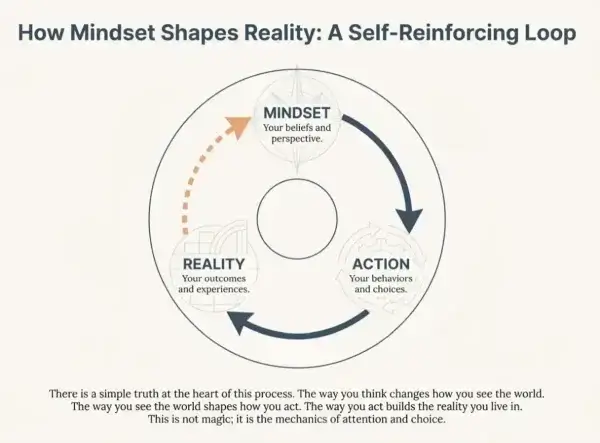
There is a simple truth at the heart of positive psychology and what many people call the Law of Attraction. The way you think changes how you see the world. The way you see the world shapes how you act. The way you act builds the reality you live in. None of this is magic. It is attention, choice, and the natural way your brain rewires itself over time.
The Power Of Positive Thought
Life expands in the direction of your focus. When you place attention on possibilities, solutions, and the good that already exists, your perception widens. You begin to notice openings that were always there, waiting for you to see them.
How Positive Thinking Works
Energy Flows Where Attention Goes
Mindset shift
A positive mindset is not about ignoring difficulty. It is choosing to see from a perspective that supports grateful mental clarity and resilience. When you expect good things, your brain becomes more alert to opportunity. It feels like wiping a foggy window clean and finally seeing what was hidden.
Real life example: Job search
Two people look for a job. One assumes the worst. The other believes something good is already waiting for them out there. The second person notices openings, reaches out with confidence, and follows leads. Their belief fuels action, and action fuels new outcomes.
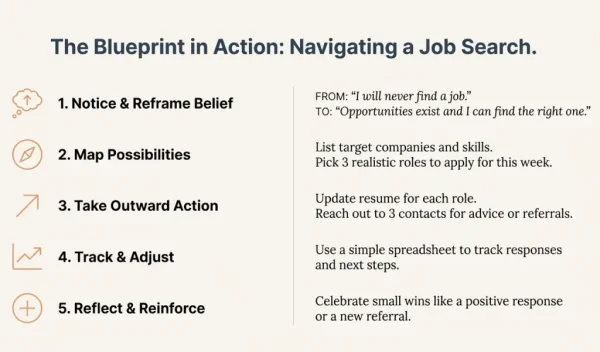
- Notice and reframe belief
- Identify limiting thoughts such as I will never find a job.
- Replace them with a supportive belief like Opportunities exist and I can find the right one.
- Map possibilities
- List target companies, roles you enjoy, and skills you already have.
- Pick three realistic roles to apply for this week.
- Take outward action
- Update your resume for each role.
- Reach out to three contacts with a clear message asking for advice or referrals.
- Follow up and adjust
- Track responses and next steps in a simple spreadsheet.
- If something does not work, adjust the approach and try again.
- Reflect and reinforce
- Celebrate small wins such as a response or referral.
- Journal what you learned and use it to guide your next attempts.
Action and behavior
Belief shapes behavior, and behavior reinforces belief. This creates a loop that builds confidence from the inside out. When you trust that growth is possible, you take the steps that make growth real.
Real life example: Improving health
Someone who believes they can improve their health begins with small steps that build momentum. Each choice strengthens the belief that change is happening.
- Start with one small habit
- Choose something simple like a ten minute walk or drinking an extra glass of water.
- Create an anchor
- Attach the habit to an existing routine. For example, walk after breakfast.
- Track progress
- Use a habit tracker or a journal.
- Review weekly to notice improvements in mood, energy, or sleep.
- Scale slowly
- When the ten minute walk feels easy, add five more minutes or include a simple strength routine.
- Reinforce belief
- Remind yourself that small wins add up.
Neuroplasticity
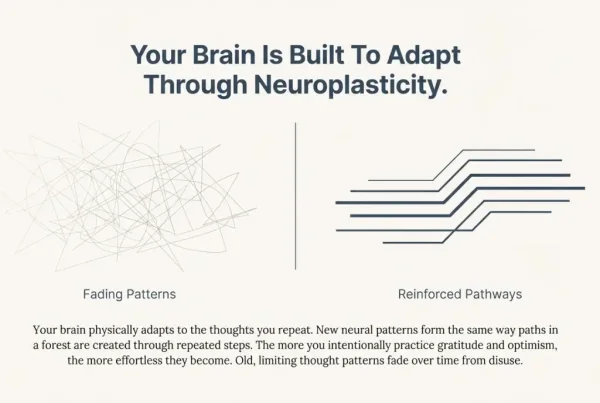
Your brain adapts to the thoughts you repeat. New patterns form the same way paths in a forest form through repeated steps. The more you practice gratitude and optimism, the more natural they become. Old patterns fade over time.
Real life example: Rewiring self talk
A person who often says I always fail can learn to say I am learning and improving. At first it feels strange. With practice it becomes normal.
- Notice your language
- Listen for phrases that limit you.
- Choose a replacement phrase
- Pick a balanced phrase like I am learning and I can improve.
- Use reminders
- Place the phrase on a sticky note or use it as phone wallpaper.
- Say it each morning for seven days.
- Use it in stressful moments
- When a limiting thought appears, pause and repeat the new phrase.
- Reinforce with evidence
- Record small wins and review them weekly.
Focus and manifestation
When you focus on what you want instead of what you lack, your attention shifts toward choices that support your intention. Manifestation becomes alignment rather than wishful hoping.
Real life example: Writing a book
Someone who wants to write a book starts with ten minutes of daily notes. Ten minutes becomes a chapter. A chapter becomes a path forward.
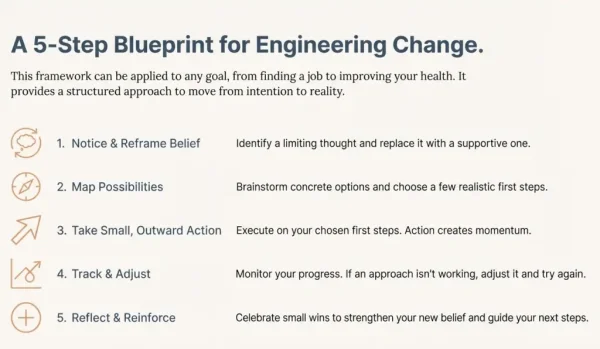
- Clarify the outcome
- Set a simple goal like complete one chapter every two weeks.
- Create a tiny daily habit
- Set a non negotiable ten minute writing window.
- Use structure
- Outline chapters so each writing session has a clear purpose.
- Gather accountability
- Share your goal with a trusted person or writing group.
- Review and expand
- Review weekly, celebrate progress, and plan the next steps.
How to practice this in daily life
5 Daily Practices to Completely Rewire your Mind.
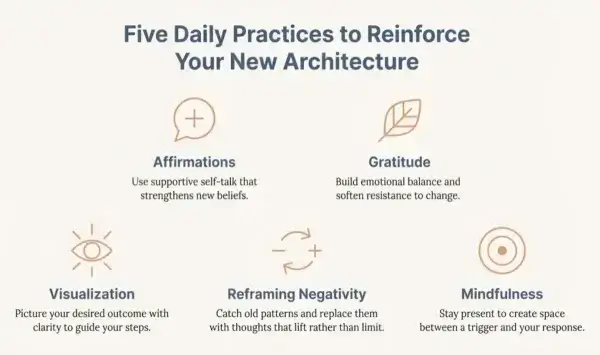
Affirmations
Use supportive self talk that strengthens new beliefs.
- Pick one simple phrase such as I am capable of learning.
- Repeat it each morning and when negative thoughts appear.
- Pair it with one deep breath to settle your mind.
Gratitude
Gratitude builds emotional balance and softens resistance.
- Write down three things you are grateful for each night.
- Be specific. Small details make the practice stronger.
- Review the list weekly to see how much support already exists.
Visualization
Picture your desired outcome with clarity. Let that feeling guide your steps.
- Spend three to five minutes imagining the scene with detail.
- Choose one simple action that moves you toward the image.
- Use the practice before big decisions.
Reframing negativity
Catch old patterns. Replace them with thoughts that lift rather than limit.
- When a limiting thought appears, pause and write it down.
- Ask what evidence supports it and what evidence does not.
- Offer a balanced alternative and act on it in a small way.
Mindfulness
Stay present with what is happening. Presence gives you space to choose instead of react.
- Practice three minutes of breath awareness each day.
- When stress rises, return to a single breath before responding.
- Let presence guide the next small step.
Closing reflection
Positive thinking is not a promise that life will always be easy. Rather, it is an invitation to shift how you move through life. An ongoing process that helps you notice opportunities, take aligned action, and build new neural pathways via neuroplasticity over time. Start with small steps and notice small wins. Let practice reshape what you believe is possible helping you manifest dreams through a mindset shift to positive thought.