
Are you considering using an electric vehicle for delivery gig work, food delivery, rideshare, pizza delivery, pharmaceutical delivery, or medical courier work? An EV can be surprisingly economical for high-mileage drivers, but the answer depends on much more than the price of electricity.
Your charging situation, annual mileage, insurance, tires, depreciation, purchase price, and the amount of time you spend charging during a work shift can all change the math.
Using an Electric Car for Delivery and Gig Work
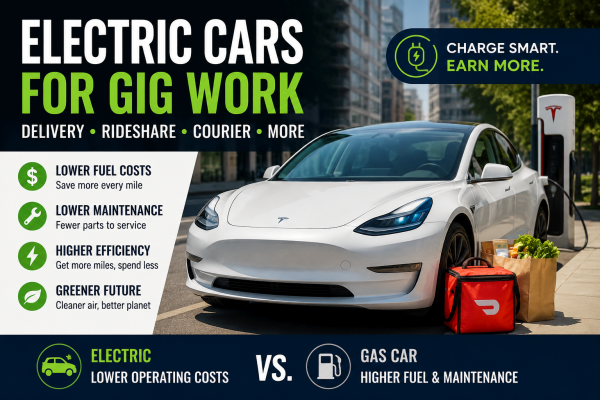
Quick Answer: Is an EV Worth It for Gig Work?
An electric vehicle can be an excellent choice for gig work if you drive a lot of miles, have reliable access to inexpensive home charging, and plan to keep the vehicle long enough to spread out the purchase and depreciation costs.
The biggest financial advantage is usually energy cost. Charging an EV at home can cost considerably less per mile than buying gasoline, while EVs also eliminate routine engine maintenance such as oil changes and spark plug replacement.
However, an EV is not automatically cheaper.
Higher insurance costs, tire wear, depreciation, purchase price, public charging rates, and charging downtime can reduce or even eliminate the savings. This is especially important for drivers who cannot charge at home.
The short version is:
- High-mileage driver with home charging: An EV can make excellent financial sense.
- Part-time driver who already owns an EV: An EV can be a very economical way to earn extra income.
- Driver dependent on public fast charging: The economics become much less attractive.
- Buying a new EV solely for occasional gig work: A reliable hybrid may be the better financial choice.
The calculator below can help you compare the annual operating costs of an electric vehicle and a gasoline vehicle using your own mileage, fuel, and electricity assumptions.
Electric vs. Gas Car: Annual Savings Calculator
This calculator uses these default assumptions unless you change them below: gas priced at $4.10 per gallon, a 30 MPG gas car, a Tesla using 250 Wh per mile, home charging at $0.18 per kWh, Supercharging at $0.38 per kWh, 70% of charging done at home, and an extra $650 per year in Tesla insurance costs. Open “Advanced options” below to adjust any of these for your own numbers.
Why Drivers Consider EVs for Gig Work
Gig work puts unusual demands on a vehicle. A driver may spend several hours a day sitting in traffic, repeatedly accelerating and stopping, running climate control while waiting for orders, and accumulating thousands of miles every month. That makes operating cost particularly important.
An EV addresses several of those costs at once.
Electricity can be considerably cheaper than gasoline when charging at home, especially when the vehicle is charged during lower cost periods. An EV also has no engine oil to replace, no intake and oil filters, no spark plugs or other engine mechanical wear items, and no conventional multi speed transmission requiring the same type of routine service as a gasoline vehicle.
Regenerative braking can also help reduce brake wear because the electric motor assists and performs some of the vehicle's deceleration.
There is another advantage that is easy to overlook: cost predictability.
Gasoline prices can change significantly over time, while a driver's residential electricity rate may be more predictable. That makes it easier to estimate energy cost per mile and track whether gig work is actually profitable.
Comfort can matter too.
A driver spending six, eight, or more hours behind the wheel may appreciate the quiet cabin, smooth acceleration, climate control without engine idling, and other features found on many modern EVs.
Some delivery platforms may also offer EV-specific incentives from time to time, although eligibility and availability vary by platform and location.
Beyond Tesla: EVs Worth Considering for Gig Work
Tesla is a well-known choice among gig drivers, but it is far from the only EV worth considering.
The best EV for gig work depends on the type of driving you do, your cargo requirements, local charging options, purchase price, insurance costs, and how many miles you expect to drive.
- Ford Mustang Mach-E: A crossover with useful cargo space, strong acceleration, and a more traditional SUV-style interior. It can be attractive to drivers who want an alternative to Tesla.
- Hyundai Ioniq 5 and Kia EV6: Both use an 800-volt electrical architecture and are known for fast DC charging, which can be particularly useful for drivers who depend on public charging.
- Chevrolet Equinox EV: A practical crossover with useful cargo space that can appeal to drivers looking for a more mainstream EV.
- Chevrolet Bolt EUV: An affordable used-market option for drivers who prioritize low purchase cost and efficiency.
- Nissan Leaf: An affordable entry point for some lower-mileage drivers, although its charging system and charging infrastructure considerations should be evaluated carefully before purchasing one for commercial use.
- Tesla Model 3: Its efficiency, charging ecosystem, and sedan configuration can make it attractive for high-mileage driving.
- Tesla Model Y: The additional cargo capacity makes it more practical for grocery, retail, and courier work.
The important point is that the underlying economics discussed throughout this article apply to EVs generally. The vehicle you choose changes the purchase price, efficiency, range, cargo capacity, charging speed, insurance, and depreciation, but the basic calculation remains the same.
The Real Cost of Driving an EV for Gig Work
The biggest mistake when comparing an electric vehicle with a gasoline vehicle for gig work is looking only at the price of electricity or gasoline. For a high mileage driver, energy is only one part of the operating cost.
To make the comparison more useful, we can look at a typical Tesla Model 3 versus a 30 MPG gasoline sedan at both 20,000 and 40,000 miles per year.
Assumptions Used
- Home electricity: $0.18/kWh
- Supercharger electricity: $0.38/kWh
- Gasoline: $4.10/gallon
- Tesla Model 3 efficiency: approximately 250 Wh/mile in mixed driving
- Gas sedan efficiency: 30 MPG combined
- Charging mix: 70% home charging and 30% Supercharging
Estimated Annual Operating Costs
| Category | Tesla Model 3 20,000 mi/yr |
Gas Sedan 30 MPG 20,000 mi/yr |
Tesla Model 3 40,000 mi/yr |
Gas Sedan 30 MPG 40,000 mi/yr |
|---|---|---|---|---|
| Annual Energy/Fuel Cost | ~$1,200 | ~$2,733 | ~$2,400 | ~$5,467 |
| Estimated Annual Maintenance | ~$360 | ~$900 | ~$720 | ~$1,800 |
| Estimated Annual Tire Cost | ~$560 | ~$400 | ~$1,120 | ~$800 |
| Estimated Annual Insurance (gig endorsement) |
~$2,550 | ~$1,900 | ~$2,550 | ~$1,900 |
| Total Estimated Annual Operating Cost | ~$4,670 | ~$5,933 | ~$6,790 | ~$9,967 |
These figures exclude depreciation and financing. Those costs can vary substantially depending on whether the vehicle is purchased new or used, how long it is kept, financing terms, and resale value.
What the Numbers Tell Us
At 20,000 miles per year, the estimated operating cost in this example is approximately $4,670 for the Tesla Model 3 compared with $5,933 for the gasoline sedan.
At 40,000 miles per year, the difference becomes larger. The estimated annual operating cost rises to approximately $6,790 for the Tesla versus $9,967 for the gasoline sedan.
The important takeaway for gig workers is that higher mileage increases the value of lower energy and maintenance costs. The more miles you drive, the more significant those recurring operating-cost differences become.
Home Charging vs. Public Fast Charging
This may be the single most important factor when deciding whether an EV makes financial sense for gig work.
A driver with a Level 2 home charger can plug in after a shift and allow the vehicle to recharge while parked overnight. The next shift can then begin with a full or nearly full battery without spending time at a charging station.
A driver without home charging (maybe lives in an apartment/dorm without plugin access) has a completely different situation.
Public charging rates vary by network, location, charger type, and time of use. DC fast charging can also introduce an additional cost that is easy to overlook: your time.
If you spend 30 minutes charging during a busy delivery shift, that is potentially 30 minutes during which you are not completing deliveries or transporting passengers.
For a full time driver, those lost earning opportunities can become a meaningful business expense.
This is why the question is not simply:
"How much does electricity cost?"
The better question is:
"How much does it cost me to keep my vehicle working for every hour I am trying to earn money?"
Electric Vehicle Insurance for Gig Work
Insurance deserves special attention because commercial use can change the coverage requirements.
A personal auto policy may not automatically cover food delivery, rideshare, pharmaceutical delivery, or other commercial driving activities.
Some platforms provide insurance coverage in certain circumstances, but that does not necessarily mean every part of your work is covered.
Before using any vehicle for gig work, contact your insurance provider and specifically explain the type of work you intend to perform.
Ask about:
- Food delivery
- Rideshare
- Grocery delivery
- Package delivery
- Medical or pharmaceutical courier work
- Personal use while also performing gig work
Do not assume that insurance for one type of gig work automatically covers another.
An inexpensive EV can become an expensive mistake if the driver discovers after an accident that the intended commercial activity was excluded.
Electric Vehicle Tire Wear
Tires are one of the other commonly higher Electric Vehicle expenses that can surprise drivers. Many EVs are heavier than comparable gasoline vehicles because of their battery packs. Electric motors can also deliver substantial torque immediately. That combination can increase tire wear, particularly when a driver frequently accelerates aggressively.
Delivery driving adds another source of wear because of constant stop and go traffic, repeated turns, parking maneuvers, and high annual mileage. For a gig driver, tires should be treated as a regular operating expense rather than an occasional surprise repair. Proper inflation, regular rotation, alignment checks, and moderate acceleration can help extend tire life.
Electric Vehicle Depreciation and High Mileage
Fuel savings are only one part of the ownership equation. High annual mileage reduces the resale value of almost any vehicle. A delivery vehicle can accumulate 30,000, 40,000, or even 50,000 miles in a single year, which can dramatically change the vehicle's value compared with a privately owned car driven only a few thousand miles annually.
Electric Vehicle resale values can also be affected by changing technology, manufacturer price reductions, battery developments, and changes in the used EV market. That means an EV that saves $3,000 per year in fuel is not automatically $3,000 cheaper to own.
The better calculation is:
Energy savings + maintenance savings - insurance - tires - depreciation - financing - charging costs - other operating expenses = actual financial benefit
This is why the purchase price matters so much.
Electric Vehicle Maintenance Savings
EVs eliminate several traditional gasoline vehicle maintenance items. There is no engine oil/filters, no spark plug replacement, and no conventional engine transmission service. However, an Electric Vehicle is not mechanically maintenance free.
Drivers still need to account for:
- Tire replacement
- Tire rotations
- Wheel alignment
- Cabin air filters
- Windshield washer fluid
- Brake inspections
- Suspension components
- Wiper blades
- 12-volt battery service where applicable
Regenerative braking can significantly reduce friction brake use, but the friction brakes still need to be inspected. Infrequent brake use can also allow corrosion to develop in some conditions. The maintenance advantage of an EV is still real, but it's more of a reduced routine maintenance, not zero maintenance.
Electric Vehicle Battery and Warranty Coverage
Battery warranty coverage is another important consideration for gig drivers.
EV manufacturers generally provide separate warranty coverage for the battery and electric drive components, but coverage varies by manufacturer, model, model year, battery configuration, mileage, and specific warranty terms. A high mileage gig driver should therefore check the actual warranty documentation for the vehicle being considered.
The basic vehicle warranty can expire surprisingly quickly when a vehicle is driven 35,000 to 50,000 miles per year. That makes the battery and electric drive unit warranty particularly important.
Keep in mind that warranty coverage does not normally mean the manufacturer will pay for ordinary wear and tear. Tires, suspension components, wiper blades, and other normal wear items remain the owner's responsibility.
Driver Comfort During Long Gig Work Shifts
The economics matter, but so does the experience of spending hundreds of hours in the vehicle.
An EV can offer several practical advantages for long shifts:
- Quiet operation
- Smooth acceleration
- Climate control without idling a gasoline engine
- Heated seats and steering wheels on equipped models
- Regenerative braking in stop-and-go traffic
- Convenient cabin preconditioning while charging
- Additional storage on models equipped with a front trunk
These features do not necessarily make an EV more profitable, but they can make long shifts more comfortable.
For rideshare drivers, the quiet cabin can also improve the passenger experience.
Using an EV for Pharmaceutical and Medical Courier Work
Medical and pharmaceutical courier work deserves its own consideration because the requirements can be different from food delivery or rideshare.
A courier may transport medications, laboratory specimens, medical supplies, or other sensitive materials. Temperature control can therefore become an important consideration. An EV can run its climate control system while parked without leaving a gasoline engine idling. That can be useful when waiting outside a pharmacy, laboratory, clinic, or medical facility.
Cargo security is another consideration. Vehicles equipped with a front trunk or additional enclosed storage can provide useful separation for packages and equipment. However, vehicle selection should never be based solely on the fact that it is electric.
Medical and pharmaceutical courier contracts may have specific requirements involving:
- Temperature control
- Temperature monitoring
- Security
- Chain of custody
- Package handling
- Insurance
- Background checks
- Vehicle requirements
Always verify the requirements of the company or contract before accepting this type of work.
Cold Weather and Electric Vehicle Range
Cold weather can reduce EV efficiency and usable driving range. The exact effect varies with temperature, vehicle design, battery condition, driving speed, heating use, and other factors.
For delivery drivers, the important issue is not a specific percentage but the practical effect on the workday. A driver who normally completes an entire shift on one charge may need additional charging during colder weather. That makes planning more important during winter. Home charging is particularly valuable because starting the shift with a fully charged battery reduces the chance of needing a lengthy charging stop while working.
Driver Assistance Features
Modern EVs may include driver-assistance systems such as Tesla Autopilot, Ford BlueCruise, GM Super Cruise, or Hyundai Highway Driving Assist. These systems can be useful during longer highway stretches between delivery zones, but they have limited usefulness during much of the actual delivery process.
Gig driving frequently involves:
- Apartment complexes
- Parking lots
- Narrow residential streets
- Frequent stops
- Backing into driveways
- Searching for building entrances
- Constant navigation changes
Driver assistance systems do not replace an attentive driver. They should be treated as convenience and fatigue-reduction features rather than a reason to purchase a particular EV for delivery work.
EV Charging Downtime Is an Operating Cost
This is one of the most overlooked costs of using an EV for gig work.
A gasoline vehicle can generally refuel in a few minutes and return to work. An EV may require significantly more time when using public charging. For a personal vehicle, 30 minutes at a charging station may not matter. For a gig driver, it can directly reduce earning time.
Imagine a driver who normally earns $20 per hour and spends 30 minutes charging during a busy shift. The charging session may have an electricity cost, but the lost earning opportunity could be just as important. That is why drivers should calculate cost per working mile and earnings per available hour, not just electricity cost. Home charging largely eliminates this problem because charging can happen while the vehicle is parked outside working hours.
EV Cargo Capacity for Delivery Work
The ideal EV also depends on what you are delivering. Food delivery generally requires relatively little cargo space. Grocery delivery, Amazon Flex, retail delivery, and courier work can require considerably more.
A sedan may be perfectly adequate for restaurant delivery but frustrating when transporting several grocery orders. SUV style EVs and hatchbacks can provide more flexible cargo space. Models such as the Tesla Model Y, Ford Mustang Mach-E, and Hyundai Ioniq 5 can be useful for drivers who want to combine food delivery with grocery, retail, or courier work.
Before buying, consider the actual cargo dimensions rather than simply looking at the vehicle's advertised cargo volume. A low cargo floor, wide hatch opening, folding rear seats, and useful storage compartments can matter more than a single published cubic-foot number.
Over the Air Software Updates
Many modern Electric Vehicles receive over the air (OTA) software updates. These updates can add features, modify vehicle behavior, improve efficiency, update navigation, or change driver-assistance functionality without requiring a traditional service center visit.
For delivery drivers, there is a practical benefit and a practical drawback.
The benefit is that some improvements can arrive without taking the vehicle to a dealer. The drawback is that software updates can temporarily take the vehicle out of service. For someone using an EV as an income producing vehicle, it makes sense to schedule updates during non-working periods whenever possible.
Best EVs for Gig Work
There is no single "best" EV for every type of gig work.
Instead, consider which vehicle best matches your mileage, charging access, cargo requirements, budget, and insurance costs.
| Model | Why It May Work for Gig Driving |
|---|---|
| Tesla Model 3 | Efficient sedan with a relatively practical size for food delivery and rideshare. |
| Tesla Model Y | More cargo capacity for grocery, retail, and courier work. |
| Ford Mustang Mach-E | Comfortable crossover with useful cargo space and highway driver assistance. |
| Hyundai Ioniq 5 / Kia EV6 | Fast charging can be valuable for drivers who depend on public charging. |
| Chevrolet Equinox EV | Practical crossover configuration for drivers seeking a mainstream EV. |
| Chevrolet Bolt EUV | Potentially attractive used-market option for budget-conscious drivers. |
Do not choose a vehicle based solely on the estimated fuel savings.
Get an insurance quote, check charging availability, calculate energy cost per mile, and estimate depreciation before making the purchase decision.
EV Gig Work Advantages and Disadvantages
| Advantages | Disadvantages |
|---|---|
| Lower energy costs with home charging | Potentially higher insurance costs |
| Reduced routine powertrain maintenance | Potentially faster tire wear |
| Reduced friction-brake wear through regenerative braking | High annual mileage increases depreciation |
| Battery and drive-system warranty coverage | Cold weather can reduce range |
| Quiet and comfortable for long shifts | Public charging can add downtime |
| Climate control without engine idling | Higher purchase price on some models |
| Useful cargo configurations on many EV crossovers | Charging access may limit where you can work efficiently |
When an EV Makes Financial Sense for Gig Work
An EV becomes more attractive when several of these conditions are true:
- You already own the EV.
- You can charge at home consistently.
- You drive a high number of miles each year.
- Your local electricity rates are relatively low.
- You plan to keep the vehicle for several years.
- Your insurance company offers appropriate coverage at a reasonable price.
- You can avoid frequent public fast charging.
- The vehicle's cargo capacity matches the work you intend to perform.
The more of these conditions that apply to you, the stronger the case for an EV becomes.
When an EV May Not Make Sense
An EV may be a poor financial choice when:
- You are buying a new vehicle solely for occasional gig work.
- You cannot charge at home.
- You rely on expensive public fast charging every day.
- Your commercial insurance costs are significantly higher.
- You drive only a few hours each week.
- You expect to replace the vehicle frequently.
- You need to maximize cargo capacity at the lowest possible purchase price.
This is where many "EVs are cheaper" calculations fall apart.
Saving money on electricity does not automatically compensate for a large vehicle payment, insurance premium, depreciation, or charging downtime.
When a Hybrid May Be the Better Choice
For some gig drivers, a hybrid is the better financial tool.
A hybrid can provide excellent fuel economy without requiring access to charging infrastructure. Refueling takes only a few minutes, public charging downtime is eliminated, and used hybrid vehicles can sometimes be purchased for considerably less than a comparable EV.
A hybrid may be especially attractive for:
- Part-time delivery drivers
- Drivers without home charging
- Drivers with unpredictable schedules
- Drivers who frequently travel outside charging infrastructure
- Drivers who want a lower upfront purchase price
The most economical vehicle is not necessarily the vehicle with the lowest energy cost.
It is the vehicle that produces the best combination of operating cost, purchase cost, reliability, downtime, insurance, and earning potential for your particular situation.
Real-World Gig Driver Scenarios
The following examples illustrate how dramatically the answer can change depending on the driver.
The Full-Time Delivery or Rideshare Driver
A driver traveling 40,000 to 50,000 miles per year with a Level 2 charger at home is close to the ideal EV candidate.
Fuel savings can become substantial at this mileage, and reduced routine maintenance can provide additional savings.
The driver still needs to budget for tires, insurance, depreciation, and other wear, but the high mileage gives the lower energy cost more opportunity to offset those expenses.
The Pharmaceutical or Medical Courier
A courier may benefit from an EV's low operating cost, quiet operation, and ability to maintain climate control without running a gasoline engine. However, the contract's requirements matter more than the vehicle's fuel type. Temperature monitoring, security, chain of custody, cargo requirements, and commercial insurance should all be verified before accepting routes.
The Weekend Side Hustle Driver
Someone driving only 6,000 to 8,000 miles a year may not save enough on fuel to justify purchasing a new Electric car solely for gig work. If the driver already owns an EV, however, the situation changes significantly because the vehicle's purchase cost and depreciation are no longer directly attributable to the gig work decision. For a driver shopping specifically for a vehicle, a used hybrid may be worth serious consideration.
The Apartment Dwelling Driver Without Home Charging
This is one of the most difficult situations for EV gig work economics. Without a home charger, the driver may need to rely on public charging networks. That increases both direct charging costs and unpaid charging time. A nearby workplace charger, apartment charger, or inexpensive Level 2 station can change the calculation, but frequent dependence on public DC fast charging makes an EV less compelling for many full time drivers.
Long Term EV Ownership for Gig Work
Delivery Gig work can put significantly more miles on a vehicle than ordinary commuting. Frequent acceleration, braking, short trips, parking maneuvers, rough roads, and long periods of climate controlled waiting can all contribute to wear.
Over several years, drivers should budget for:
- Battery capacity changes over time
- Tire replacement
- Suspension wear
- Wheel alignment
- Cabin air filters
- Brake inspections
- 12-volt battery service where applicable
- Interior wear
- Reduced resale value from high mileage
None of these automatically make an EV a bad gig vehicle. They simply illustrate why the initial fuel savings calculation should not be treated as the entire cost of ownership.
Tax Deductions for Gig Drivers
Gig drivers may be able to deduct qualifying vehicle expenses using the standard mileage method or an applicable actual expense method, depending on their circumstances and current tax rules. The details can become complicated when a vehicle is used for both personal and business driving.
Keep accurate records of:
- Business mileage
- Personal mileage
- Charging expenses
- Vehicle-related expenses
- Dates and purposes of business trips
Tax rules can change, and the correct method depends on your individual situation. Consult a qualified tax professional before making tax decisions based on this article.
Frequently Asked Questions
Is an electric car worth it for DoorDash or Uber Eats?
It can be, especially for high-mileage drivers who can charge at home. Lower energy and routine maintenance costs can provide meaningful savings. Occasional drivers or those who rely heavily on public charging may not save enough to offset insurance, depreciation, purchase price, and charging costs.
Can I use an electric car for Uber or Lyft?
Yes. EVs can be used for rideshare where the vehicle meets the platform's current requirements. Lower energy costs can be particularly valuable for drivers who spend many hours and miles on the road. Always verify the current vehicle and insurance requirements for your market.
Is the Ford Mustang Mach-E a good choice for delivery work?
The Mustang Mach-E can be a practical delivery vehicle because it combines crossover cargo space, comfortable seating, and strong highway capability. Whether it is financially worthwhile depends on its purchase price, insurance, charging costs, depreciation, and the type of gig work you perform.
Are EVs good for pharmaceutical or medical courier delivery?
They can be, but the vehicle must meet the requirements of the specific courier contract. EVs offer low operating costs and can run climate control without idling a gasoline engine. However, pharmaceutical and medical deliveries may have specific temperature, security, handling, and chain-of-custody requirements.
Does an EV require special insurance for delivery or rideshare driving?
It depends on the type of work and your insurance provider. Personal auto insurance may exclude commercial delivery or rideshare activity unless appropriate coverage is added. Do not assume that platform-provided insurance covers every situation.
How much does it cost to charge an EV for gig work?
The cost depends on the vehicle's efficiency, your electricity rate, charging losses, and whether you use home or public charging. Home charging can cost only a few cents per mile for an efficient EV in some locations, while frequent public fast charging can cost considerably more.
Do EVs need more maintenance than gas cars for delivery driving?
No. EVs generally require less routine powertrain maintenance because they do not have engine oil, spark plugs, or conventional engine transmission service. However, EV drivers still need to budget for tires, suspension components, cabin filters, brakes, wipers, and other normal vehicle maintenance.
How much range do I lose in winter?
Cold weather can reduce EV efficiency and usable range, but the exact impact varies by vehicle, temperature, speed, battery condition, and climate-control use. Drivers working long shifts should plan for reduced winter range and potentially more frequent charging.
Should I use Autopilot, BlueCruise, or Super Cruise for deliveries?
Driver-assistance systems can be useful during longer highway stretches between delivery areas, but they provide limited benefit during frequent stops, neighborhood driving, parking, and pickup or delivery locations. These systems do not replace an attentive driver.
Which EV has the best cargo space for grocery or courier delivery?
Electric crossovers and hatchbacks generally provide more practical cargo flexibility than sedans. Models such as the Tesla Model Y, Ford Mustang Mach-E, and Hyundai Ioniq 5 can be useful for grocery, courier, and larger delivery orders. The right choice depends on your specific cargo requirements and budget.
Do tires wear out faster on an EV?
They can. EVs may be heavier than comparable gasoline vehicles, and their instant torque can increase tire wear when accelerating aggressively. High-mileage delivery drivers should treat tires as a significant operating expense and keep up with inflation, rotation, and alignment.
Does an EV's warranty cover normal wear and tear?
Generally, no. Manufacturer warranties cover specified defects and components for defined periods or mileage, but normal wear items such as tires, wiper blades, and many suspension components are generally excluded. Battery and electric drive-system coverage varies by manufacturer and model.
Is buying a brand-new EV just for gig work a good idea?
It requires careful calculation. A new EV may make sense for someone who drives very high mileage, has inexpensive home charging, and plans to keep the vehicle for many years. For occasional gig work, depreciation, insurance, financing, and purchase price can overwhelm the savings on electricity and maintenance. A vehicle you already own or an efficient used hybrid may be more economical.
Can I write off EV charging costs as a gig driver?
Potentially, depending on the applicable tax rules and the expense method you use. Vehicle deductions can be complicated when a vehicle is used for both personal and business driving. Keep accurate records and consult a qualified tax professional about your situation.
Does an EV hold up well under high-mileage delivery driving?
An EV can be well suited to high-mileage driving because its electric drivetrain has fewer moving parts than a conventional engine and transmission. However, high mileage still accelerates wear on tires, suspension, interior components, and other systems. Battery condition, warranty coverage, driving habits, charging practices, and maintenance history all matter.
My Take: The EV Question Is Really About Your Numbers
There is a temptation to ask whether an electric vehicle is "better" than a gasoline vehicle for gig work.
I think that is the wrong question.
The better question is:
Does an EV make financial sense for the way I actually drive?
An EV can be an outstanding gig work vehicle when you have inexpensive home charging, drive a lot of miles, and keep the vehicle long enough to benefit from its lower energy and routine maintenance costs.
But an EV can also be a poor financial choice when you have to purchase an expensive vehicle for occasional work, depend on public fast charging, pay substantially more for commercial insurance, or accumulate depreciation faster than your fuel savings can compensate for.
That is why the calculator above is more useful than a generic claim that "EVs are cheaper."
Run the numbers using your own mileage.
Use your actual electricity rate.
Check your actual insurance quote.
Estimate your tire and maintenance costs.
Then consider how much time you would spend charging during a typical workweek.
Final Thoughts: Is an EV Right for Your Gig Work?
An electric vehicle is not a universal answer for delivery drivers, rideshare drivers, or couriers.
But under the right circumstances, it can be an extremely economical way to put a lot of miles on the road.
The strongest EV candidate is usually the driver who:
- Already owns an EV or can purchase one at a reasonable price
- Has dependable home charging
- Drives substantial annual mileage
- Has reasonable electricity rates
- Can obtain appropriate commercial insurance at an acceptable cost
- Plans to keep the vehicle for several years
The strongest candidate for a hybrid or efficient gasoline vehicle is often the driver who:
- Drives only occasionally
- Does not have home charging
- Depends heavily on public fast charging
- Needs to minimize upfront purchase cost
- Wants to avoid charging downtime
Before you consider buying any EV for delivery, get three numbers:
Your actual insurance cost, your actual charging or fuel cost per mile, and the number of miles you realistically expect to drive.
Those three numbers will tell you far more about whether an EV makes sense for your gig work than a generic list of advantages and disadvantages.
And perhaps that is the most important lesson here.
The cheapest vehicle to operate is not necessarily the cheapest vehicle to own. For delivery gig work, the winner is the vehicle that lets you keep the most money after energy, maintenance, tires, insurance, depreciation, financing, and lost working time are all accounted for.
I hope this helps you determine if an electric car for delivery is right for your gig.