
How to Fix IRQL_NOT_LESS_OR_EQUAL (0x0000000A) Windows BSOD Error?
A Stop 0x0000000A error, also known as IRQL_NOT_LESS_OR_EQUAL, is a Windows blue screen error that can occur during normal use, Windows installation or upgrade, startup, or after installing new hardware, drivers, firmware, or system software. The error can be frustrating because Windows may suddenly stop and restart without giving you much information about what went wrong. However, the 0x0000000A stop code provides an important clue: Windows or a kernel mode driver attempted to access memory incorrectly while operating at an interrupt request level (IRQL) where that memory access was not permitted.
In many cases, the problem is caused by a faulty, incompatible, or outdated device driver. It can also be triggered by system software, BIOS or firmware problems, recently installed hardware, or, in some cases, defective memory or other hardware.
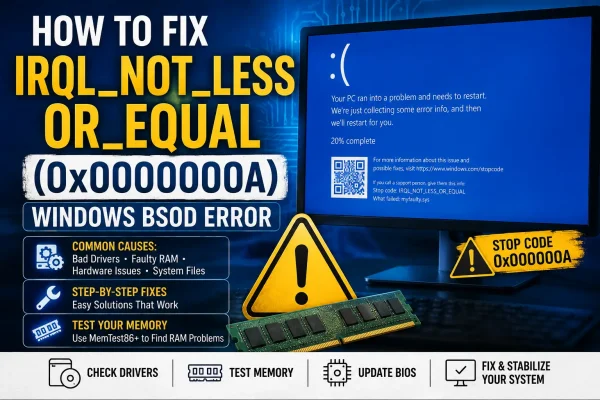
What Does Stop Code 0x0000000A Mean?
The 0x0000000A bug check corresponds to the Windows error IRQL_NOT_LESS_OR_EQUAL.
In simple terms, Windows detected that kernel-level code tried to access an invalid or inappropriate memory address while operating at an interrupt request level that did not allow that type of memory access. That sounds complicated, but you do not necessarily need to understand IRQL or kernel memory management to troubleshoot the problem.
For most Windows users, the important question is:
What changed shortly before the blue screen started occurring?
If the problem began immediately after installing a driver, Windows update, hardware component, BIOS update, antivirus program, backup utility, or other system software, that recent change is a good place to start.
Common Causes of the 0x0000000A Error
There is no single cause of an IRQL_NOT_LESS_OR_EQUAL blue screen. Common possibilities include:
- Faulty or incompatible device drivers
- Recently installed hardware
- Defective or unstable RAM
- BIOS or firmware problems
- Incompatible system services
- Antivirus or security software conflicts
- Backup or other low-level system utilities
- Windows updates or upgrades
- Overclocking or unstable memory settings
- Corrupted Windows system files
Microsoft specifically notes that this bug check commonly occurs after installation of a faulty device driver, system service, or BIOS. It can also occur during a Windows upgrade when incompatible drivers or system software are involved.
Before Trying to Fix 0x0000000A
Think about what changed immediately before the problem appeared.
Ask yourself:
- Did I install a new driver?
- Did I install a new graphics card, RAM, storage device, USB device, or other hardware?
- Did I update the BIOS or firmware?
- Did Windows recently install an update?
- Did I install antivirus, backup, virtualization, or other system software?
- Does the blue screen mention a specific .sys driver?
- Does Windows crash during startup, or only after the computer has been running for a while?
If you can identify a recent change, troubleshoot that component first. It is often much faster than randomly changing multiple system settings.
How to Fix IRQL_NOT_LESS_OR_EQUAL (0x0000000A)
1. Roll Back or Remove a Recently Installed Driver
Drivers are one of the most common things to investigate when you encounter a 0x0000000A blue screen. If the problem started after installing or updating a driver, try rolling it back.
In Windows:
- Right-click the Start button and open Device Manager.
- Locate the device associated with the suspected driver.
- Right-click the device and select Properties.
- Open the Driver tab.
- If available, select Roll Back Driver.
If rolling back the driver is not available, you can uninstall the device or driver and then install a current driver directly from the hardware manufacturer's website.
Avoid relying exclusively on generic third-party driver updater programs. For important hardware such as graphics cards, chipsets, network adapters, storage controllers, and motherboard devices, obtaining the driver directly from the manufacturer is generally the better approach.
2. Disconnect Recently Installed Hardware
If the blue screen started after adding new hardware, temporarily remove or disconnect it.
This is especially useful when troubleshooting:
- New RAM
- Graphics cards
- PCIe expansion cards
- USB devices
- Storage devices
- Network adapters
- Docking stations
- Other recently installed peripherals
If the 0x0000000A error disappears after removing the hardware, you have a strong clue about where to look next. New hardware can be defective, but it can also expose an existing driver or compatibility problem.
3. Check for BIOS and Firmware Updates
A BIOS or firmware problem can also contribute to system instability. If the blue screen began after changing BIOS settings, updating firmware, enabling memory overclocking, or installing new hardware, check your computer or motherboard manufacturer's support page for an appropriate BIOS update. If you recently changed BIOS settings, consider returning those settings to their previous values.
This is particularly important for memory settings such as XMP or other memory overclocking profiles. If the system becomes unstable after enabling an aggressive memory profile, temporarily return the memory to its default settings and see whether the blue screens stop.
4. Test Your System Memory
Bad RAM can cause a surprisingly wide range of Windows problems, including crashes and blue screens. I've personally seen brand new memory that turned out to be defective, so don't assume newly installed RAM is automatically good.
One useful way to test system memory is with MemTest86+, a standalone memory-testing utility that runs outside Windows. You can create a bootable USB drive, restart the computer, and boot from the USB to test the installed RAM.
For the most useful results:
- Allow the memory test to complete multiple passes.
- Do not treat a single successful pass as proof that the RAM is perfect.
- If errors appear, test the memory modules individually when possible.
- Also check whether the modules are installed according to the motherboard manufacturer's recommended configuration.
Important: Memory errors do not always mean the RAM stick itself is defective. Problems with the motherboard, memory slot, memory controller, voltage, timing, or unstable BIOS settings can also produce memory-test errors.
5. Run Windows Memory Diagnostic
Windows includes its own basic memory-testing utility, which can be useful if you do not have a separate bootable memory testing tool available.
Press: Windows Key + R
Then type:
mdsched.exePress Enter and choose Restart now and check for problems.
Windows will restart and perform a memory test before loading the operating system.
For intermittent problems, I would still consider using a dedicated bootable memory tester for a more thorough test.
6. Check Windows System Files
Corrupted Windows system files can contribute to system instability. Windows includes System File Checker for checking and repairing protected system files.
Open Command Prompt as Administrator or an elevated Windows Terminal and run:
sfc /scannowAllow the scan to complete.
If Windows reports that it found problems that could not be repaired, you can use DISM to repair the Windows component store:
DISM /Online /Cleanup-Image /RestoreHealthAfter DISM completes, run:
sfc /scannowagain.
Restart Windows afterward and see whether the blue screen returns.
7. Install Pending Windows Updates
If the system is stable enough to remain running, check Windows Update for pending updates.
Updates can contain fixes for operating-system bugs, hardware compatibility problems, and driver-related issues.
However, if the problem began immediately after a particular Windows update, the update itself may be worth investigating rather than simply installing more updates.
If the system became unstable immediately after an update, Windows recovery options may allow you to uninstall the most recent update.
8. Check the Blue Screen for a Driver Name
Sometimes the blue screen provides more information than just the 0x0000000A code.
Look for a driver filename ending in:
.sysFor example, a blue screen might identify a particular driver associated with graphics, networking, storage, audio, or another device.
A named driver does not always mean that driver itself is defective. Another component can sometimes cause a driver to crash. Nevertheless, a consistently named driver is an important clue and should be investigated.
Search for the driver name together with IRQL_NOT_LESS_OR_EQUAL and your Windows version, then check the hardware manufacturer's support information.
9. Use Safe Mode to Isolate the Problem
If Windows crashes repeatedly during normal startup, try starting Windows in Safe Mode.
Safe Mode loads Windows with a limited set of drivers and services. If the computer is stable in Safe Mode but repeatedly crashes during normal operation, that can point toward a driver, service, startup program, or other software component that is loaded during a normal boot.
This can be particularly useful when you need to remove a recently installed driver or application that is preventing Windows from starting normally.
10. Remove Recently Installed System Software
Low-level applications can interact closely with Windows and hardware.
If the problem started after installing software such as:
- Antivirus or security software
- Backup software
- Virtualization software
- Hardware monitoring utilities
- Disk management utilities
- Overclocking software
- Third-party system optimization tools
temporarily uninstall or disable the software and determine whether the blue screens continue.
Microsoft specifically identifies system services, antivirus software, and backup tools as possible sources of 0x0000000A problems, particularly during Windows upgrades.
Fixing 0x0000000A During a Windows Upgrade
If the IRQL_NOT_LESS_OR_EQUAL error appears while upgrading Windows, incompatible drivers or system software deserve particular attention. Older drivers may not work correctly with the newer version of Windows. Security software, backup utilities, and other system level applications can also interfere with the upgrade process.
Before attempting the upgrade again:
- Install current drivers for important hardware.
- Remove unnecessary third-party hardware or peripherals.
- Temporarily uninstall incompatible security or system-level software if necessary.
- Disconnect nonessential USB devices.
- Make sure the computer manufacturer provides support for the target Windows version.
- Back up important files before attempting another upgrade.
If the upgrade fails with the same stop code, look closely at the setup logs and any driver or hardware mentioned in the error information.
What If the Computer Keeps Crashing?
If Windows continues producing 0x0000000A blue screens after you've addressed obvious driver and software problems, start looking more seriously at hardware.
The most useful things to investigate include:
- RAM: Run a thorough memory test.
- Motherboard: Check BIOS settings, firmware, and memory compatibility.
- CPU: Return any overclocking or undervolting settings to default.
- Storage: Check the health of the system drive and controller drivers.
- Graphics hardware: Reinstall or roll back the graphics driver and check for hardware instability.
- Power: Consider whether a failing or inadequate power supply could be contributing to instability.
If you recently installed hardware, remove it temporarily and test the computer again. This simple process of elimination can sometimes identify a hardware problem much faster than software troubleshooting.
Should You Replace the RAM?
Not necessarily.
A memory test failure means something in the memory subsystem is unstable, but it does not automatically prove that the RAM module itself is defective.
If you have multiple memory modules, test them individually when possible. You can also move a module to another compatible memory slot to help determine whether the problem follows the module or remains associated with a particular slot.
It's also a good idea to check the motherboard manufacturer's recommended memory configuration and make sure any memory overclocking profile is disabled while troubleshooting.
If one module consistently produces errors while another does not, then it's likely that that module is defective.
Can Driver Verifier Help?
Advanced Windows users can use Driver Verifier to stress and monitor drivers for problems.
Windows includes Driver Verifier, and it can be started by entering:
verifierin an elevated Command Prompt or Windows Terminal.
Warning: Driver Verifier is an advanced troubleshooting tool and can intentionally cause a faulty driver to crash Windows so that the problem can be identified. Do not enable it indiscriminately or verify every driver at once.
If you use Driver Verifier, target suspected third party drivers rather than blindly selecting everything. If enabling Driver Verifier causes Windows to become unstable or unable to boot normally, use Windows recovery options or Safe Mode to disable it.
What If the Blue Screen Names a Specific Driver?
If the BSOD consistently identifies the same .sys file, investigate the hardware or software associated with that driver.
For example, a graphics driver may point toward your video hardware or graphics software, while a network driver may point toward your Wi-Fi or Ethernet adapter.
However, don't immediately assume that the named driver is the root cause.
A faulty memory module or another unstable component can corrupt data used by a legitimate driver and cause that driver to appear in the crash information.
The best approach is to treat the driver name as a clue rather than absolute proof.
Frequently Asked Questions
What does Stop Code 0x0000000A mean?
Stop Code 0x0000000A is the Windows IRQL_NOT_LESS_OR_EQUAL bug check. It indicates that Windows or a kernel-mode driver attempted to access memory incorrectly while operating at an elevated interrupt request level.
What causes IRQL_NOT_LESS_OR_EQUAL?
Common causes include faulty or incompatible device drivers, recently installed hardware, BIOS or firmware problems, system services, security software, unstable memory settings, defective RAM, and other hardware or software problems.
Can bad RAM cause a 0x0000000A blue screen?
Yes. Defective or unstable RAM can cause Windows crashes and blue screens, including IRQL_NOT_LESS_OR_EQUAL. Memory should be tested if driver and software troubleshooting does not resolve the problem.
Can a driver cause IRQL_NOT_LESS_OR_EQUAL?
Yes. Faulty or incompatible kernel-mode drivers are a common cause of the 0x0000000A bug check. If the problem began after installing or updating a driver, rolling it back or installing a newer manufacturer-provided version may resolve the problem.
How do I fix IRQL_NOT_LESS_OR_EQUAL in Windows?
Start by identifying anything that changed before the problem began. Check recently installed drivers and hardware, test system memory, update or roll back drivers, check BIOS and firmware settings, run Windows system-file repairs, and use Safe Mode if necessary to isolate problematic software.
How do I test RAM for a 0x0000000A error?
You can use Windows Memory Diagnostic for a basic test or a dedicated bootable memory-testing utility such as MemTest86+. Running a memory test outside Windows can help determine whether defective or unstable RAM is contributing to the blue screen.
Is 0x0000000A a hardware or software problem?
It can be either. Driver and system-software problems are common causes, but defective RAM, newly installed hardware, BIOS settings, firmware problems, and other hardware instability can also produce the error.
Can I fix 0x0000000A without reinstalling Windows?
Usually, yes. Reinstalling Windows should not be the first troubleshooting step. Driver rollback, hardware removal, memory testing, Windows system-file repair, BIOS troubleshooting, and Safe Mode can often identify and resolve the underlying problem.
Why does 0x0000000A happen after a Windows upgrade?
An upgrade can expose compatibility problems with older device drivers, system services, antivirus software, backup utilities, or other low-level software. Updating or temporarily removing incompatible components can help resolve upgrade-related IRQL_NOT_LESS_OR_EQUAL errors.
Final Thoughts
The 0x0000000A IRQL_NOT_LESS_OR_EQUAL blue screen can look intimidating, but it is often possible to narrow down the cause without reinstalling Windows.
Start with the most recent change. If you installed a driver, roll it back. If you installed hardware, remove it temporarily. If the problem continues, test your RAM and investigate BIOS, firmware, Windows system files, and other low level software.
Don't overlook memory. Like I mentioned, I've personally encountered brand new RAM that was defective, and intermittent memory problems can produce some of the most confusing Windows crashes. The key is to troubleshoot systematically rather than changing everything at once. Once you identify the component or software responsible, the 0x0000000A error usually becomes much less mysterious.
Related Windows Troubleshooting
- How to Test Your System for USB Boot Compatibility
- How to Reset a Windows Password
- Force Windows to See a USB Flash Drive as a Local Disk