Use a USB Flash Drive as Extra Memory in Windows with ReadyBoost: This tutorial explains how to use a USB flash drive as extended system memory when running the Windows operating system. With the release of Windows Vista, Microsoft introduced a feature called ReadyBoost, which allows Windows to use fast removable storage such as USB flash drives, SD cards, or CF cards to improve system responsiveness.
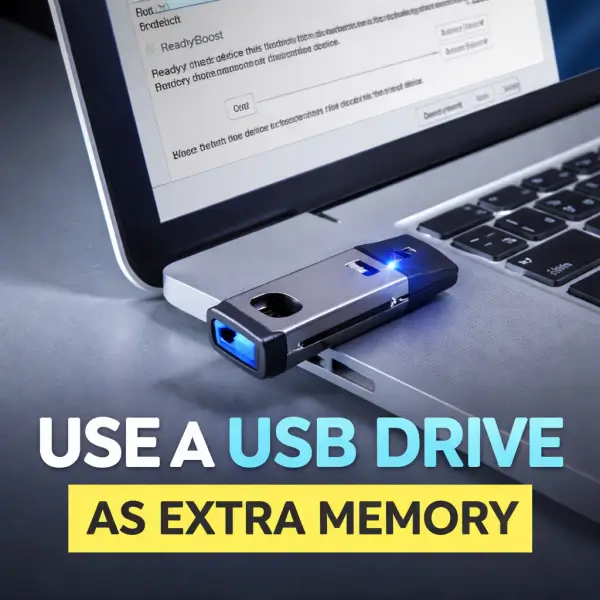
This process works by caching frequently accessed data on faster SSD flash based storage instead of relying solely on slower mechanical hard drives. While it does not replace physical RAM, it can help improve performance on systems with limited memory.
Is ReadyBoost Still Useful Today?
ReadyBoost is still supported in Windows 7, Windows 8, Windows 10, and Windows 11, but its usefulness depends on your hardware:
- Most helpful on systems with traditional hard drives (HDDs)
- Minimal to no benefit on systems using SSDs or NVMe drives
- Best for computers with 4 GB of RAM or less
If your PC already has an SSD and sufficient RAM, Windows will often disable ReadyBoost automatically because it provides no measurable benefit.
How to Set Up ReadyBoost Using a USB Flash Drive
To use your USB flash drive as extended system memory:
- Insert your USB flash drive into your computer
- Open File Explorer and click This PC
- Right-click your Removable Disk and select Properties
- Click the ReadyBoost tab
- Select Use this device
- Choose how much space to allocate for ReadyBoost caching
- Click Apply, then OK
Requirements
Not all USB flash drives are supported. Windows automatically tests the device before enabling the feature.
- USB drive must meet minimum read and write speed requirements
- At least 256 MB of free space is required
- USB 2.0 or newer recommended
If your flash drive does not display the ReadyBoost tab, it does not meet the minimum performance requirements.
Additional Notes and Best Practices
- Using a dedicated fast Solid State USB drive works best
- Do not remove the drive while the system is running
- Ready Boost uses encrypted cache files for security
- You can safely disable it at any time
Final Thoughts
ReadyBoost can still improve performance on older or low-memory systems using mechanical hard drives, but it is not a substitute for adding physical RAM. On modern systems with SSDs, it might provide little to no benefit and so is often disabled automatically by Windows.
If your system feels slow and supports it, this might be a quick and inexpensive option worth testing.