
The following tutorial explains how to fix the "No Devices Match MBR Identifier" boot error that can occur when booting Linux distributions from a USB flash drive. This error typically means that the Disk Identifier stored in the Master Boot Record (MBR) does not match the identifier expected by the GRUB bootloader, usually saved in the /boot/grub/mbrid file.
This can happen if you manually wrote the ISO, cloned a drive, or used tools that altered the MBR without updating GRUB. Luckily, this issue is straightforward to fix using either Linux or Windows methods.
Fixing the "No Devices Match MBR Identifier" Error
Option 1: Fixing from Linux
- Open a terminal and list all disks:
sudo fdisk -lYou can also use:
lsblk -f - Locate your USB flash drive in the output. You should see a line like:
Disk identifier: 0x1234abcdCopy this hexadecimal Disk ID.
- Update the GRUB `mbrid` file with the correct disk ID:
sudo sh -c "echo -n -e '\x12\x34\xab\xcd' > /boot/grub/mbrid"Note: You must reverse the byte order when writing to the file. Example:
- Original Disk ID: 0x1234abcd
- Reversed for mbrid: \x12\x34\xab\xcd
- Once updated, reboot the system and your USB should boot correctly.
Option 2: Fixing from Windows
If you are on a Windows machine, you can use a simple tool to read the MBR ID and automatically update the mbrid file on your Linux USB.
- Download Set-MBRID.exe
- Copy Set-MBRID.exe to the USB drive containing your Linux installation.
- Run the tool by right clicking and selecting Run as Administrator. The program will:
- Read the Disk Identifier of the USB drive
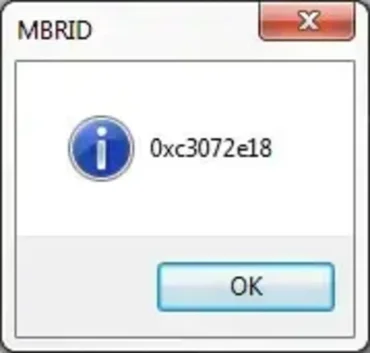
- Display the ID in a popup
- Create or overwrite
/boot/grub/mbridwith the correct MBR ID
Important Notes & Safety Tips
- Always back up your USB drive before making changes to the MBR.
- This process applies only to MBR partitioned drives. Modern Linux USBs may use GPT instead.
- Do not run these commands on your main system disk unless you are experienced; it may render your system unbootable.
- If you prefer, tools like UUI or YUMI can create bootable USB drives without MBR conflicts.
Final Thoughts
Correcting the MBRID mismatch is often the final step needed to get a custom Linux USB to boot properly. You can now choose the Linux method or Windows tool depending on your preference. After updating the MBRID, your Linux USB should boot without the "No Devices Match MBR Identifier" error.